
Students Crack Herculaneum Scrolls for $700,000
Artificial intelligence helped young researchers decipher scrolls buried during the eruption of Vesuvius in 79 AD, which was associated with a substantial monetary reward. The scrolls originate from the ancient library in the city of Herculaneum. Finally, we are discovering their content.
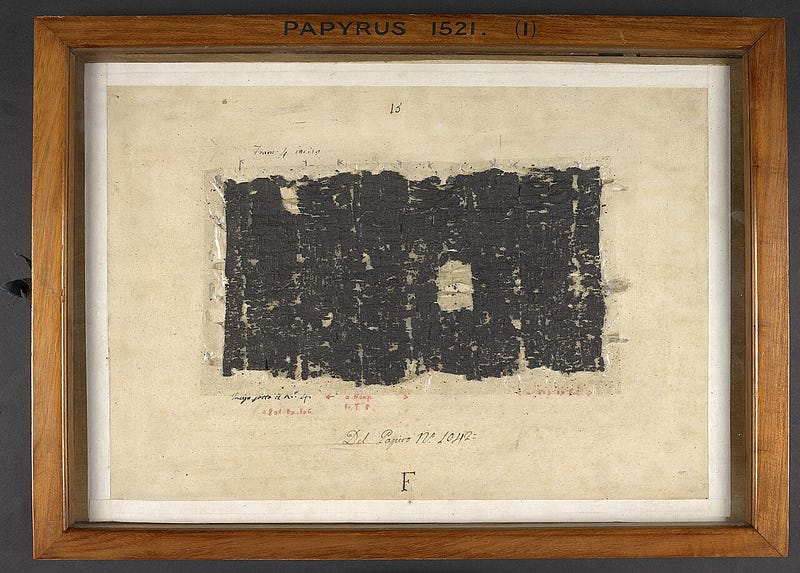

The tragedy from almost 2,000 years ago continues to capture the imagination of scholars and history enthusiasts. I’m talking about the eruption of Vesuvius, which occurred on August 24, 79 AD. The powerful eruption led to the destruction and burial under layers of ash of, among others, Pompeii and Herculaneum. In both cities, or rather what remained of them, archaeologists found the remains of 1500 residents.
Vesuvius destroyed almost everything, but not this place
The eruption of Vesuvius not only led to many deaths but also the destruction of urban infrastructure. Among the affected sites was the so-called Villa of the Papyri, which included a library. According to historians, it most likely belonged to Julius Caesar’s father-in-law. To this day, the Villa of the Papyri remains one of the most valuable and mysterious relics of the tragedy in Herculaneum.
Its remains were first discovered in the 18th century. At that time, workers uncovered several blackened, illegible scrolls. In the following years, more were found. To date, over 1800 scrolls have been discovered. For centuries, their content remained a mystery. It was only a few decades ago that scientists proposed using X-ray imaging to examine two scrolls stored in the French National Library in Paris.
Unfortunately, after burning, the letters became indistinguishable from the papyrus. For this reason, researchers failed to decipher the ancient texts. It wasn’t until 2015 that they recognized some words after increasing the contrast using a more advanced imaging technique.
Vesuvius Challenge Resolved
In 2023, further work on deciphering the scrolls was made possible, among other things, by artificial intelligence. That’s why the Vesuvius Challenge was organized, a competition for scientific teams specializing in creating and training machine learning models. Almost a year later, it was resolved.
One of the initiators of the competition is Dr. Brent Seales. Together with his research team, he spent years developing algorithms enabling digital unwrapping of scrolls and detecting the presence of ink based on the changes it caused in the papyrus fibers. He then made these algorithms available to the participants of the Vesuvius Challenge.
In early February 2024, Nat Friedman, one of the organizers of the competition, announced that the $700,000 prize would be awarded to three students who managed to decipher over 2000 Greek letters from the scroll. The winning team consisted of Youssef Nader from Germany, Luke Farritor from the United States, and Julian Schilliger from Switzerland.
“This marks the beginning of a revolution in Herculaneum papyrology and Greek philosophy in general. It is the only library that has come to us from ancient Rome,” commented Federica Nicolardi, a papyrus researcher at the University of Naples Federico II, in The Guardian.
Interestingly, this is not Farritor’s first success in this field. Earlier, in October 2023, the young American won a $40,000 prize for identifying the “first letters” of a scroll. His algorithm read a few lines from the charred text, including the Greek word πορϕυρας (purple).
In November, Farritor joined forces with Nader and Schilliger, who developed an algorithm for automatic image unwrapping using CT scans. Together, they deciphered over 2000 letters from the scroll. Thanks to them, researchers can now familiarize themselves with a fragment of its content for the first time.
“The adrenaline rush motivated us to act. It meant working for 20 hours a day. I didn’t know when one day ended and the next began,” Nader recalled in an interview with The Guardian.
Who is the author of the scrolls from Herculaneum?
According to preliminary findings by researchers, the author of the scroll was likely Philodemus of Gadara. In the recovered text, he discussed sources of pleasure, including music and food. He devoted a lot of space to… capers.
He also addressed issues of abundance and the fear associated with pleasures. “When it comes to food, we don’t immediately believe that what is scarce is absolutely more enjoyable than what is abundant,” reflected the philosopher from 2,000 years ago.
This is a true breakthrough in understanding the heritage of Herculaneum. However, researchers emphasize that there may be more artifacts in the Villa of the Papyri that can be deciphered over time. The technology used by the winners of the Vesuvius Challenge could be applied, for example, to deciphering papyri wrapped around Egyptian mummies, letters, and documents. All these records may shed new light on the daily lives of ancient Egyptians.
This is not the end of deciphering the scrolls from Herculaneum. The competition continues. This year’s goal set for young researchers is to decipher 85% of the scroll and lay the groundwork for deciphering the discovered papyri. Therefore, scientists must automate the process of tracking the surface of the papyrus inside each scroll and improve the detection of ink in the most damaged parts.
Attention all readers!
As content creators on Medium.com, we face minimal compensation for our hard work. If you find value in my articles, please consider supporting me on my “Buy Me a Coffee” page. Your small contributions can make a big difference in fueling my passion for creating quality content. Thank you for your support!

