
STS-51-L. The Day Challenger Exploded 73 Seconds after Lift-Off, Killing All Seven Crew Members
In memory of those brave souls who lost their lives in the name of science and space exploration.
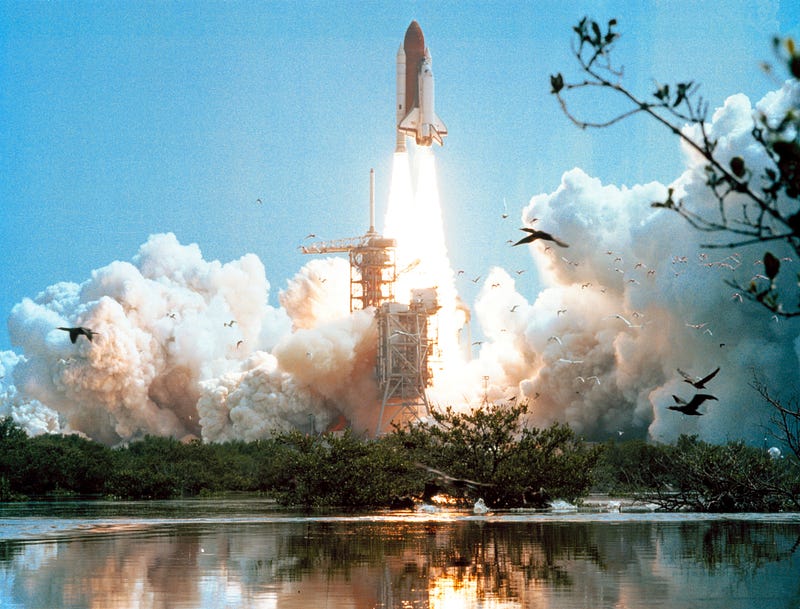
To start this article off, did you know just how many Space Shuttles were actually built and used in exploratory and experimental low Earth orbit between 1981 and 2011?
There were six space shuttles designed and built by Rockwell International based within Palmdale, California, and flown by the National Aeronautics and Space Administration (NASA) and were primarily used for achieving Earth-orbital flight insertions of between 115 and 400 miles.
The first-ever successful flight was achieved on 12th April 1981.
- Challenger
- Enterprise
- Columbia
- Discovery
- Atlantis
- Endeavor
But within the scope of this article, I intend to follow and retell the tale of STS-51-L. NASA’s LAST EVER recorded flight into Earth orbit; heralding the end, the moth-balling so to speak, of this six-strong fleet of Space Shuttles…
Challenger disintegrated over the Atlantic Ocean, off the coast of Cape Canaveral, Florida, at 11:39hrs eastern standard time (EST) or 16:39 coordinated universal time (UTC) on 28th January 1986.
- a single joint in its right-side solid rocket booster (SRB) which failed on lift-off. This was caused by the failure of the seals used in the joint that were not designed to handle the unusually cold conditions that existed at this launch. The ambient air temperature is usually quoted as 36 degrees Fahrenheit (2.2 degrees Celsius) at launch time, but the temperature near the failed Solid Rocket Booster joint at that time was estimated to be just 28 degrees Fahrenheit (-2.2 degrees Celsius.)
The single failure of this infamous O-ring seal (more commonly known as packing or a ‘toric’ join) is a mechanical gasket in the shape of a torus; it is a loop of elastomer with a round cross-section, it is designed to be seated into a groove and compressed during an assembly point between two or more parts, having the final effect of creating a seal at the interface.
This was responsible for creating a breach in the Solid Rocket Booster (SRB) joint, allowing pressurized burning gas from within the SRB motor to reach the outside air and impinge upon the adjacent SRB aft field joint attachment hardware and external fuel tank. This led to the separation of the right-hand SRB’s aft field joint attachment and the structural failure of the external tank (ET.)
Aerodynamic forces then rapidly tore Challenger apart… sealing its fate in history forever within seconds.
I remember this event live at the time of the terrible historical disaster. I was sat at home in our front room, in Worcester watching the launch from start to the untimely demise…
I was in year five of secondary school at the time and sat at home enjoying a bit of peace from doing any homework that I should have been doing. I am sure you can relate to this one, when something disastrous or momentous occurs at a point in your own life, most people can recall what they were doing, and where they were at the time it all took place.
I certainly know exactly where I was when Challenger was destroyed. Do you remember?
I was transfixed, my eyes glued to the television in our living room. My mum had gone out, my sisters were typically out shopping in town (again…) and my brother was at King’s College University in London. So the house was quiet. Our family dog was doing what he was best at snoozing laid on his side upon the hearthrug in front of me.
I had always been an avid fan and follower of space, well anything to do with space and science fiction. And when it came to Star Trek well, say no more, that was me all over again… fixed to the television screen.
I have already published two articles on Star Trek which gives you further information on the ‘buzz’ I got from watching this, please just click on the titles below to have a good read (hey but please after you have finished reading here first!!)
and,
Literally, no more than five minutes had gone by since the image of that horrifying disaster had been televised live and displayed onto every television set on the planet (for those watching) the house phone began ringing incessantly from the study room just off from the front room. My best friend was calling me to shriek down the phone,
‘… did you just see that, oh my God,’ before I could even say ‘hello’ just as soon as I picked up the receiver,
‘… what the hell just happened there, was that real?’ he shouted down the phone to me.
We then spent a good 30 minutes simply talking about that and nothing else. The rest of that day very much proceeded in a similar style to that. When my sisters both returned from their ‘clothes shopping,’ trip to town, they were also talking non-stop to the dozen about what had happened earlier. They had been in the middle of a clothes shop and saw the whole situation play out live on the store’s television. I found out that every shop they had been into that day, every store had the television on with staff & shoppers alike just staring at the events live as they came in across the television networks.
When the evening came, our mum came home. The last person we thought would have known about it. She had been a Human Biology teacher at an all-girls secondary school and had just been attending a teachers’ meeting for most of the day.
Turns out that much of the meeting had revolved around watching the live television broadcast due to its nature, as it should have heralded a major achievement. So they were actually planning teaching plans for the following weeks’ science education lessons, at her school.
This leads me on to my next point, and a lady called Sharon Christa McAuliffe.
At the time of this event, the then-President, Ronald Reagan, had announced what had been known as ‘The Teacher in Space Project,’ Christa McAuliffe had come to learn about NASA’s efforts to find their first civilian, a teacher, to fly into space. NASA was looking to find just an ‘ordinary person,’ who could communicate with students whilst flying over the Earth in orbit.
And so yes, it was to have been heralded as a major achievement because that is why so many millions of ordinary people, both adult and children alike, were eagerly watching this one very special space launch, anticipating to be part of a very special lesson from space for the very first time ever in Earth’s long history…
So just what has the world learned harshly as a result of this tragic historical event?
It has proven beyond a doubt that humanity NEEDS to slow down, as I have said in one of my latest articles.
Humanity needs to WALK before trying to RUN
Humanity needs to LOOK before trying to LEAP
Damages and/or Faults along the way throughout any further space venture MUST be rectified BEFORE going forward. No matter the cost or the time delays.
Where Do We Go From Here?
There are many ongoing discussions between space agencies regarding future planning and exploration of missions. This is the only way forward.
Humanity is nowhere near the level of fantasy and science fiction that Star Trek depicts. For now, it is best left just there, in science fiction, because Humanity is not anywhere near this level to yet make it science fact.
And if that means slowly then so be it.
Better that, than further disasters and loss of innocent lives.
And this is my commemoration for this very brave and courageous Teacher. A lady that will never be forgotten. God bless you and Rest In Peace Christa McAuliffe… Sharon Crista McAuliffe (02/09/1948–28/01/1986) at just 37.
I would love to hear from you about what you think about space exploration.
Developing this here on Medium is great because we can chat together here. I like to relate with others on topics that are of interest, indeed anything that can get people talking…
Perhaps you would like to support me throughout my writing journey? If so then why not subscribe to my emails too, so you can see when I’ve next published. It might even cheer up your lonely inbox😳.