
Street Photography and Sixteenth-century Portuguese Age of Discoveries
Street photography in Lagos and Lisbon
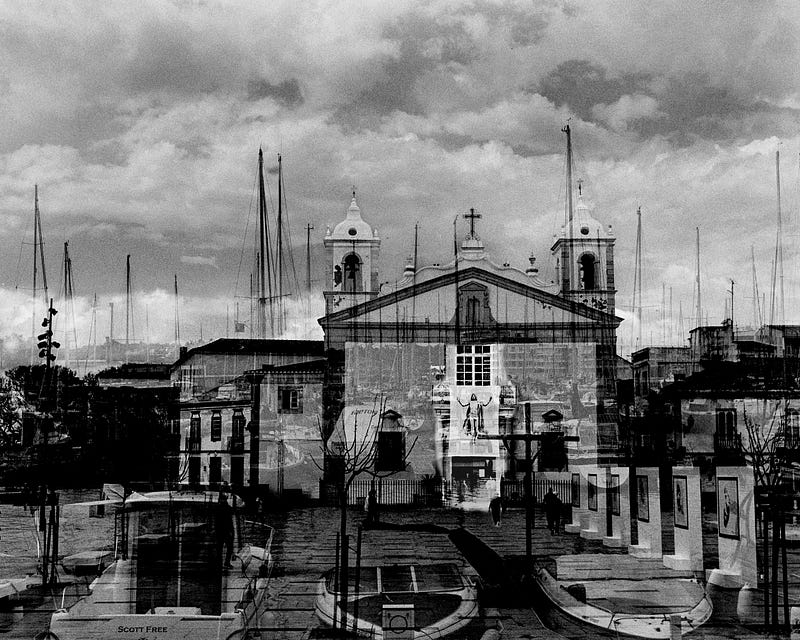
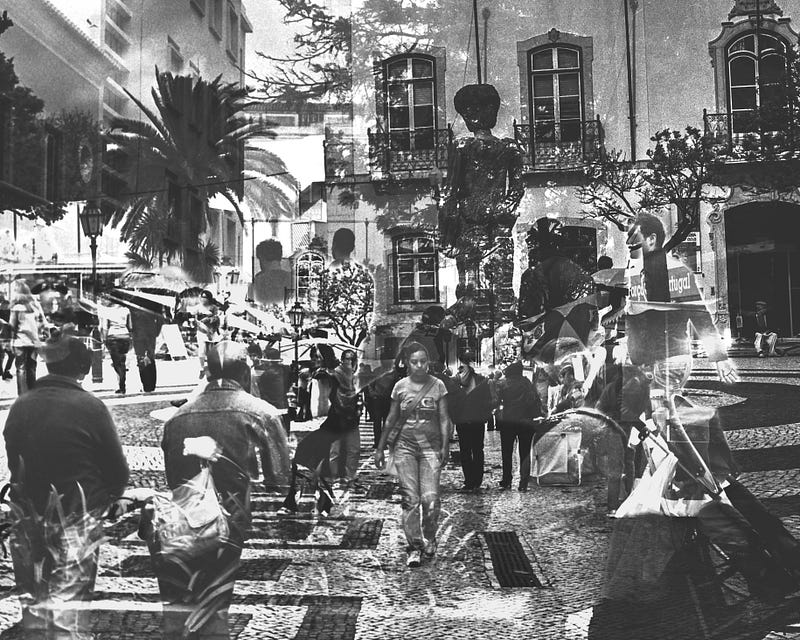
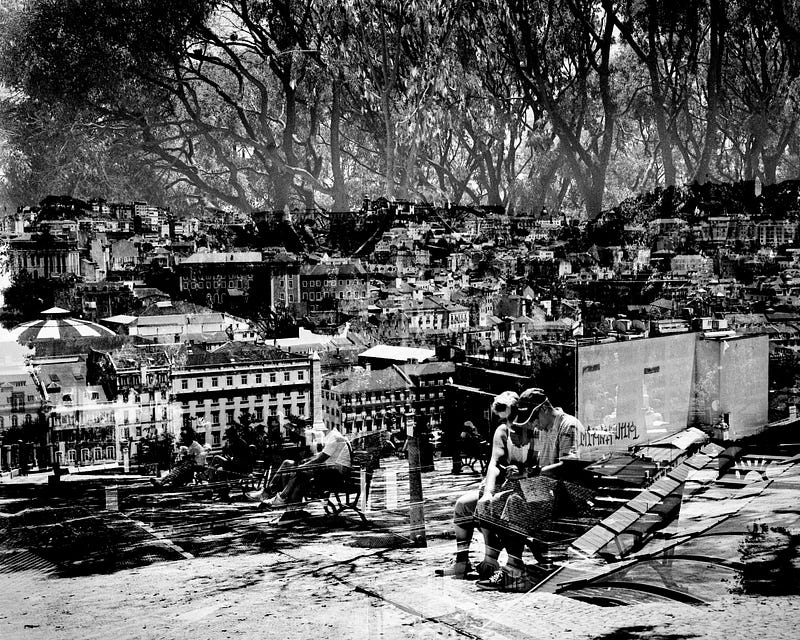
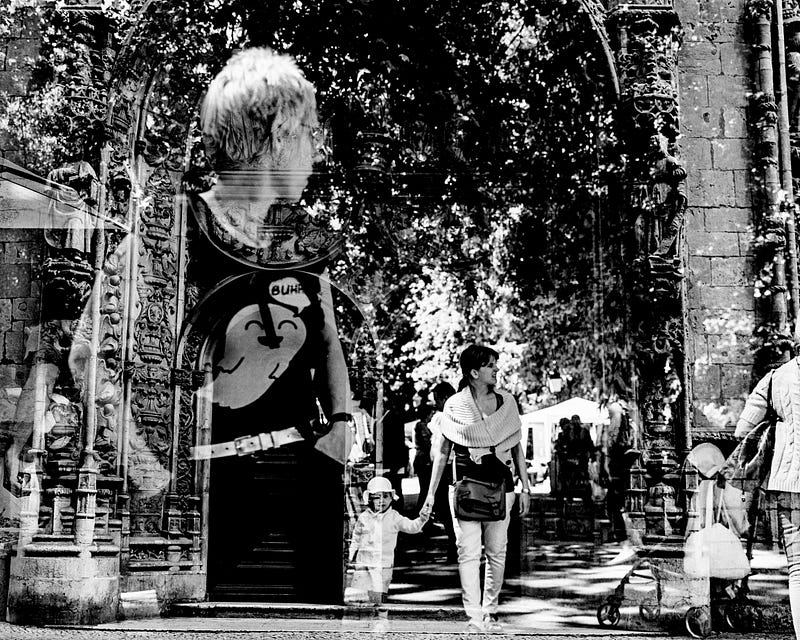
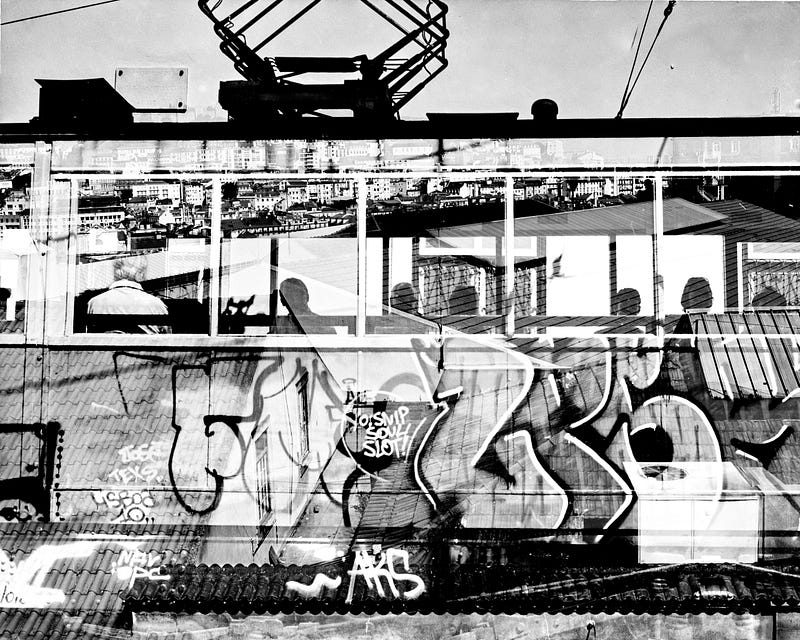
Sharing street photography in Lagos and Lisbon and the stories of curious personalities of the Descobrimentos. Lisbon was the Metropolis capital and from Lagos, Algarve, numerous ships sailed for exploring journeys. In this work I continue my own exploration on multi-exposure images on the same negative in 6x7 medium format.
This is an over enthusiastic story of what the Portuguese golden age was. Some might disagree, these are based in the sources I supply in the end. Text as always is the company for the pictures which are my main message as a photographer.
Chapter 1 — Pêro da Covilhã : A Spy in the Renaissance
Pêro da Covilhã was a Portuguese spy from the fifteenth century. He played a major role in providing King João II detailed information on how the oriental spice trade was done in those times from India to the Arab Gulf and beyond to Venice. Because he has no surname, Covilhã was is hometown, it is believed that he was a common. He had lived most of his adulthood in Sevilla so he was proficient in Spanish castelhano and most important the arabic language.
Interestingly is that although he was very competent in providing the needed information on the spice trade he never returned to Lisbon. So the king sent out Priest Francisco Reis to find him.
Before parting to India, Pêro da Covilhã had already been of great help for the Royal Family. Years before in 1437, the princes had suffered an heavy defeat in Tangier, current Morocco, and they were made prisoners. D. Fernando was left behind as an hostage while the infant D. Henrique made the promise to surrender Ceuta, conquered years before, for his return. Although the importance of Ceuta in trade with North Africa had lost importance after the Muslims lost the city, D. Henrique promise was never kept and D. Fernando died in prison after great suffering, his dead body finally hanging upside down on the walls of Fez. He later became a martyr and a Portuguese saint.
Pêro da Covilhã was given the mission to recover the prince’s body so he performed a cunning mission with the king of Fez. As a martyr, getting the prince back became a cause of national pride. After the audience with the king, the spy undiplomatically kidnapped seven wives and some kids of King Mulachik and traded them back for the prince’s remains.
In preparing for his important mission to India he received an intensive course on cosmography, geography and other scientific subjects. He finally left to the east with a credit letter “for all territories of the world” assured by the Medici Bank, in Firenze. This was 1487, five years before Columbus sailed to the West.
He arrived to Alexandria in Egypt in disguise as this was the final port from where the goods were transported to Veneza. From there to Cairo, passing as a trader from the Maghreb, he finally made acquaintance with Indian spice traders from whom he learned the route to take, passing the Red Sea to Yemen and from there traveling by sea dhow, a single mast unsafe trade barge that scared Marco Polo, to the east coast of India. The Portuguese arrived in Kolkata on Christmas 1488. By the time it was an underdeveloped city with no actual port. But the capital was of amazing opulence, his rulers and belongings highly adorned with gold and precious stones and perfumed with magnificent scents. The city market was rich in diversity and quality of the products. In Kolkata, market flowed both ways, receiving products brought by the merchants from the middle east. Despite the prices were very high so Pêro continued his way. If Portugal was to found a commercial outpost in India, Goa was a much better option. Pêro found the island was already a foreign colony in the hands of Muslims, so a conquest would cause a lot less animosity to the local Brahman kings. Well handled, casting out the Arabs might even result in creating good relations with Hindus. For the commerce Portugal had the technical advantage of having developed the Caravela ship that could sail against the wind. With the monsoon winds, the Muslim barges could only go to India in August and return back in February.
From there, Pêro turned back to complete the second and most important task. The Counsel of the Wise that scientifically trained Pêro for his endeavor was formed a few years before by the king with important man of science and philosophy selected from all around Europe. By then, contrary to what was thought, they had concluded that Africa was surrounded by sea so commander Bartolomeu Dias was in charge of the parallel task to find the passage to the Indian Ocean.
Pêro da Covilhã’s next mission was then to do the opposite voyage, take measurements with the astrolabe, gather coastal and sea maps. He sailed in summer 1489 with the monsoon wind to the east of Africa to Mombasa and from there to Mozambique. By the end of 1489 he reported back to Rabi Abraão, a Portuguese cartographer in Cairo. At this time Pêro received a new mission, to find Prester John. This legendary Christian Emperor of Ethiopia and the Middle East created by European popular mythology was seen by many as a possible ally in the fight against the Muslims.
Rabi Abraão arrived in Lisbon on 1490, at about the same time Bartolomeu Dias was returning victorious after sailing through what would be named the Cape of Good Hope and reaching Eastern Africa. One and one is two, both adventures made the full circle and less than eight years later Vasco da Gama uncovered the only full maritime route to India from Europe passing the southern tip of Africa. In the following years the center of financial power of the western civilization moved from Veneza to Lisbon as the Portuguese navy ruled an area that went from Brazil to Japan.
Years later several Portuguese expeditions, the first by the said Priest Francisco did find and interact with the Abyssinian Priest-King and his people. Pêro da Covilhã was in fact there and had come to be a wealthy landlord. Successive expeditions sent hundreds of people there for decades. Some married and raised family there. The people were indeed Christian but some details of their cult were considered blasphemy by the Europeans. In such a pious time, this aspects were insurmountable when the objective was to have a close ally relationship.
Chapter 2 — Fernão Mendes Pinto: Slave, merchant, pirate and missionary
In 1537, Fernão sails for the East Indies, to meet his brothers, but he was captured by the Ottomans during an incursion in the Red Sea and was sold to a Greek Muslim. Badly treated, he threatened to kill himself and was sold to a Sephardic Jew who traded him back for ransom to the Portuguese in Hormuz. There, he was forced to join the Navy and participated in a number of navy battles against the Turks and eventually run away to Malasia. For 21 years Fernão alternatively traded as a merchant and teamed up with fellow corsair captain António de Faria to explore the China Sea. This adventures ended when he was captured along the coasts of China, was accused and condemned to work on the construction of the Great Wall. His time in prison ended prematurely when a horde of tartars invaded China and captured him. Finally he provided precious tactics on how soldiers could take a stone castle and earned is freedom in exchange.
Fernão Mendes Pinto, metaphorically named in Portugal “Fernão, Mentes? Minto!” (Fernão, You lie?, I lie!), wrote on his later life his memoir book “Peregrinação”, incredible tales mostly perceived as fantasies for several centuries. In recent times, historians come to agree that the accuracy of the dates and places shows he must have been someone who have participated in the events, or had at least near knowledge. Keeping knowledge a secret was of master importance in this time and ultimately, through the ages, records were eventually destroyed by fire. In fact, most of this events and realities were only known in Europe long after his death, so how would he know otherwise? It is now set that he was mercenary-General and commanded the armies of the king of Birmany. He described a court so sumptuous it seemed papal. Such a description was very similar to the Dalai Lama court, in Lhasa.
Our hero found it’s way to Japan. By then it’s said he had had a mythical experience and had released all his slaves and delivered his revenues from the Japanese trade to the Jesuits, whom he had become a brother layman. He took on the founder of the brotherhood, Saint Francisco Xavier, sailing to several of his journeys to Japan. By this time the Priest had wrote a grave letter to the king of Portugal expressing his views that the Portuguese behavior around India was intolerable and unchangeable. Therefore he would part further east where he could find true Christians. Fernão finds himself as the first captain to bring fire arms to the islands of Japan where he coasted. “He would bring that baton to his shoulder, a very bright flare would come out of the front and almost every time a bird would fell dead from the sky”, stories noticed of his arrival.
At the governor house, Saint Francisco argued theology with Buddhist monks. He wrote a catechism adapted to the Japanese mentality that had wide acceptance. In 1582 there were 150 000 Japanese converts accounted for. The young went to study in Jesuit universities in Goa and Macao. Portuguese merchants went there in such quantities and remained there to found Nagasaki.
In Japan, the Portuguese built the first fire arms factories, introducing the European forging techniques. From India the ships brought the spices and the highly sought silk from China (Japanese were not allowed to trade directly with China). New terms were introduced in the Japanese language. Many authors say Arigato is derived from the Portuguese Obrigado, but I have seen this rebutted in some sources as Obrigado only seems to start being used in the eighteenth century. Portuguese Pão (Bread) gave Japanese Pan. The Jesuits introduced the method to fry fish in tempura. Advanced techniques in masonry building introduced by the foreigners were of great importance in this soil shacking Island.
In Goa and Macao mixed marriages were the norm. In Macao the community started adopting abandoned female sex babies from Canton (Guangzhou). With a dowry by the Misericórdia Institution, most married when reaching adulthood. A great number of african slaves escaped the Portuguese to mainland China. Taken under refuge, they formed their own district on the province capital. Several new ingredients, vegetables and fruits were introduced in China and India. Peppers were brought from Brazil, vindaloo from Goa is the contraction of vinha d’alhos (garlic vinegar sauce).
From China, Portuguese brought tea which was introduced in the English court by Catarina de Bragança, queen to Charles II, around the 1650’s. Her dowry was Mumbai. Notably, in 1949, Indian historian and politician K. M. Panikkar defined the age of colonial power in India as the Era of Vasco da Gama.
Sources:
The First Global Village — How Portugal changed the world, Martin Page
History of Portugal, Alexandre Herculano
History of Portugal, Oliveira Martins
The Silk Roads — A new history of the world, Peter Frankopan