Street Musicians of Spain
Plus a side riff about Barcelona UNESCO sites designed by Antoni Gaudi
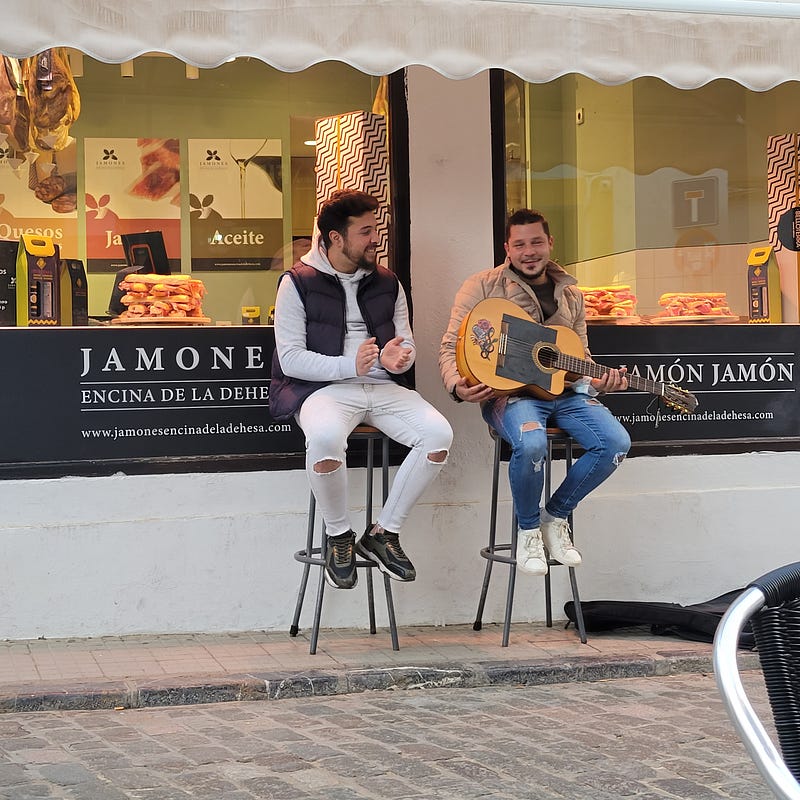
- Late afternoon, sitting outside on a tilted street in Cordoba, enjoying a glass of red wine and a “merienda” of grilled eggplant and red peppers, briny olives, soft bread with olive oil, and anchovies. Suddenly, two guys with one guitar pull up chairs across the street, and one starts strumming and singing while the other claps. The sound is evocative and sensual — the guy on the right has the raspy sound of the Gypsy Kings lead singer, the kind that makes me worry about the stress on vocal cords (not a typical worry, but my masters is in voice). Second guy takes the guitar and launches into Despacito, the first Spanish-language billboard topper (this one Puerto Rican) since Macarena. A woman with a mop of messy dark hair pushing a large garbage bin and wearing a protective uniform, stops for a minute and sings along. She’s young and adorable, although she’s masked and we can’t see her face, and the two singers let her sing and dance to a verse. It’s enchanting, and we all clap for her. They finish the song and walk around with the guitar held upside down for us to place coins on top. Then, pleased with their success, they saunter into the Ham Store to buy some dinner.
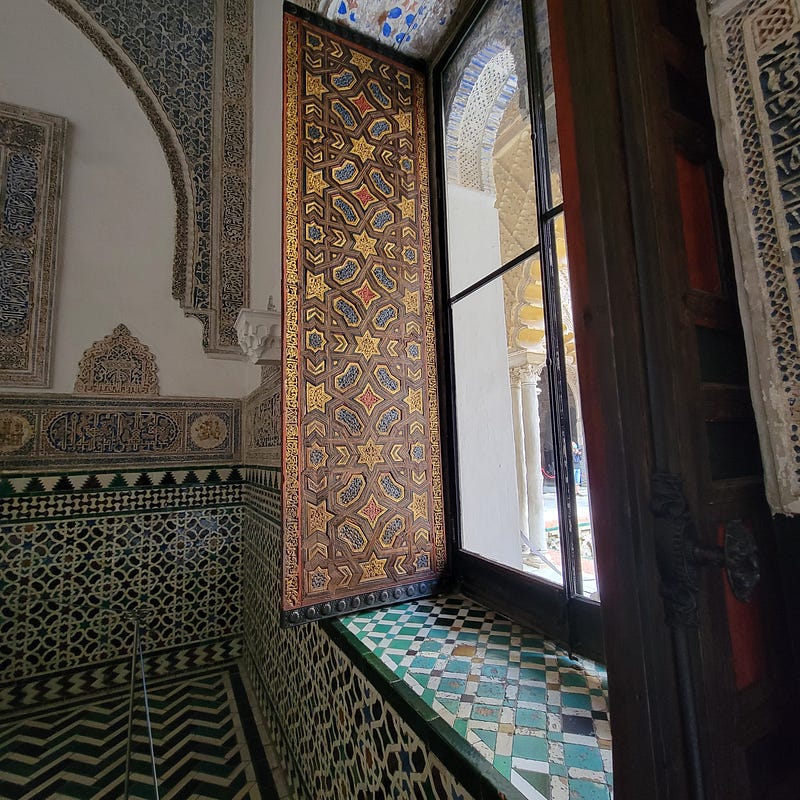
2. After a forty-minute train ride to Seville, we’re guided through the Royal Alcazar palace followed by the cathedral (also beautiful, but I’m not as interested in religious art). Still, it’s all breathtaking, and I take picture after picture until we’re too exhausted to walk anymore. We sit at an outdoor restaurant in a row of touristy places, and although the menu seems to be the same everywhere, filled with meats made of animal parts I didn’t know were eaten (oxtail? pig feet?), I order green salad and a yummy, marinated beet and onion salad. Suddenly, a group of young men start singing — boisterous but off-pitch, like a group of Americans would sing Happy Birthday. We’re finished anyway and jump up to leave before they ask for money.
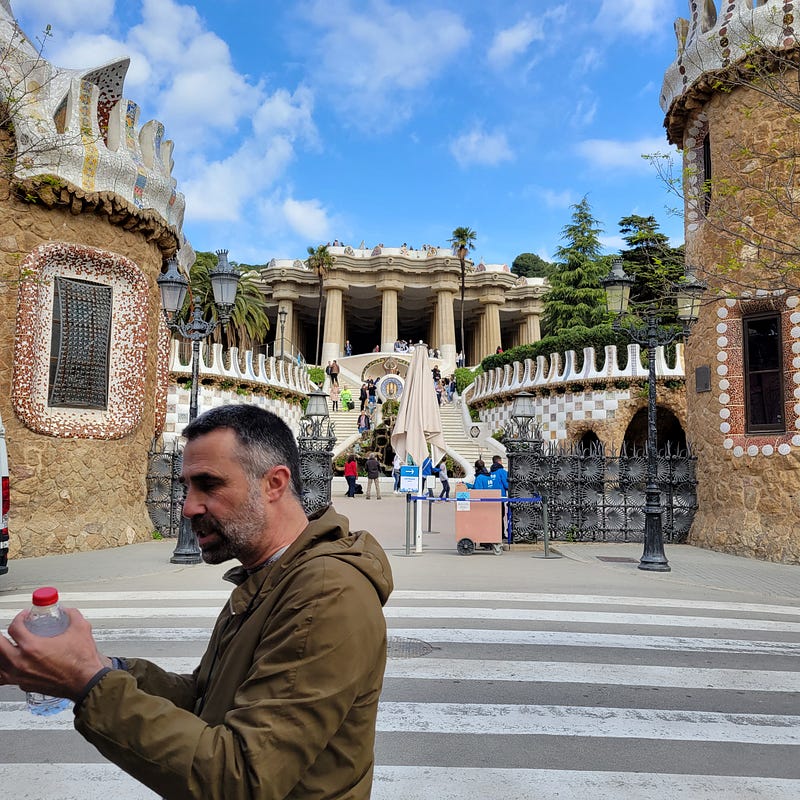
3. In 1900, when Count Eusebi Guell hired his friend Antoni Gaudi to design an enormous tract of land overlooking the city of Barcelona, the plan was to sell 60 fabulous homes to fellow wealthy people who wanted a summer retreat about an hour away from the city’s smells and heat (by horse and cart). But “Park Guell” was finished by other architects (after Gaudi began work on the basilica Sagrada Familia in 1914). The two structures at the gate resemble the kind of home some mythological being might live in, inside a paradise of construction marvels, striking architectural innovations, and acres of flowers, trees, bushes, and herbs.
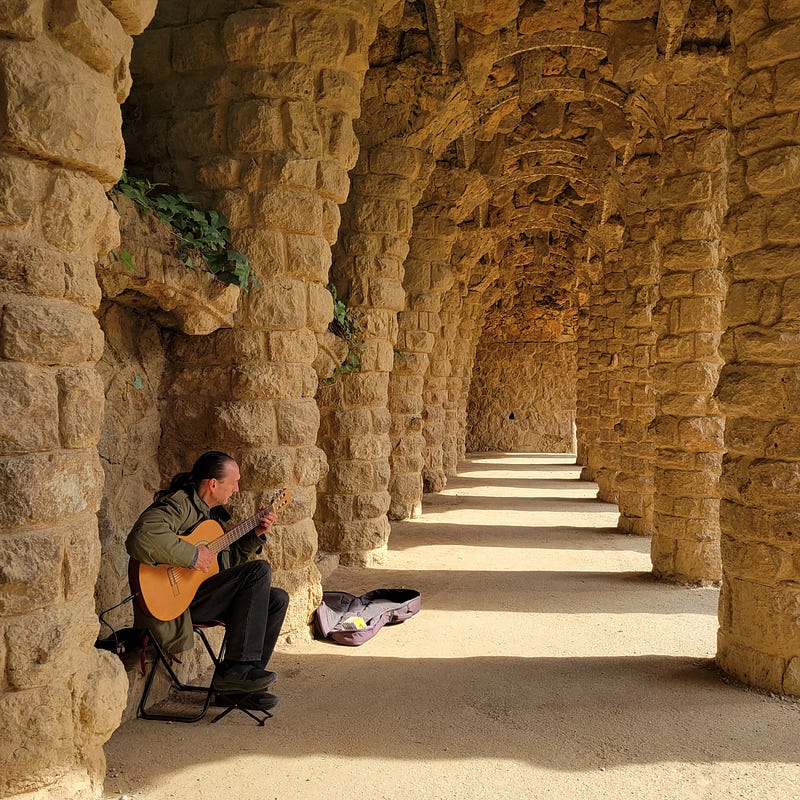
The park’s paths are lined with men hawking what I call “chachke-rai” that nobody needs. They’re Pakistani immigrants, called “manteros” here, because they show their wares on blankets that can easily be swept up when police approach. I love the mosaic benches, the winding paths, the sculptures, and whimsical touches everywhere. There is an explosion of color and form. We walk under several Gaudi structures with pillars and ceilings that seem about to tumble to the ground but have survived a century. We stop to listen to a phenomenal classical guitarist playing under the curves of one such structure.
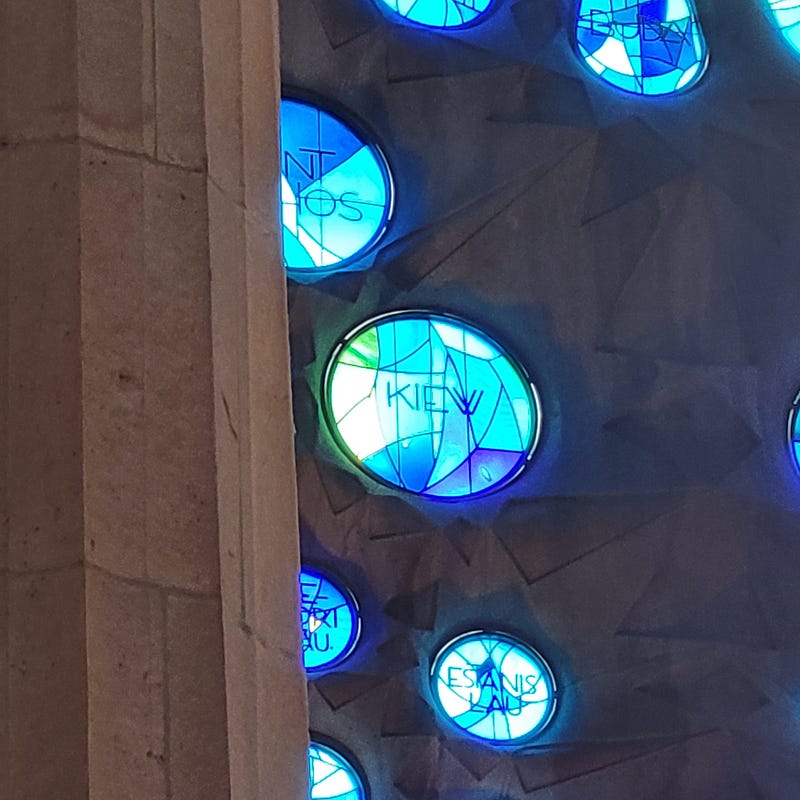
We leave Park Guell to visit the Basilica of the Holy Family, another UNESCO World Heritage Site. We learn about how Gaudi used workers to model the holy family, the disciples, the angels and other figures, and how he became more and more religious, spending his final years sleeping on a cot in the studio where he worked, behind the church. We look at the models Gaudi built (reconstructed after the originals were destroyed), the still-in-construction towers, each one with a story, and the stunning stained-glass windows with names of other centers of Catholicism around the world.
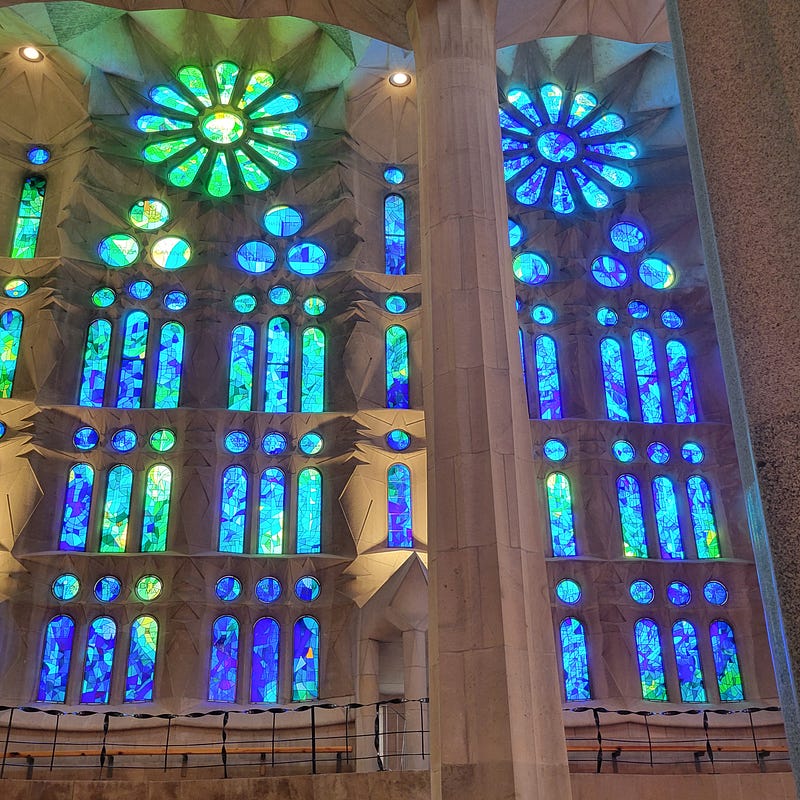
The organ starts playing — loud and ominous as I focus on the Kiev window — a reminder that while we’ve been having fun seeing Spain, Russia is attacking Ukraine, murdering thousands of innocent people, and devastating the country. We’ve seen ruins in Spain, but we’ve also seen medieval castles and churches hundreds of years old. If there any beautiful old buildings survived WWII in Ukraine, they’re probably being demolished by Putin right now.
Before coming to Barcelona, I’d read that it was a city filled with magnificent architecture, and I’d heard of Antoni Gaudi. Aside from him, I was only aware of a few famous Catalonians, like Montserrat Caballé, the opera singer (whose rendition of Casta Diva is magnificent) and Pablo Casals, one of the greatest cellists ever. I’ve read of Jewish scholars Moses ben Nakhman (aka The Ramban, or Nakhmanides, 1194–1270) and his disciple Shlomo ben Abraham ben Adret (aka The Ramba, 1235–1310). And I knew about the sculptor Joan Miro, one of whose sculptures we have in the city of Chicago.
I didn’t know how much I’d love this entire country. Adios, España. Hasta la próxima vez!