
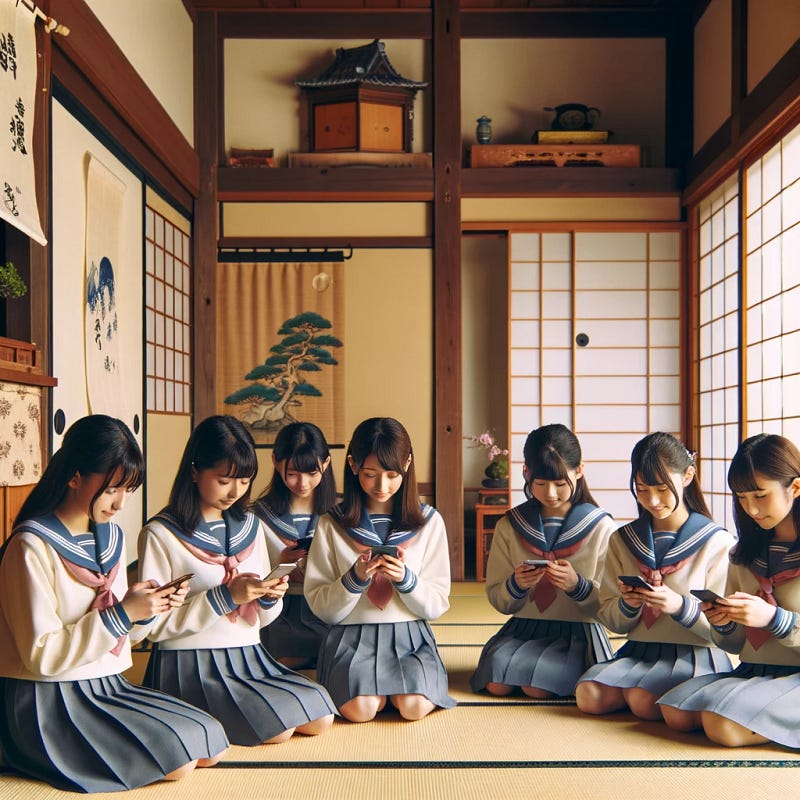
Streamed, Filmed, and Cyberbullied: The Smartphone Saga in Japanese Schools
Hey everyone!!
Did you see my previous article??
I summarized some common smartphone usage rules in Japanese schools, so please check out this article too. Even if you didn’t see the previous one, I tried to make this article understandable on its own so you can still enjoy it!
(I’m writing this article with reference to this YouTube video)
Introduction
In recent years, smartphones have become ubiquitous in Japan, profoundly affecting various aspects of society. One area experiencing major impact is the nation’s schools, where student smartphone use is transforming classroom dynamics and student-teacher relationships, often in concerning ways. This essay will examine troubling issues like classroom livestreaming, surreptitious filming of teachers, online impersonation and bullying — realities now facing Japanese schools in the smartphone era.
To illustrate these challenges, interviews with three current Japanese teachers help reveal smartphone troubles emerging in their schools. The testimonies expose deep anxieties taking hold among Japan’s teaching community. However, perspectives from education experts also suggest potential solutions, signaling a way forward through enhanced training, external support systems and legal protections. Reforms are imperative, because returning to an era without smartphones in schools is impossible.
The Spread of Smartphones in Japanese Schools
Recent statistics indicate just how pervasive smartphones have become among Japanese students. A 2020 survey showed that over 80% of junior high school students now possess smartphones, with over 90% owning phones by high school. Elementary students are not far behind, with around 50% in grades 4–6 also having phones. This proliferation is a very recent phenomenon — only a few years prior, less than 20% of junior high students owned smartphones.
School rules prohibit or restrict phone use on premises, but enforcement is difficult. One teacher describes confiscating multiple phones per day, only to have students pull out spares. With social media deeply embedded in youth culture, smartphones provide an irresistible temptation. The rise of online gaming and livestreaming adds further appeal. For many students today, smartphones are an indispensable part of life.
Yet amid this rapid adoption, schools are struggling to adapt. Teaching styles and disciplinary practices premised on an offline world are being upended. Troubling incidents involving secret photography, classroom livestreaming and cyberbullying reveal a growing crisis — one that demands urgent action from educators, administrators and policymakers.
Secret Livestreaming of Classroom Discipline
In one disturbing episode, students used smartphones to secretly livestream disciplinary action on social media, unbeknownst to teachers at the time. The incident, experienced by colleagues of Mr. Nakamura, a junior high teacher in the Kanto region, is chillingly recounted:
Four students were being reprimanded for an incident after school hours. Unseen by teachers, one student pulled out a concealed smartphone, livestreaming the disciplinary meeting on Instagram. Later that day, the angry parent of another student who was not involved arrived at the school, castigating teachers for failing to realize the session was being broadcasted live online, demanding they consider such risks when disciplining students in the future. Only through this parental complaint did the teachers learn about the secret livestreaming.
This alarming case underscores intensifying threats to teacher privacy and authority. Students filming teachers without consent or knowledge raises obvious ethical and legal concerns. But even more chilling is how smartphones empower students to instantly share such material globally. Any alleged teacher misbehavior captured on video can be construed as misconduct or abuse by viewers lacking context, placing educators in precarious positions.
Moreover, the incident reveals the weakened state of teachers facing parent complaints, whether justified or not. Strong social pressures to avoid confronting parents exists, even in cases like this with clearly unreasonable demands. Such power imbalances make enforcing discipline and upholding policies increasingly difficult for teachers.
Hidden Recording in Private Spaces
Surreptitious filming does not stop at the school gates either. Another educator, Mr. K, faced this disturbing reality on a weekend outing with family. At a restaurant, Mr. K noticed a student seated nearby holding up a phone appearing to record him eating dinner with family. The student smiled and continued filming as the uncomfortable teacher hesitated to confront or stop the behavior in front of family members.
This feeling of violation in a private, off-campus setting left Mr. K shaken. Even more concerning, the student’s parent was present but did nothing to stop the recording. Mr. K worries such videos could spread online, subjecting teachers to celebrity-like public scrutiny anytime they venture out. These experiences inflict lasting psychological harm, breeding mistrust and hyper-vigilance among teachers.
Online Impersonation and Harassment
Sadly, violations are not limited to filming either. Teachers across Japan report frequent harassment and threats via social media. Students have created fake accounts impersonating teachers and sending abusive messages to other students. Mr. S, a teacher in Kyushu, explains escalating cyberbullying at his school:
Students who are usually gentle become totally different on smartphones. One sent a video to a girl after they quarreled, threatening to commit suicide.
This illustrates how even students normally well-behaved resort to cyberbullying’s anonymity and psychological distance. Impersonating authority figures amplifies harm, leveraging trusted roles to deceive victims. Left unchecked, such conduct can foster lasting trauma, damaging crucial relationships between students and teachers.
Broader Harms to the Teaching Profession
These incidents, multiplied across Japan’s schools, accelerate dangerous trends harming the teaching profession itself. Firstly, livestreaming and recorded evidence of alleged misconduct, often lacking context, significantly undermines teacher authority. Students themselves acknowledge smartphones provide powerful leverage over teachers, who can be forced out by a single video. The threat of reputation destruction through viral clips is a terrifying prospect for educators.
Secondly, teacher privacy is invaded both on and off campus, with filming and harassment eroding personal life boundaries. Teachers can no longer separate public and private selves, feeling unable to unwind comfortably in public. Constant anxiety and stress raise risks of burnout.
Moreover, teachers are also increasingly expected to handle complex discipline and cyberbullying issues caused by smartphones, tasks they lack expertise and support in. But failure to fix these problems, due to insufficient training or resources, results in blame and criticism. Teachers are caught in an impossible bind.
In combination, these factors make the teaching profession profoundly less appealing. Without countermeasures, teacher shortages will likely worsen as qualified individuals shun such unstable, high-pressure roles. Urgent action is required to avert this crisis and restore public confidence in teachers.
Potential Solutions and Reforms
How then can Japan’s schools address these smartphone risks? Consultations with education experts reveal several promising directions.
Firstly, teacher training programs must equip educators with knowledge and skills to handle smartphone-enabled threats like surreptitious filming, cyberbullying and online impersonation. Grounding teachers in both technological and legal literacy is essential.
Secondly, establishing counseling and mental health support systems focused on smartphone issues would provide vital assistance. Teachers facing violations require qualified third-party experts to turn to, instead of attempting to resolve complex cases alone.
Streamlining disciplinary processes is also beneficial, leveraging school counselors, social workers and law enforcement to share burdens. This prevents over-reliance on individual teachers as catch-all disciplinarians. Specialization of roles is important — a key reform could separate classroom teaching duties from disciplinary ones.
Additionally, enhancing laws and regulations to protect teacher privacy, curb cyberbullying, and restrict recording without consent will strengthen the legal rights of educators. Currently, teachers possess minimal protections or recourse in these contexts. Altering this is crucial.
A combination of training, mental health resources, role realignment and stronger rules will refortify teachers against smartphone risks. Students will also benefit from structured support and specialized guidance when engaging in misconduct. Over time, a healthier school ecosystem can emerge — one that embraces smartphones’ inevitability but also reinforces positive usage and consequences.
Youtube Comments
In the comments section of this YouTube video, various perspectives on the challenges facing today’s education system are presented.
Positive opinions include expecting AI education introduction, strengthening teacher authority, strict monitoring like installing surveillance cameras.
On the other hand, many critical views exist too, like pointing out teachers’ excessive demands, issues with parents’ discipline, and strictly regulating violation of children’s privacy.
Overall, various opinions seem to exist regarding future educational approaches — balancing teacher work improvements and authority strengthening, reforming parent awareness, respecting children’s rights while maintaining discipline.
The comments suggest education is approaching a serious turning point. Constructive discussions among teachers, parents, and society as a whole to create the optimal learning environment for children will be important.


