
Strathspeys And The Diddly-Eyeing Of Them
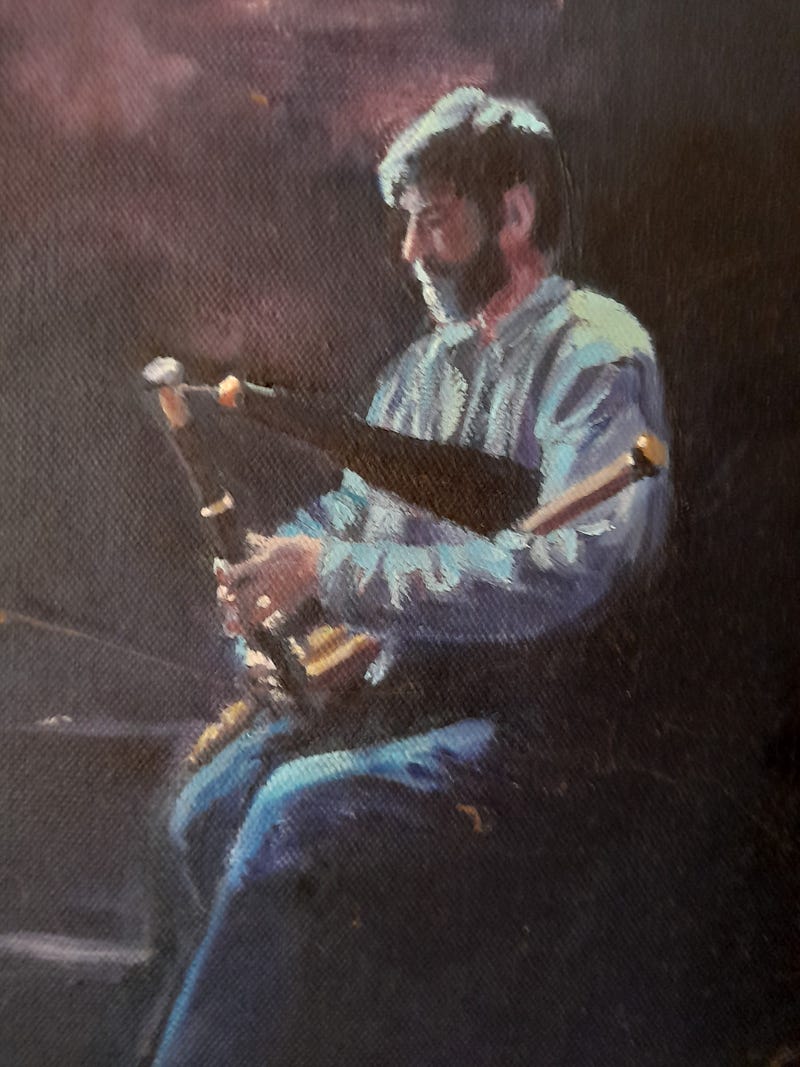
Back in the day, the Friday night trad music session in my local pub was the highlight of my week. There, sitting in the ancient armchairs that faced the shop/pub counter, were the same two ol’ fellas, nursing their pint of Guinness, while behind them was always a jam-packed crowd of punters and musicians, both visiting and local. This was an old-style Irish Session, and a magnet not only for uilleann pipers in particular, but also for other musicians from all over the world. “Trad is the best drug going,” I always say. “ It’s sociable, it’s all for free, and you never run out!”
This regular Friday night session was convivially hosted by Con Durham, a true master piper whose playing was mesmerising, wild, and full of humour, and it began back in 1982, when 26 yr-old Con moved locally with his piperess (her choice of expression) partner and their first baby. The proprietress of the pub/shop/petrol station gave him a sack of potatoes, and his payment in kind was to “play a few tunes” on a Friday night. Those who loved him will have to be satisfied with what we got from him (and it was a lot), for sadly my dearest friend and teacher passed in 2012, barely recorded for posterity. (But on the off-chance you happen to have made a phone recording of Con Durham’s playing, please upload it to U-tube!)
How to describe the thrill of playing with two other pipers, let alone the lift of playing with eleven? Evidently, tens of thousands felt this thrill too, for they flocked to this remotest outpost of Ireland and Europe, year in, year out.
Back now, to one particular evening at the Friday session during a lull, when a visitor behind us overheard the conversation between two fiddle players, a flautist and a piper, which went something like this:
“That first tune, have you a name for it?”
“I do. I got it from the playing of Micksy Mike-Pat; he called it The Gap In The Brick”
“The Gap In The Brick.”
“Great tune! What class of a tune is it I wonder, would it be a slide?”
“Em, I think it’s a strathspey maybe.”
“I thought strathspeys were a kind of reel?”
“No, they’re jigs aren’t they?”
“That’s funny, I have never been able to figure out what a strathspey is either. Some are jigs, but some are reels, …could be anything really, ….maybe they’re tunes for a set-dance?”
This is where the serendipitous visitor piped up: “I can tell you exactly what a strathspey is,” and we all turned to her as one.
“I am from Strathspey, myself. It’s a town in the Scottish Highlands,” she says,
“When the English colonised Scotland, they didn’t only ban Gaelic and Catholicism, but dancing and music as well. Like in Ireland, they outlawed and destroyed our musical instruments.
“In Strathspey, where my ancestors are from, people carried on with their ceilidhs regardless of having no instruments, by diddly-eyeing the tunes. (by lilting them). Every tune that survived, it survived only through the diddly-eyeing of it. And so they were all called Strathspeys.”
You can be certain, the visitor was pressed, and she opened her mouth and obliged us with a rousing example of a genuine Strathspeyer’s strathspey. When the applause died down and Con quipped, “Sure, a bird never flew on one wing….”, she readily rewarded us another.
Written words cannot do diddly-eyeing justice, but in the event you have no clue what it may be, here is my simple attempt to give you a very basic idea:
Ahhhhhhhh,
DYTE in Dye in Deetinna Dye,
A Deet n Dye n Dairy;
aDYTE in Dye a Diddly Aye,
Dee-Dye, Dee-Dee, Dee-Doh hoh!
How often imperialist regimes try to kill language and artistic expression. And how often that tactic bites them back in the face, for it seems to have the effect of squeezing that forbidden artistic expression into a more subtle and refined art form all of its own!
See this inspirational story, by Marci Renée: