
Storytelling Through Recipes — Pomegranate-Roasted Baby Eggplant with Garlic Yogurt
The way mom used to make it — kinda
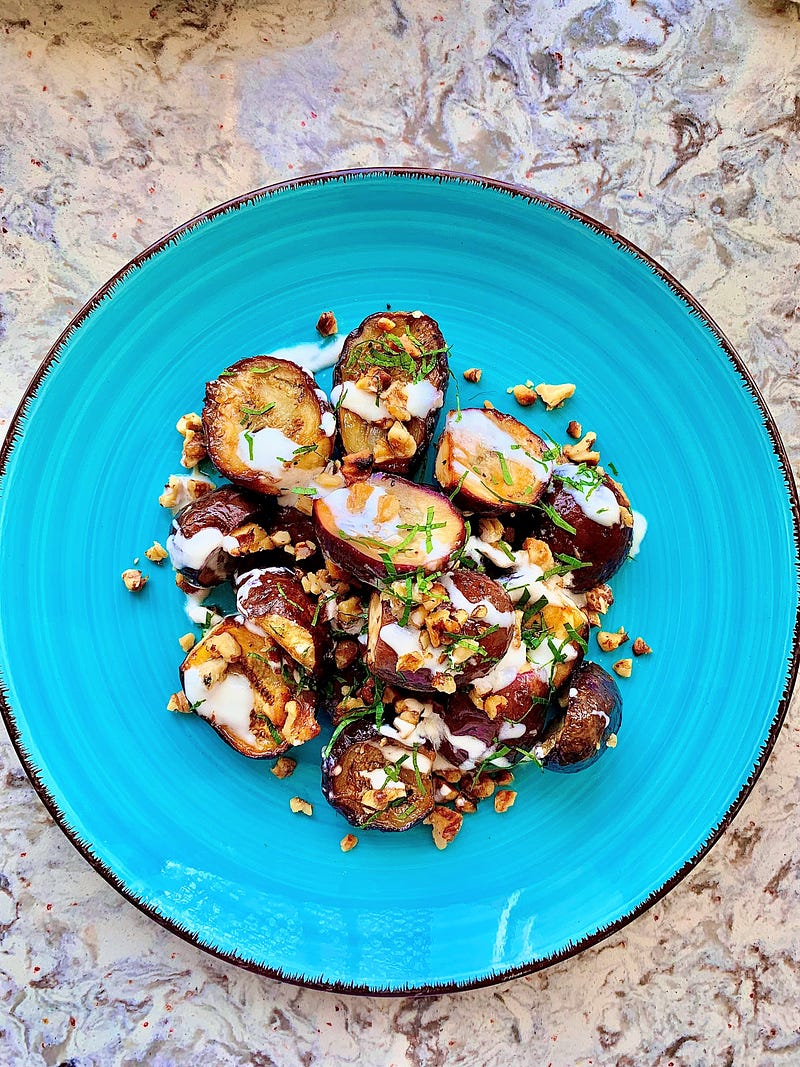
This roasted eggplant is inspired by the Lebanese dish ‘fattat betenjan’ (eggplant casserole), which my mom used to make frequently as her one of her go-to dinner party meals. Fattah by definition includes toasted bread, but I adapted this to be a side dish which highlights the flavors that make it so unique.
Every year, Muslims celebrate the month of Ramadan. For me, Ramadan was always filled with lots of dinner parties (which we call a’zumas), social gatherings, and 3am breakfasts with friends. My childhood is filled with fond memories of twinkly lights, fragrant perfume, and food spreads so large they could feed a village. My mom liked to host at least one party every year, and fattat betenjan has become one of her signatures.
Her method consisted of layering toasted pita bread, eggplant, and yogurt in a casserole dish, topped with pine nuts and parsley. The ingredient that makes this dish so unique and absolutely divine is the pomegranate molasses cooked with the eggplant. Pomegranate molasses gives food a wonderfully tart *zing*; it’s highly concentrated, a little sweet, and adds a certain ‘je ne sais quoi’ that leaves people asking, “What is in this?”.
The eggplant is traditionally cubed and cooked down in a sauté pan, so it ends up going soft. The toasted bread would be the textural element; but since I’m omitting it, I opted to roast baby eggplants instead for some texture and depth of flavor.
If you’re someone who’s not used to Middle Eastern flavors, but are looking to expand your horizons, this dish is a good starting point! It’s flavor profile is on the milder side and pretty pleasing to most palates.
*Note: I typically don’t cook with measuring tools unless I’m baking. This is a result of practice and preference. I’ve given you accurate measurements to achieve a great result, but regardless, I always recommend cooking to taste and not following a recipe blindly. Taste as you go and adjust to your liking — If you want it sweeter, put more honey. If you taste the pomegranate molasses and can already tell it’s too strong for you, put little by little until you think it’s right. If you could drink the garlic yogurt like water (as I could), make a large amount. Okay you get the idea, I will now step down from my soapbox*
Recipe Ingredients:
Yield: about 2 servings, can easily be adjusted to feed more
- 15 baby eggplants, cut in half lengthwise with tops removed
- 3 Tbsp. EVOO
- 2 tsp champagne citrus vinegar
- 1 Tbsp. pomegranate molasses
- 2 tsp honey
- A pinch of dry thyme
- Salt and black pepper to taste
- 1/2 cup plain yogurt
- 2 cloves garlic, crushed or finely minced
- 1/2 Tbsp. lemon juice
- 1 tsp olive oil
- Walnuts, roughly chopped
- A handful fresh parsley
About the Ingredients:
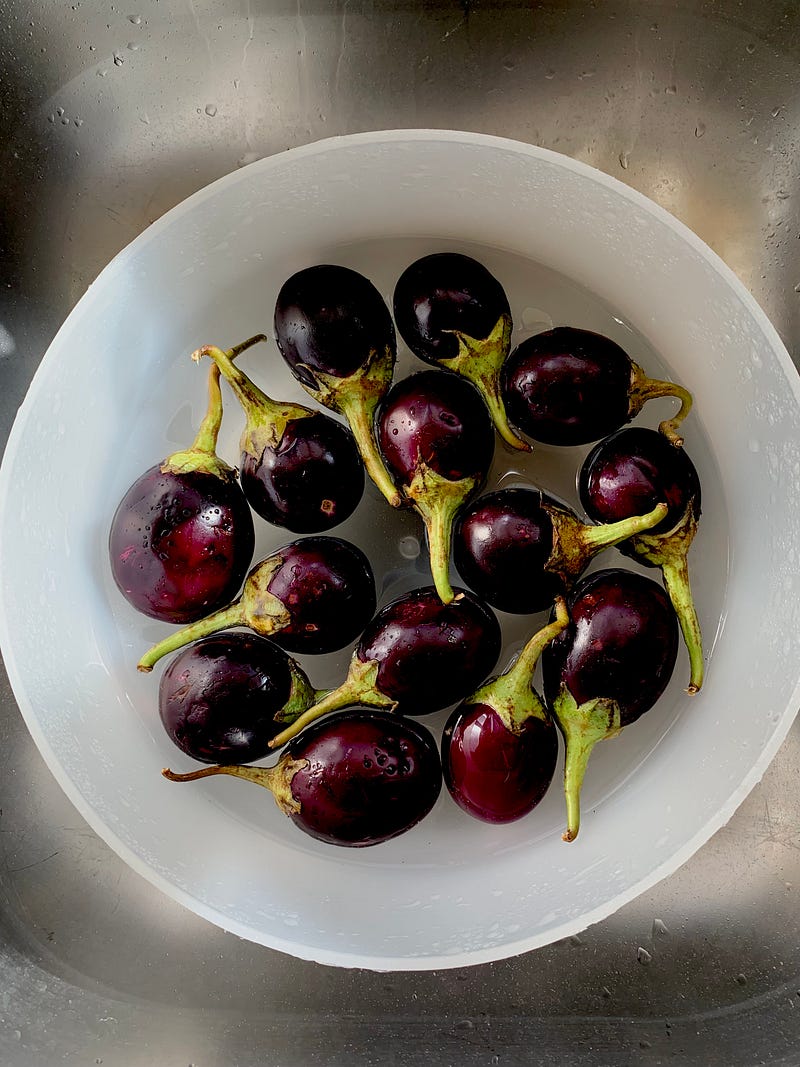
~ When buying eggplants, you want to look for those with very dark skin and bright green tops. Purple hue is fine, but the closest to black the better. (This is true for American and baby eggplants. Chinese and Japanese eggplants are different.)
~ I have O brand citrus champagne vinegar. If you don’t have this, you can use any grape/champagne vinegar you like with some lemon juice. I like this vinegar because it’s very crisp and bright, but if you prefer a deeper flavor, you could even go with a dark balsamic.
~ I absolutely love thyme on vegetables, but I stress only using a small pinch here because it has a very potent flavor. For this particular recipe, a little goes a long way in rounding out the flavor, but too much can easily overpower the whole thing.
~ Pine nuts are traditional here, so feel free to use them! The reason I went for walnuts is 1: They’re more robust and won’t burn as easily, and 2: They’re less expensive and much easier to find than the ever-elusive pine nut. Pine nut harvest is usually September to late October though, so you may have better luck finding them around this time :)
~You can cut the parsley anyway you want! Keep the leaves whole, chop them, chiffonade the way I did, whatever you like.
~ You can find pomegranate molasses at most Middle Eastern stores or online!
Recipe Instructions:
- Preheat your oven to 400 degrees Fahrenheit. If your oven has a roast setting, use it; if not, standard bake works fine. Combine crushed garlic, lemon juice and 1 tsp olive oil with the yogurt. Set it aside in the refrigerator to let the flavors marry.
- Lay your cut eggplants face up on a baking tray, and sprinkle kosher salt over the surface. Let them sit while you make the marinade. In a small bowl, whisk together the 3 Tbsp. olive oil, vinegar, molasses, honey, thyme, salt, and pepper.
- Once you see beads of moisture on the surface of the eggplants, pat them dry with a paper towel. The salt draws out excess moisture so they can get crispy rather than soggy while in the oven.
- Pour your mixture over the eggplants, coating well on all sides. Turn them over so they lay cut side down on the tray. Roast your eggplants for ten minutes, or until a fork easily pierces the flesh.
- Meanwhile, roughly chop your walnuts to your desired size. Put your oven onto the broil setting, low. Add walnuts to the same tray, and broil with the eggplant for an additional two minutes.
- Once the eggplant is fully cooked and the walnuts are evenly toasted (they should be a warm golden brown, not too dark), remove the tray from the oven.
- If you want a smooth yogurt like I did, you can strain it through a fine-mesh sieve in order to remove the pieces of garlic. Drizzle this over your plated eggplant and garnish with the walnuts and parsley. If fresh pomegranate seeds are available to you, I highly recommend adding this as garnish as well!
This is my spin on fattet betenjan they way my mom made it for us growing up. Even though my family isn’t Lebanese, we’ve always had a very broadened view of other cultures and a strong sense of pan-Arabism. This dish isn’t Egyptian, but it is one of the meals that I always identify with in sharing my Middle Eastern heritage. I hope you like my adaption, and that you might want to adopt some of these flavors or techniques into your own cooking!
Until next time storytellers,
Sahar Elgamil ❤
Check out my culinary creations @elgamil.sahar on Instagram! You can see dishes I made back in culinary school as well as from before :)


