
Travel: Melbourne
Story time: Laneway coffee
Perfect coffee in an imperfect world
The day the sky fell
Bits and pieces were still coming down, hissing through the air and smacking into the dusty Afghanistan earth.
Blue pulled his head smartly back into the carrier. “Better wait a bit, guys,” he said to the anxious faces staring back. “All our vehicles look okay but the village copped a hiding.”
When one noise stopped and another began the soldiers fanned out through the houses, picking their way over the rubble, looking for trouble, finding anguish. A pair of gunships raced overhead aiming for the scrubby ridgeline where the rockets had come from.
All around, shrieks and moans. No enemy here; just people needing help.
Some were past it. A stallholder, crushed like his spices, his wife beside him holding out the limp body of a boy, her face like none he’d ever seen before, nor ever wanted to again.
Her eyes were twin pits of despair as she offered him her son, his legs a ruin, blood pulsing out red against the shocking white of the shattered bones.
“Max!” he yelled. “Need you, mate!”
“And so does every other bastard,” the medic grunted, dropping down beside the boy, checking him with quick hands. “Ah, got it.”
He dug his thumb into the bloody mess.
“Bluey, get me a compression bandage out of my pack. No not that one. The big one. Give it here.”
Together they carried the boy to the makeshift LZ. The medic vanished back into the dust and smoke; Blue did his best to reassure the woman.
“He’ll be right. Look, the blood’s stopped. They’ll fix him up, he’ll be back kicking a ball around before you know it.”
She didn’t speak English, but maybe the tone of his voice could reassure. Her eyes were bleak and her face a mask. He spoke faster.
“They’re bloody good at the base. Best in the world. Mate of mine caught a burst downstairs, thought he’d lost the family jewels, so much blood pissing out. Just a couple extra holes in his bum. Stitched up the ones didn’t belong. He’s off home now, right as rain.”
Idiot. Her husband was dead. Her world was blown up. She didn’t speak English. He was talking to himself.
The chopper landed, a big Chinook. Blue loaded the boy onto a stretcher, told the medic as much as he knew, gestured to the woman to follow. She hesitated, looking back toward the village.
“He needs you to hold his hand, tell him he'll be okay. It’s important.”
Blue took the woman’s hand in his — a big no-no here but what the hell — all but dragged her aboard, transferred the hand to her son’s, patted her on the shoulder, looked one last time into her eyes.
The best in the world
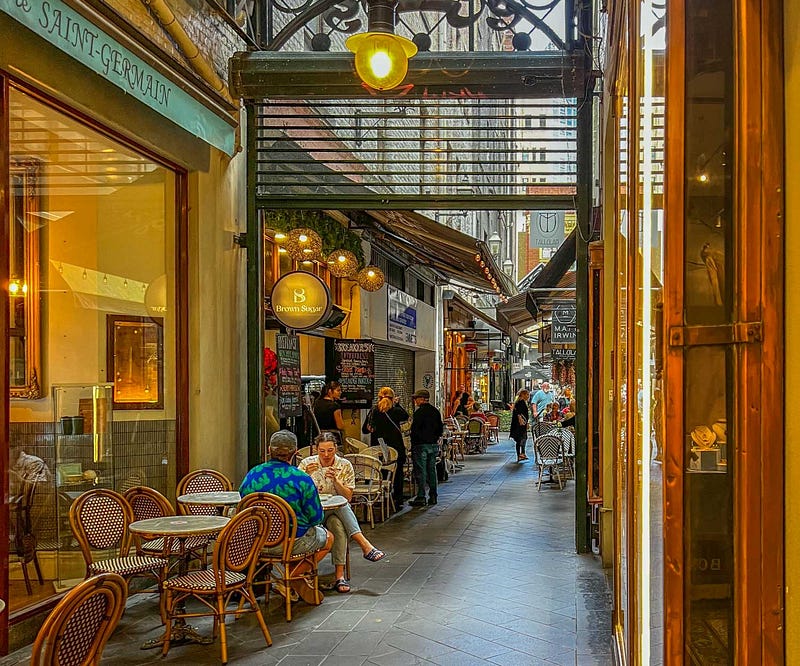
In the heart of Melbourne there is a network of arcades and laneways. Boutiques and tiny bistros overflow into the narrow passages. Tourists and shoppers, diners and idlers stroll along, an elbow away from toppling an expensive and exquisite dessert onto the tiles below.
It is Paris in Australia, down to the names of the cafes and the round-backed chairs flanking a table about as big as a teatray.
Here is the best coffee in the world, made by the best baristas. Melburnians rightly turn their noses up at the inferior offerings elsewhere. America is a desolation where Starbucks is the sad victor in the coffee wars. Asia is a write-off, and Paris, the best in Europe, still can’t quite understand espresso, like as not grinding Robusta beans for their hapless customers.
In Melbourne, paradise awaits.
The arcades were once a haven from the manure-caked streets. The sudden wealth of the Gold Rush days built elegant enclaves of wood-panelling and tiled floors, swept clean for the fancy ladies and their escorts out to shop the latest fashions off the steamships from London and Paris.
Arching glass ceilings kept off the frequent Melbourne showers, and awnings shaded against the fierce Antipodean sun.
The horses and the crinolines have gone now but these refuges remain, restored to glory and populated with eager shoppers.
I have a regular table at Vespa Rossa, right in the middle of it all. I’ve people-watched around the world but give me a flat white and a bowl of something hot and spicy and Italian, and there is no finer way to spend a half hour, at least with all my clothes on.
Which way to turn?
He was still looking into those eyes. Bleak, despairing, uncertain. They were now his own as he regarded his changing form in the morning mirror, the once fit and trim corporal barely recognisable.
The red hair had gone years ago, hearing along with it, blasted away by a thousand explosions.
Health and happiness was a mixed bag nowadays. Some days were good, some nights were bad.
They’d moved out at dusk, rising moon behind them lighting up the road ahead. There had been more villages to patrol, more insurgents to hunt down, more blood to pour into the dust.
A thousand roads between, none of them leading to whatever they’d been fighting for. The story of his life was a roadmap of dark and lonely highways.
Max was here somewhere. Max understood. He’d seen worse but found roots over the years here in Melbourne. They met up whenever Blue swung through.
“We’ll have a coffee, mate,” he’d say, but it always turned into a beer or six. Memories of old times, a night of smiles and stories, a blessed escape before climbing back in the van and hitting the road again.
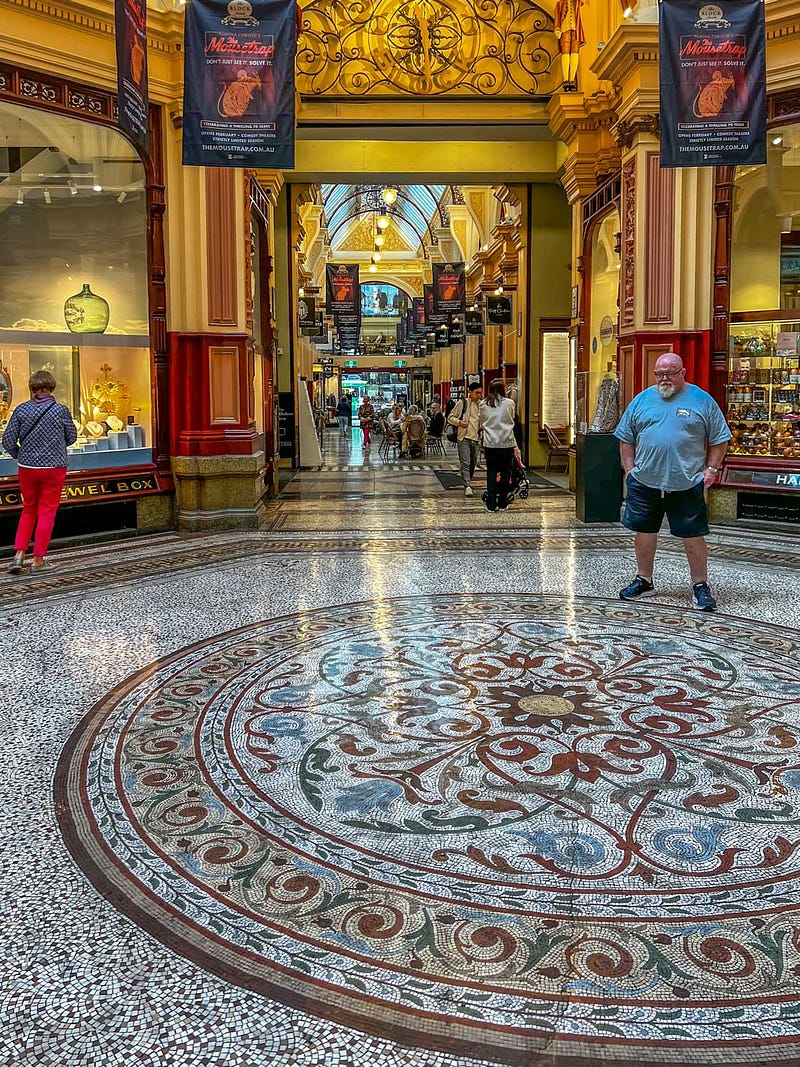
He looked at the intricate mosaic, shapes weaving and repeating like one of those Persian carpets, like the laneways themselves.
He was a little early. He’d walk around, maybe see a place he liked, text Max the name. Max’d find him.
Didn’t work so well the other way round. Funny, he’d been a great navigator back in the day. Still was, out on the road. This place, though. This place was a jumble. Like one of those Afghan bazaars, new side passages opening up, eyes peering out of corners, maybe a smile, usually not.
The spices always got him. Funny, he’d never minded cinnamon before. Couldn’t stand it now. The deep red colour and the smell took him back.
A bowl of brunch
Starting to get a little cold this time of year. Maybe some rain in those clouds when I looked straight up into the sky above.
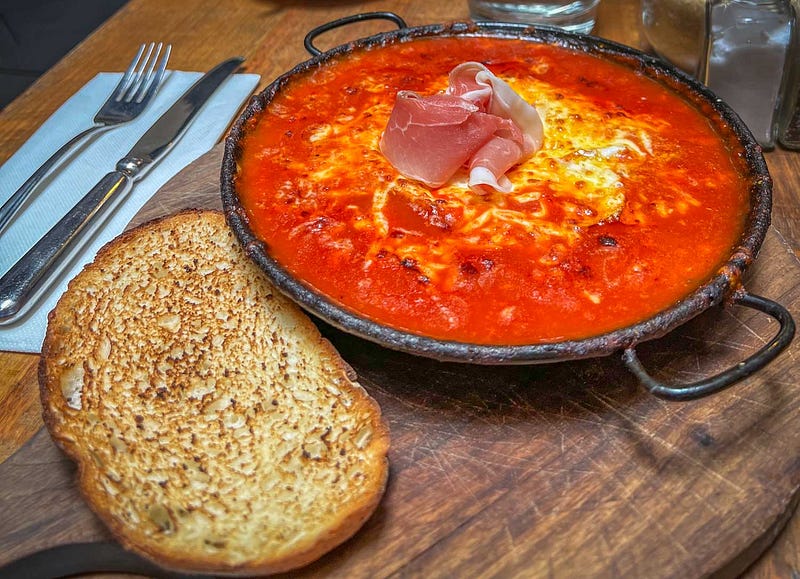
The waiter eased a paddle onto my table. A pan of “Tuscan Breakfast” and a generous slice of toasted sourdough.
I pulled out my phone, managed to get a photo before diving into the volcanic dish.
A passerby smiled at me. Lady in a headscarf, maybe Iranian. Our eyes met and she twinkled. Hey, I’m a photographer, I shrugged, this is what I do. Take photos.
Along with every other tourist in the place. Was I a tourist? No, this is my happy place. This is home.
I dug in. Oh my good god but this was amazing. Hot and spicy, but not quite so red-hot as the colour implied. A twist of prosciutto above melted cheese that hung in strands when I lifted a forkful.
There were beans and chorizo in there as well. It was a thick, tomato-rich soup and I’d be needing every morsel of that yummy sourdough to mop up the dregs.
Slow down, Britni! Savour the moment.
I made a mental note to ask for this dish again when winter had set in. Right now, at the beginning of autumn, it was a teeny bit too warming, but I’d want it when the short grey days of July dampened me.
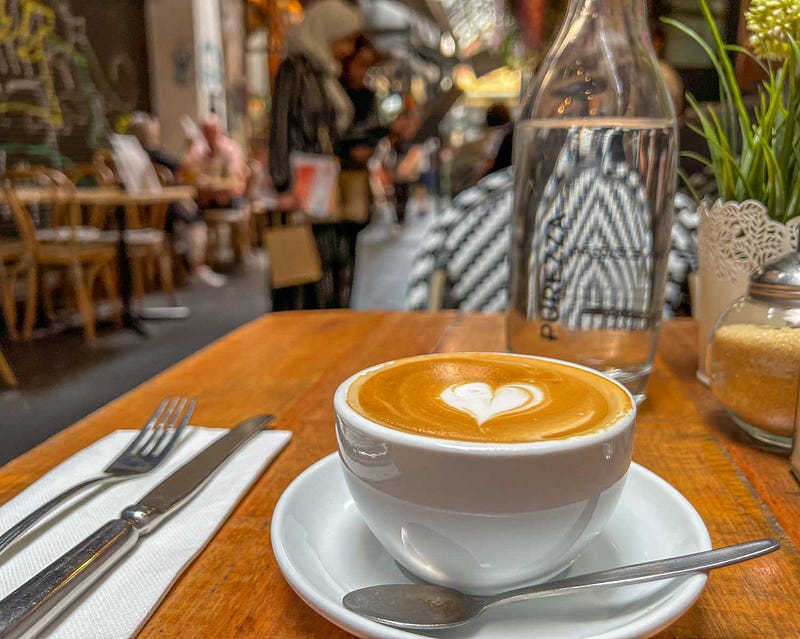
I poured myself some water to help wash it down. My coffee was far too good to waste like that. That needed appreciation as well; the rich, perfectly roasted beans extracted without a hint of bitterness or burning.
Here was heaven.
The shifting heart
Melbourne had always been a bit odd. They called it the second biggest Greek city in the world last century.
Maybe it still was, but here were Chinese students, Indian cabdrivers, Lebanese waiters…
Some resented it. Some of the old battalion whined on Facebook that they had been fighting to keep Australia Australian, keep out the wogs and the dagos.
They were full of it, Blue thought. The world was changing. Look at the pandemic, jumping across the planet in a few days. Hell, look at climate change. We’re all in the same boat.
Best get used to it.
Women in hijab. Never used to see them when he was a boy, but now they were everywhere. Sometimes they took him back to a place he’d left behind. Good mates, bad times.
At least in Australia it wasn’t those awful burkas, or even a flapping chador. Just a headscarf and something down over the hips. The younger ones barely bothered.
He smiled at an older lady, sipping tea; a younger man seated opposite, olive skin and dark eyes on the menu.
She glanced at him and his legs fell apart.
Blue landed on his backside — thank god — and looked up at anxious faces, their eyes full of concern.
And a pair of dark eyes, open wide in shock and recognition.
He got to his feet, grateful for the assistance of her young companion.
“My son,” she said, “he’s a doctor. Sit down with us.”
Across the passage, curious eyes watched the drama.
A million stories in the laneway city
I refrained from licking the pan, instead using the last sodden crust of my toast to gather up as much of the rich juice as I could. Next time I might ask for a spoon. Or a second piece of sourdough.
I love it here. The people-watching is fabulous. Lovers holding hands, oblivious to the throng about them. Couples of uncertain gender, laughing over a prosecco and smashed avo. Children with their noses pressed against the windows of the chocolate shop.
And whatever had just happened at the adjacent cafe. Three people staring intently, hungrily, at each other. Four now with another man, a clone of the one who had fallen, pulling up a chair and ordering coffee. “Anything but cappuccino; it’s all good here.”
I met the eye of the waitress, keen to see me moving on now I’d cleared my plate, and hurried to the till for my bill.
Pricey for a brunch, sure, but worth every cent.
“Fabulous,” I said to the barista. “As always.”
He smiled at me. As always.
Britni