
A Tale of Hope and Suffering: The Story of a 5-Year-Old Boy Trapped in a Well for 100 Hours
How a tiny village turned overnight into a theater of a meticulous relief operation and a human tragedy
It was a bright cold Tuesday in Ighrane, a remote and arid hilly village of about 500 people.
At 3 p.m. Khaled missed his youngest boy and started looking for him. He asked his neighbors and checked the Kindergarten before heading to the surrounding fields.
While he was searching away from home, some villagers noticed a narrow well next to the man’s home and lowered a smartphone into it to make sure that his 5-year-old boy didn’t slip there while he was playing.
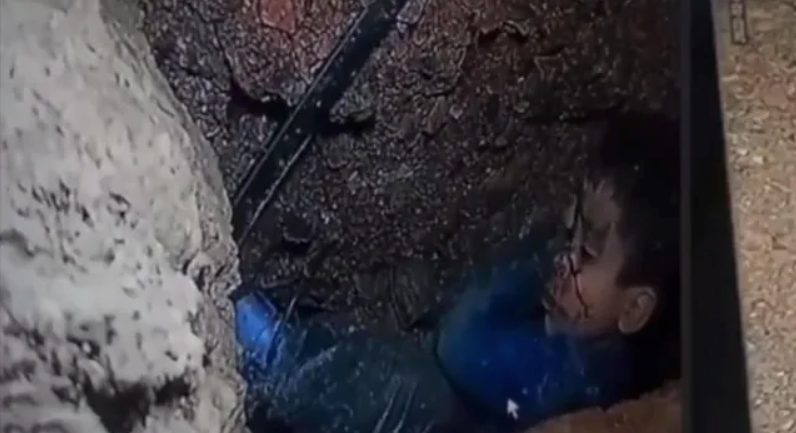
Unfortunately, the phone’s camera confirmed what they feared. Rayan was stuck 32 m (100 feet) underground and his face was bleeding.
Around 5 p.m. as Khaled came back, the gathering told him the terrible news.
The mother started screaming, and the father froze in his place. He had dug the well by himself, looking for water to irrigate his crops and cover his own family's needs. But he had found no water and hadn’t covered the hole yet.
Knowing that Rayan was still alive and could be saved, he tried to steady his breath and calm the panic.
Although the well’s diameter is just 45 cm at the top and narrows further to the bottom until it reaches 20 cm, a volunteer named Imad Fahmy, working as a rescuer at the Red Crescent, stepped in and managed to go down the hole relying on a rope tied with a pulley and reach a deep of 17 m.
In his second trial, he reached a deep of 28 m and spoke to the child, who was responsive. But the very narrow diameter at that level prevented him from retrieving the boy.
Before that attempt, a villager named Mohamed, who already knows Rayan personally, tried to rescue him but he was pulled out when he reached a deep of 30 m and was just 2 m away from the victim. He asked multiple times for another chance to go down the well and try to pull Rayan with a long hook, but the search crew didn’t allow it for safety reasons.
From a Local to a Global Event
On Wednesday, authorities began a new rescue plan. They deployed bulldozers to dig a hole in the hill next to the well to rescue Rayan through a horizontal trench instead of a vertical one.
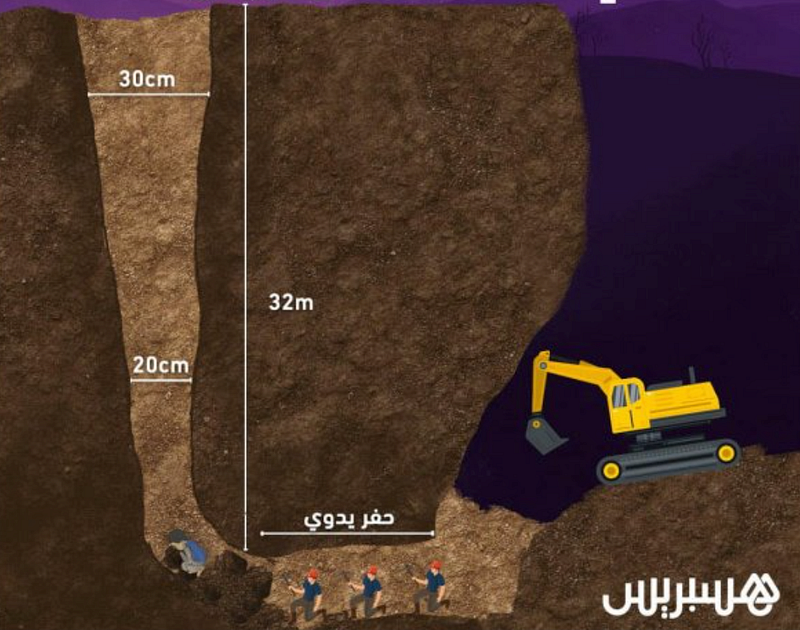
This approach is safer, but it should be executed carefully to avoid any rock or dirt collapse, which could harm the child and the team.
Meanwhile, the incident was going viral on social media with the Twitter hashtag #SaveRayan trending across several countries, and international channels like CNN, BBC, and Al Jazeera covering the ordeal. The story was gaining more and more global attention and sparking an outpouring of sympathy. People were live broadcasting and breathlessly following the updates of the operation.
A crowd of hundreds of spectators from different cities rallied on the incident’s scene and waited there in cold winter until they can see Rayan out of the hole. Some even have slept under trees as they kept vigil.
On Thursday, a camera spotted the boy’s little movements underground, which gave high hopes to save him.
On Friday, the crew reached the required depth of 32 meters and embarked on a horizontal dig inch by inch, using traditional tools to avoid any landslides or cracks in the hole from below.
In an update on the child’s health situation, the committee overseeing the rescue operations affirmed Rayan is alive.
“I prayed to God and begged him to get him out of the well, alive and safe. Please God, ease my pain. I hope the authorities and rescuers manage to save my son,” Rayan’s mother, Wassima Kharchich, told France24 on Saturday.
On Saturday night, after over 100 hours of a lot of excavation, patience, and pain, Rayan ended the tragedy and came out amid cheers of joy.
Medical staff wrapped in a yellow blanket and carried him on a stretcher to an ambulance while security guards huddled tightly around him. Minutes later, the royal palace released a statement.
There was no need to take Rayan to a hospital on the helicopter that had been waiting for days. Despite the painstaking efforts that continued throughout the nights, he came out lifeless. In an official statement, Moroccan’s king expressed his condolences to Khaled Oram and Wassima Kharchich (Rayan’s parents).
The audience who clung to optimism was suddenly united in grief. Some burst into tears in public.
Millions of individuals have followed the story moment by moment and watched the rescue mission live on television or on the Internet. They prayed for Rayan, but the meticulous relief operation came to a sad end.
Rescuers have slid water and oxygen supplies down, but they were not sure if he had used it. Besides the lack of oxygen and water, the little boy has suffered for long five days from the narrowness of the ground, the darkness of the hole, the cold weather, loneliness, and head injuries.
With a broken heart, we said goodbye to Rayan.
Why Did the Rescue Operations Take so Long?
In an answer to the question “Why did the rescue operations take so long?”, Abbas Sharaki, professor of geology and water resources at Cairo University, said to ozoneeg.net:
The Moroccan authorities have tried to reach the child Rayan safely, considering the fragility of the soil. In these cases, it is necessary to seek the help of major companies specialized in drillings, such as oil and mining companies, because of their experience, devices, and equipment, that we need to prevent collapse during drilling.
Ahmed Bukhari, the advisor to the Minister of Equipment and Water in Morocco, stated that it was possible to rescue Rayan in less than 48 hours. In a statement to Hespress, he said:
The absence of advanced rescue equipments, the limited number of the used machines, and their capacity that does not exceed 20 meters per day, as well as the difficulty to provide better equipments that are used in big projects (such as dams construction) and have a digging capacity reaching 100 meters per day, are factors that contributed to the delay in saving Rayan.
Shortly after that statement, Ahmed Bukhari got fired.
As a follower of the story who was also shocked by its devastating end, I wished we could see better teaming and international collaboration during Rayan’s rescue operations, such as the collaboration that saved the lives of 33 Chilean workers who were stuck some 700 meters underground after a mine collapse on August 5, 2010.
Although experts have considered that mission almost impossible, all the miners were safe within 69 days.
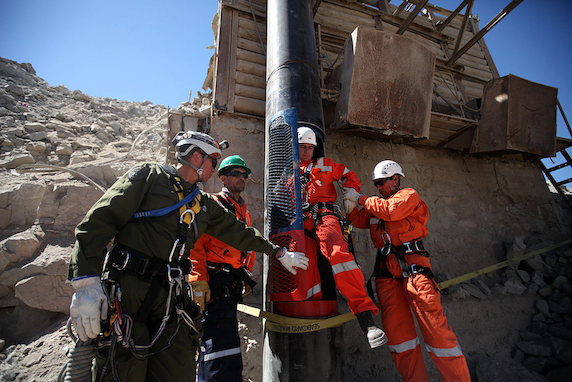
In Santiago, Chile’s capital city, President Piæera and Laurence Golborne, the Minister of Mining, met on the morning of August 6, 2010. Piæera then sent Golborne to the mine with a mandate to do whatever possible to bring the miners home, sparing no expense. Golborne and Piæera quickly reached out to their networks of colleagues around the world. As the president put it, “We were humble enough to ask for help” (Robbins, 2007). — How ‘Teaming’ Saved 33 Lives in the Chilean Mining Disaster
To enhance the miners’ physical and psychological survival while they are underground, Michael Duncan, a deputy chief medical officer with NASA, brought experience with long space flights.
In Rayan’s case, we haven’t seen any psychological support by keeping at least his family members talking to him.
From the Well to the Grave
On Monday, February 7, 2022, two days after being pulled out of the hole, Rayan Oram’s body was buried in the presence of thousands of people, in a solemn farewell and a mass funeral in northern Morocco.
Rayan is not the first child to slip his feet to the bottom of a dark well, but he has reserved for himself the largest area of light.
He remembered us of the 2-year-old Julen Rosello, who fell into a well a hundred meters deep in 2019 and came out lifeless 13 days later after “one of the most complex and extensive rescue operations in the history of Spain.”
On February 18, 2022, another Rayan (a 5-year-old boy named Haider) died after being trapped for three days in a well in a village in southern Afghanistan. According to his grandfather, he fell down the well of 25 meters when “he was trying to ‘help’ the adults dig a new borehole in the parched village.”
Water gets harder to come by, which motivates farmers to dig wells and open boreholes. According to estimates, in Spain alone, there are over 1 million illegal wells.
Rayan, Julen, and Haider left, which begs many questions such as: How many children should die in such terrible tragedies until governments could provide farmers and the population with alternative water sources?
Want more?
I write about engineering, technology, and leadership for a community of smart, curious people 🧠💡. Join my email newsletter for exclusive access or sign up for Medium here if you haven’t done it yet.


