
Stormy Seas— The Storm Maiden
Feedback on; Stormborn — The Legend of Ylva Part 1 (A Fantasy Fiction Story), by Jay C Wells
These articles provide feedback on stories submitted by brave writers looking to learn and grow. Comments will be provided on anything from title and pictures, to grammar, language, and cohesion. All feedback is meant to help both the original author and anyone else reading this, and general writing tips will be highlighted.
This time we are looking at a fantasy story in an old Norse setting. Part One finds us meeting the main protagonist of the story, Ylva. From the start, the author, Jay C Wells, portrays Ylva as an enigmatic figure sitting in her favourite seat in the local pub, with a view to the water beyond the window of the village of Stolthavn. It’s Spring…
General Feedback
After the story’s title, immediately, the author sets the scene. Ylva the main protagonist, is restless with the onset of Spring and yearns for a return of storms and high waves.
With minimal use of words or a lengthy background, this is a great start to the story, making me want to read on. Here we have the classic elements of, introducing the main player (protagonist) in the story, the when — it’s Springtime and a mystery. Why does Ylva yearn for a return of stormy weather? Then a short following sentence further heightens the mystery and tension. Ylva’s wishes are about to be answered.
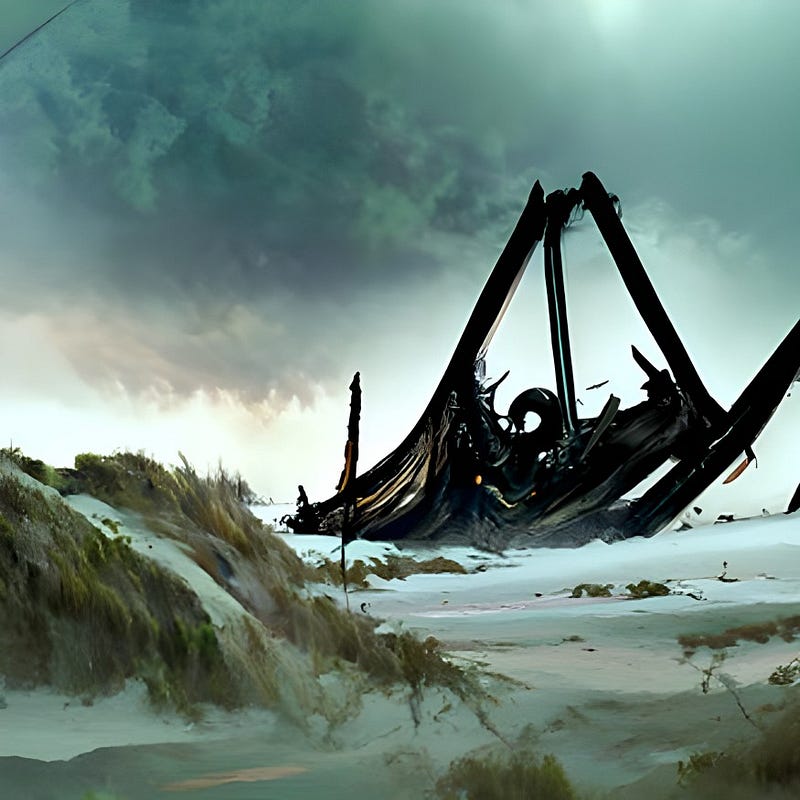
This leads directly to a picture evoking storms with dark clouds looming over the wreck of a wooden structure, possibly a portrayal of a Norse Longship, on a deserted, windswept shore.
The picture created by the author, is to me, deliberately vague. It is this representation of a jumble of smashed and otherwise broken wood, that leads the viewer to imagine what was that central, dramatic ruin. Was it a ship or ships, or, the remains of structures, a village perhaps?
The eye of the viewer is time and time again led to this dramatic and mysterious violently torn and shredded structure. The picture heightens the tension already present and makes me want to read on.
The next few sentences lead us to more mystery; it is Spring and the village of Stolthavn had once again won out over the ice of winter. But here I am asking a question, which I believe is the author’s intent; why does everyone know trouble is brewing?
While I personally like this minimal approach to the narrative, it leaves much to the conjecture of the reader. From a myriad of little clues left by you, I get a picture of a Norse village, possibly in the 900 BC to 1100 AD timescale. The names are Norse. I also see longships of Viking design. The artwork also strengthens this image. However, I wonder if even using a few words to flesh out the village, would assist the narrative along.
The story moves to a scene where the main protagonist, Ylva is relaxing, her feet up on the table in front of her, her mood reflective as she ponders what to do on such a fine sunny day. I got a picture of a domestic scene seeing a young woman reclining back on her chair, relaxed and thinking.
Although, that air of mystery about Ylva re-asserts itself when in the next sentence it states, “she misses the rough winds and high waves.” You also get the sense that Ylva lives for danger and excitement as the next sentence states there’s no fun in leaning the chair back on two legs if there is no wind threatening to blow her off balance.
The author does a good job of painting a picture of a bored young warrior woman sitting at her favourite table in an inn. The next paragraph provides a brief exposition via Ylva’s reflective thoughts. This is cleverly woven to provide us with knowledge of her mysterious appearance in the village, the names of her foster parents and how they had saved her by pulling her from the sea. And, the silver band with her name on it.
Tip 1: Background, also known as Exposition is providing essential background information about the main characters and the story setting. It is a way to draw your reader into the story. However, too much exposition may lead the reader to become bored.
The scene now switches to a group of “ruffians,” when one of the group shouts insultingly to the serving woman. The author has upped the stakes in the story by increasing the tension. Here we have the start of Microtension. We are also told through Ylva’s thoughts that these men have recently returned from raiding and are flashing their newly gained wealth.
Tip 2. Macrotension — the plot twists, turns, surprises and reversals. Microtension can be down to the choice of words or even the turn of a phrase. It is the injection of small, simmering, subtle words. It is the small, almost insignificant choice of words dropped into the character’s thoughts, speech or description, which also add depth to the story.
Here, the scene has changed to micro tension where we can feel the tension building in the choice of words used by the author in the speech between Björn and Ylva. Björn has called the serving woman “old hag” and now Ylva calls him out by asking the question “Who do you call a hag?” Björn deliberately misconstrues her question, tossing it away with negligence borne of one who is sure of himself. So now we know Ylva is a good-looking young woman. How? By the way, Björn reacts when he looks at her, by licking his lips and slapping his thigh for her to sit there.
The lack of feelings and actions leaves me to rely on the nuances I place on the spoken words, and not on how you see the characters speaking. I know that when Björn says “Old Hag, bring…” This is a lout, a boor, a loudmouth and should not call a woman in such a derogatory manner. However, the lack of actions here could make the words take on any other meaning. For example, “…,” Björn says brusquely as he slaps the woman’s ample behind as she passes the table and he gives her a cheeky lopsided grin, winking. The woman giggles, like a young maid, her hand plumping up her already-mussed hair. Björn knows full well how his roguish good looks and ready smile can charm.
Tip 3. Feelings and Actions; these add depth to the story. They breathe life into your characters, making them appear in 3D. The writers of stories know what their characters look like, however, it is vitally important this is shown throughout the character arc to the reader.
Ylva does not act like the young coquettish woman. No, she boldly keeps eye contact and getting up walks casually towards him. I believe again this scene could have benefited from using how she feels inside — what are her emotions; what is she thinking? As I have noted above “by keeping eye contact,” Ylva in part does demonstrate she is not intimidated by Björn, but she lacks the “depth of character” because she has no feelings and we are shown nothing of her outward behaviours.
For example; Ylva stares at Björn thinking, what an idiot. Doesn’t he know who I am? A warrior, a shieldmaiden fighting alongside one of the greatest warchief’s this country has ever seen! Huh, honoured by him too. At that last battle; by Odin, what a glorious fight. Although, I lost many fellow warriors and kinsmen that day. These thoughts took mere moments, as she remembered, the glory, the blood, and the sadness. It was enough. she could feel the heat, the anger rising in her stomach, a fiery bile in her throat. Her heart, she noticed, was hammering, like the big war drums calling to her. Ylva abruptly stood up, her chair rocking backwards, its legs thumping down onto the rough wooden floor. How dare this man. No, this worm, call my mother names. He’s going to pay. As she strides purposefully towards Björn, her cold, angry ice-blue eyes never leave his.
Ylva verbally challenges Björn again, who this time gets the message, she doesn’t want a dalliance with him. He jumps to his feet towering over her “like a longship over a rowing boat.” This is a good thematic example of showing Björn’s immense height in comparison to Ylva’s, whom we know as being “tall and strong.”
Tip 4. Thematic Language: There are several parts to this (1) The Theme of the Story, not to be confused with the main story idea and (2) the descriptive language used to show what is happening in any particular part/scene in the story.
The tension is now at a high point and Björn thinks that by flexing his muscles and glaring at her, she will stand down. Instead, Ylva just “smirks.” To me, I see an enigmatic smile. It is enough to confuse him. Meanwhile, the older woman rushed up with free drinks, trying to defuse the situation, pleading with him not to pick a fight with Ylva. The situation now escalates and a fight is inevitable when Björn pushes the older woman aside.
This whole confrontation is a great way of showing the rising tension to where things culminate to the stage where you cannot now just sit down and resume drinking. This is seen clearly at the point where Björn pushes the older woman.
The older woman, Ylva’s foster mother, we discover, and all the other patrons of the inn run for cover, hiding under the tables. Why? What do the locals know?
Björn is startled by Ylva’s seeming anger.
I can appreciate that a lot of work has gone into building the tension in this scene to draw it to its conclusion. However, this is a key part of the story and you would want to expand on it. I believe in this scene you could have added more depth, by adding more descriptions, and feelings to draw this scene out, and to immerse the reader into the story.
For example; Her mother rushes up to the two warriors, Oh, gods, not again. Ylva, oh Ylva, please don’t lose your temper. Dear Frigg, my heart can’t take any more of this. I can feel it hammering away, trying to break my ribs, is what it’s doing. I shouldn’t have had that bowl of soup, the way my stomach’s doing back-flips, making me sick. I look up as I put the tankards down on the table, “come now, no harm’s done. Come good sir, sit and enjoy the free ale,” I said. I couldn’t help the pleading tone as I looked from the man to Ylva. It’s too late, that look in her eyes, it make me cold all over when I see her look that way. I shiver.
Björn meanwhile is trying to face this young woman down. Ha. She might dress like a warrior, she’s too young to have fought… if she has fought in any battles. Anyway, she doesn’t stand a chance, I can break her in two with one blow. Why, doesn’t she just back down? I don’t want to hurt her. I was just looking for a bit of fun. Been at sea for weeks, I’m rich, she would have profited by a little fling. Damn it! By Odin’s left eye, she’s going to pay, and good. His thoughts are angry and confused by her stance, and he absentmindedly shoves the old woman away. “Don’t cause waves here… bitch,” he added the last word in an insulting, mocking voice, spoiling now for a fight. It’ll be quick at that. One good blow, then she’ll be more submissive. Björn smiled at the thought.
“You want waves,” I screamed at Björn, hurt by his callous treatment of my mother and irrationally angry at mum for being so submissive. I could feel the deep power growing within me, a maelstrom of seething dark waters. I saw the waves grow higher. I willed one higher and my churning maelstrom answered as an enormous wave crashed over the jetty sweeping us all off our feet. Energised by the frigid water, I lept up, grabbing at a passing chair bobbing by in the icy water. With a mighty yell in anger I lobbed the unoffending chair at Björn just as he was standing up. It smashing into Björn’s barrel of a chest to disintegrate in a shower of splinters. I quickly close in the distance between us and before he could fully straighten I sent my knee crashing into the area between his legs. I felt rather than heard the crunching of his family jewels. Good it’ll be a long time before he even thinks to use his most precious jewels. Ha!
Ylva appears to be able to control the wind and the waves. Again I appreciate that this adds to the mystery that is Ylva. However, ending with Ylva questioning her seeming powers would be good here. Even with just a few short words, “I wonder why I am able to call forth the waves?”
The ending is as it started, Ylva is sitting again in her favourite seat, in calm and sunny weather. A new sign is above her head, made by her stepfather, “Please do not pick fights with Ylva.” This short paragraph in the story brings us to the denouement or resolution of the connecting threads of this part of the story.
This is a clear example of linear storytelling, where the scene follows the beginning, middle and end with no deviations.
I liked the pace of the story, however, I felt it lacked showing actions and feelings and left much for the reader to put their own slant on the story.
The ending paragraph was a picture of contentment on the part of the main character. So the picture returned to the start for me and left me hanging, contemplating Ylva’s mysterious background and how she seems to command the wind and sea. There is no continuing tension in the scene. However, I question your intent here — Is this deliberate as a stand-alone story would end, like a short story, or TV show?
The scene could have ended with yet more added tension possibly by the villagers complaining about Ylva’s temper and they may even look at her as threatening…
Tip 5. Chapter/Scene Endings. To keep your reader engaged, it is to your advantage to keep the tension high. By this I mean, to keep the mystery, and the questions intriguing, using cliffhangers.
In the above paragraphs, I have asked many rhetorical questions. This is to highlight to you what a prospective reader may be asking.
Summary
Title of Work: Stormborn — The Legend of Ylva Part 1 (A Fantasy Fiction Story)
Intriguing start. The title makes me want to read on, wanting to know more. I want to know how the author defines “Stormborn.” The downside here is its ambiguity. On the one hand, this word gives the title mystery on which to build the story, on the other what is the meaning of Stormborn in the title?
The title, leaves me asking more questions. Good, simple, captivating, mysterious start.
The Picture
The depth of field in the picture left me drawn to the main feature every time I looked at it. I got the feeling of the immense power of the now quiescent sea, and how it could cause such devastation. The angry stormy sky told of a storm that has spent most of its fury on the structure. For me, the very ambiguity of the ruins added to the feeling of desolation and rage. I am not sure if the wreckage is a house or a ship, but in this instance, it really didn’t matter. The devastation was enough.
The picture’s caption was clear and linked to the author’s home page.
Overall, the picture was appropriate to the title and a promise of the story to come.
Tip 6. Picture Caption: All pictures included in stories or articles must be accompanied by a caption which tells the reader who the artist is, possibly with embedded links, and what site the image came from.
This is Copywrite Law. Proper artist recognition must be shown at all times. Copywrite Licence is what you may have to purchase where you want a certain picture. In essence, you are purchasing both the picture and the licence to use the picture. In all cases, whether a picture is free or you need to purchase it, the artist must be given proper recognition.
Narrative of Story (Exposition)
I was encouraged to read on, based on the opening sentences. This told of Ylva, the main protagonist of the story and her longing for the storms of the winter, now that spring was here.
On reading the story through, I liked the story overall. However, I did feel the story was let down by the lack of detail. Essential background detail to give the reader more depth to the story, such as; a village — what size, was it thatched roofs, what was the interior of the inn like — smoky atmosphere, straw on the floor, types of tables, benches, trestle etc.
Ylva’s character arc was at once exciting and mysterious, however, I felt the character was flat, and apart from her being tall and strong, we know nothing of what she looks like. Earlier in my General Feedback, I surmised she must be good-looking from the reaction of the other character, but to get a fleshed-out figure there would normally be something to let us see her. Even if you intersperse the narrative with dropped in detail, “the sunlight on her hair made it glint like a field of corn.” I do believe Ylva and your other characters would benefit from showing us details and showing us also how they felt at given times during the story. Is Ylva’s anger angle part of the story? Her flaw? Show us this. There were no feelings shown, other than the spoken word and I as the reader had to put my interpretation on this.
I did like your use of minimal imagery to tell us how the ruffians looked in general terms and the height of Björn and of Ylva’s known background which worked very well.
Formatting
There are parts of the story where the protagonist is thinking. This might be a good area to explore in terms of writing style.
It is a matter of personal style, however, I tend to put thoughts in italics, well-known authors have their character thoughts within the main body of the narrative. I certainly know that the way I show thoughts is not the norm and I would not suggest you follow this path.
Normally speech is just in quotes, single or double, but if you start with double quotes for consistency you should stick to this one style throughout.
There is a need to take into consideration the type of story being produced, is this a short story, a novella, or destined for a full novel? It is here that the requirements for each type will require more of you to tease out the story.
Generally, this appears fine overall. paragraphs were varied in length, and the story is easily read.
Grammar
It would be great to be infallible and to know every nuance of the English language. I know I would love to know everything, but I don’t, and I can only point out the obvious mistakes.
There are some missing commas and one spelling error, i.e. brusk should read brusque.
Tenses
There are also several instances of switching between past and present tense. This is guaranteed to pull any reader out of the story, i.e. Balancing on two chair legs wasn’t the same if there was no wind threatening…
In the paragraph beginning “Despite her boredom…” it is difficult to know if she is recalling memories, or if it is meant to be in the present. With your choice of words, enjoyed, wasn’t, didn’t, and was, indicate the past. However, changing these words to enjoys, isn’t, doesn’t, and is, changes the meaning to the present tense.
If the first three sentences are meant to be in the present tense, you should consider using a paragraph break at the end of the third sentence. This way you can define Ylva’s memories clearly in the remaining sentences. Then another paragraph break before Bjorn speaks, again defining Ylva being pulled back into the present, for example, Ylva is rudely pulled out of her thoughts by the coarse voice of one of the loud-mouthed ruffians sitting over at the best table in the tavern.
Switching between past and present tenses can cause confusion where you are remembering things that happened in the past and then switching to present dialogue and confrontation scenes.
Tip 7. Keep your sentences short. You can lose your reader with long sentences. They are often harder to read and understand where the beginning ties into the ending of the sentence.
Refer to the Writer’s Toolbox in the Publication, Get Read for further help and information
Language
The language was good. You used a style that is easily read and understood by the majority of readers. You did not try to use unusual or less well-known words, which I liked.
However, when reading the story, I was again pulled out of scenes by the use of some words, which I felt needed more in the way of description and/or explanation. For example,
- … the young, blond woman just smirked. I am asking myself why is she smirking.
- … his right temple in a flourishing move. To me, this word is used more to show extravagant/over-the-top behaviours and actions. Would possibly “swinging her tankard in a wide arc, Ylva brought the tankard smashing against the braggart’s head.” Although the word is technically correct, I have not seen it used in this particular context.
Cohesion and Cadence (Pacing)
The story moves seamlessly from scene to scene using great pacing and a heightening of tension.
The story begins slowly, building to a fast-paced climax. The use of tension keeps the story moving forward. However, the use of more description (what are the characters doing and thinking), would help build your tension and give your reader an in-depth experience.
It would be beneficial for you to expand on the characters, to slow the pace of the story down. Give the reader time to immerse themselves in the characters and action sections. Let the reader draw that figurative breath in before moving on.
Final Conclusions
Great premise.
We are moved seamlessly from one scene to the next. But too quickly.
The story shows great promise with lots of opportunities for expanding on these themes and I look forward to reading the next episodes.
Thank you, Jay, for giving me the opportunity to review your work and I hope to read more of this emerging story in the coming weeks.
Lorna Dolan.
If you would like to read more stories and articles by me, you can check out my homepage here.