avatarThe Mystique

Free AI web copilot to create summaries, insights and extended knowledge, download it at here

3429

Abstract

entire body — the current day Yakuza tattoos are inspired by this.</p><p id="b95e">They are also thought to be descendants of the <a href="https://www.britannica.com/topic/ronin">ronin</a> group , who identified as masterless samurai who would act as security guards. However, this eventually branched out to become bandits. They were notorious for being rebellious, disruptive and generally a danger to the public.</p><p id="2672">Modern-day members of the Yakuza will identify as either <i>tekiya</i> or <i>bakuto </i>depending on what their speciality is.</p><h2 id="a161">Rise To Power</h2><p id="b4c7">From the early 1600s to the mid to late 1900s, the Yakuza often caught the attention of local police officers because of their particular look — haircuts, tattoos, dressing style, and etiquette. In the 1600s, the group reorganized as a family mafia — similar to the <a href="https://godfather.fandom.com/wiki/Corleone_crime_family">Corleone family in The Godfather</a>. From there, they usually turned to each other for protection.</p><figure id="080e"><img src="https://cdn-images-1.readmedium.com/v2/resize:fit:800/1*jFYw9pThN7ENvOJy8fzdvQ.jpeg"><figcaption>Yakuza Tattos | Source: <a href="https://www.bbc.com/news/newsbeat-49768799">BBC</a></figcaption></figure><p id="e7c4">Some of the Yakuza began to blend in with ordinary people, taking on day jobs as service or dock workers and even going as far as becoming government officials. During and after World War II, American settlements in Japan found the Yakuza threatening — their occupation meant that they had a strong enemy — but they could not do anything about it.</p><p id="aa85">From 1958 till 1963, the Yakuza were in full force — their <a href="https://www.ojp.gov/ncjrs/virtual-library/abstracts/yakuza-past-and-present#:~:text=In%20the%201900's%2C%20American%20occupation,than%20150%20percent%20to%20184%2C000.">membership totaled to about 184,000 members</a>. Around 5200 groups in Japan began marking their territory but so many members also meant that intra-gang wars were bound to happen. They pioneered gambling, smuggling drugs and pornography, and money lending.</p><h2 id="4665">The Gang Structure and Hierarchy</h2><p id="335c">Similar to <a href="https://godfather.fandom.com/wiki/Vito_Corleone">Don Vito Corleone</a>, the Yakuza also have a patriarch known as the <i>kumicho</i>, who is the leader of the whole gang at the top of the pyramid. Under him, many members like the lieutenants, under-bosses and the leaders of smaller gangs answer to him. However, there is no organized structure in the entire gang because the dynamic differs from every clan.</p><p id="c342">Here is a <a href="http://www.conflicts.rem33.com/images/yett_secu/yakuza_chemko.htm">chart</a> of the hierarchy that has been deduced:</p><ol><li>Oyabun/Oyaji — godfather</li><li>Anego — wife</li><li>Nidaime — heir of oyaji</li><li>Kumin — member</li><li>Chinpira — hooligan</li></ol><p id="15a4">The most important relationship within the Yakuza is the <a href="https://www.refworld.org/docid/3f7d4db723.html#:~:text=The%20guiding%20principle%20of%20the,he%20must%20accept%20this%20relationship.&amp;text=The%20levels%20of%20management%20within,more%20complex%20than%20the%20Mafia's.">oyabun-kobun</a> relationship. It is a mentor-mentee relationship where the kobun pledges 100% loyalty to his oyabun in exchange for training and mentorship. The ceremony is marked by ea

Options

ch first drinking from their own glass of <a href="https://www.japan-guide.com/e/e2037_sake.html">sake</a>, a traditional Japanese beverage, and then exchanging glasses.</p><p id="8ab1">Women are not a major part of the syndicate except as prostitutes or just to give birth, with the exception of a few.</p><h2 id="4ce9">Going International — The Gang’s Global Influence</h2><p id="0988">By the late 1960s and early 1970s, the Yakuza influence had gone international. It started with gang members going to China in World War II to <a href="https://www.science.org/content/article/world-war-ii-opium-wars-recorded-ocean-s-corals">specialize in opium trade</a>. While the majority stayed in Japan, in the 1970s they made their move to South Korea. When the Japanese took control of Korea, many Koreans were already working in Japan and had begun integrating themselves in the hierarchy.</p><p id="26b4">Next, in the Philippines, a country already practicing human trafficking, the Yakuza also set up official headquarters there. Then, their influence began to spread even more until signs of the Yakuza surfaced in Indonesia, Malaysia, Thailand, Hong Kong, Singapore, and Taiwan.</p><h2 id="0430">Separating Fact From Fiction</h2><p id="b27c">Now, their existence certainly brings about rumors — most of which won’t be true. For example, some people might think they are a hidden crime syndicate that nobody would really know about. However, they are well known, and even have a magazine published with their stories in it.</p><p id="9063">Others might think that they are evil people — which would make sense considering the nature of their crimes — but the Yakuza have shown that they have a heart; by delivering supplies to victims of the <a href="https://www.britannica.com/event/Japan-earthquake-and-tsunami-of-2011">2011 Japanese tsunami</a> and the <a href="https://education.nationalgeographic.org/resource/kobe-earthquake/">Kobe earthquake of 2005</a>.</p><figure id="ccda"><img src="https://cdn-images-1.readmedium.com/v2/resize:fit:800/1*0j_ORrPCe_mvAnKrQY66MQ.jpeg"><figcaption>Destruction cause by the 2011 Tsunami | Source: <a href="https://commons.wikimedia.org/wiki/File:UKISAR_in_2011_Japan_earthquake_11_House_turned_upside-down_by_the_force_of_tsunami.jpg">Wikimedia Commons</a></figcaption></figure><p id="c63d">Some people may also assume that they are murderers — that if anyone crossed paths with them, they would likely be killed. However, the members of Yakuza do not believe in killing unless their lives are in danger. Even with each other, they do not have a death penalty punishment, unless it is a very extreme case.</p><h2 id="e13d">Where Are They Today?</h2><p id="7b5c">Their numbers have significantly declined since the 20th century, from 184,000 members to 11,400 members as of 2022. Since the <a href="https://alanrawcliffe.medium.com/the-collapse-of-the-yakuza-44c79400bf53#:~:text=Anti%20Yakuza%20legislation,commit%20illegal%20acts%20of%20violence.">Anti-Boryokudan act of 1992</a>, they are not as visible as they used to be, however they are still active in illegal activities.</p><p id="c22e">Due to some charitable acts on their end, they are considered a necessary evil. For the Japanese state, they can control underworld activities if they want. In the underworld, the Yakuza is the topmost organization, and they have made their place at the top of the hierarchy.</p></article></body>

Stories From The Most Feared Gang In The World — The Yakuza

An Introduction To One Of The Biggest Crime Syndicates in the World
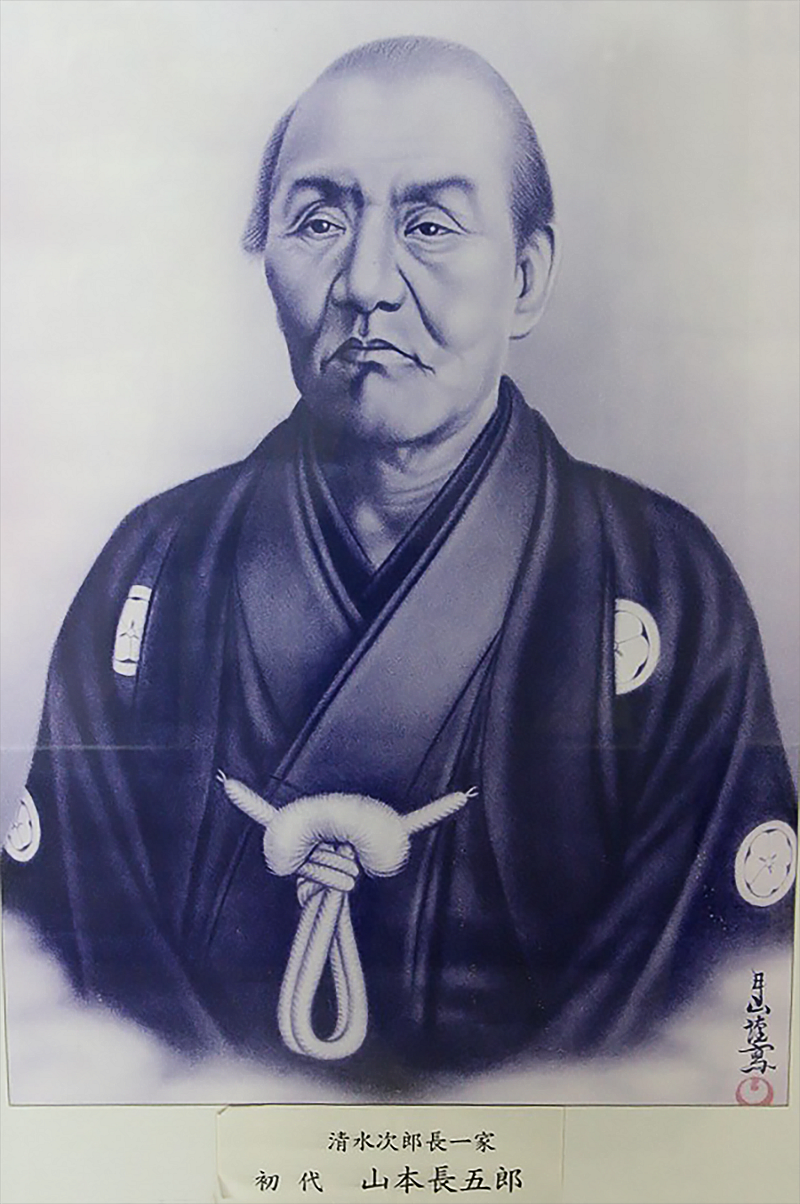
Shimizu Jorocho: The Yakuza Boss. He was the biggest boss in the Tokaido or Eastern Sea Circuit. He was also a robin hood figure for helping the weak and crushing the strong as a yakuza chieftain in the late Edo Period (1603–1868). Source | Wikipedia

One of the most feared criminal gangs in the world — the Yakuza — is of Japanese origin. The word Yakuza is believed to mean “good for nothing.” The origin of word comes from a concept in the Japanese card game called Oicho-Kabu. What happens in this game is that if the player draws 3 cards, in the order 8 (ya), 9 (ku), 3(sa), it gives a total of 20, which is the worst outcome a player can have.

The nickname given to the Yakuza by the Japanese intelligence and police force is bōryokudan, which means “violence groups.” They have earned this nickname through many crimes like smuggling, prostitution, extortion, blackmail and drug trafficking.
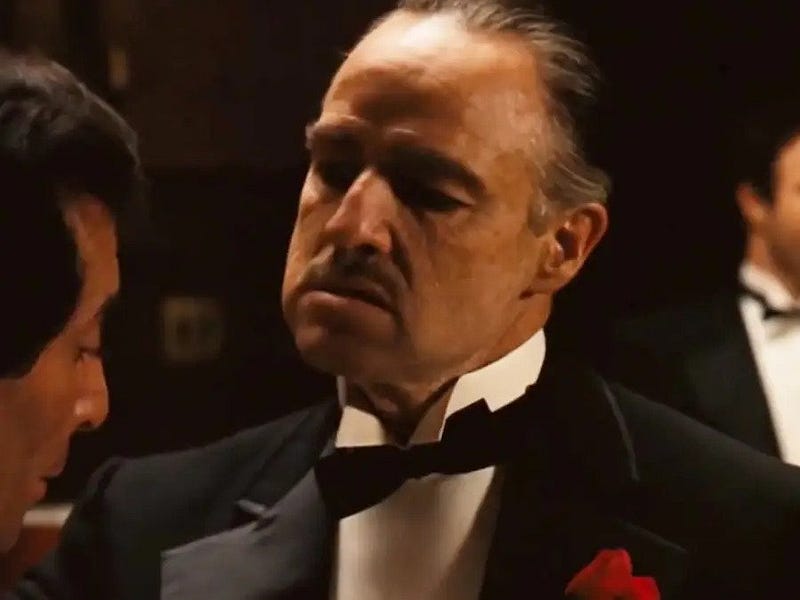
Marlon Brando as Don Vito Corleone in The Godfather | Source: Insider

Like every gang-related or mafia movie, such as The Godfather, The Irishman, or Public Enemies, the Yakuza all have a symbol to identify them with specific tattoos adorning their bodies. During the time since they have been active up till now, there is a lot to uncover about why this group is so feared — and how they operate.

Origins of the Yakuza — Japan’s Notorious Crime Syndicate

The origins of the Yakuza can be traced back to the 17th century — during the time of Tokugawa Shogunate. A group of outcasts also known as the tekiya, who used to sell low-quality goods going from village to village, began uniting together and forming a subgroup. Bosses of their mafia spearheaded this subgroup.
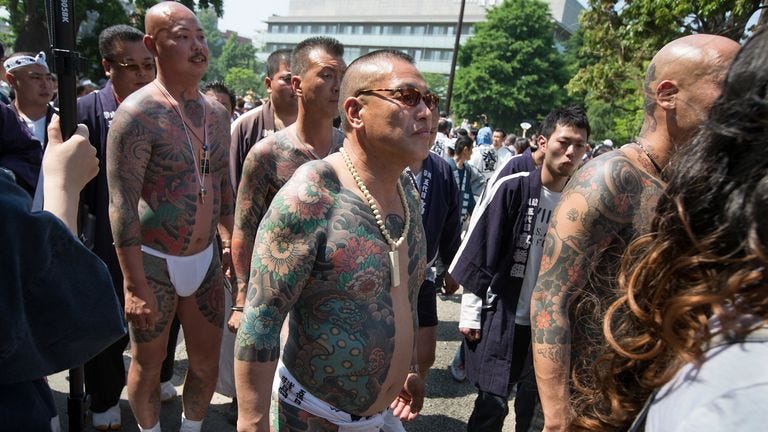
The Yakuza (recent) | Source: Sky News

Another group that gave rise to the Yakuza is the bakuto. The bakuto were a group who used to organize gambling rings and sell games that were strictly forbidden in the Tokugawa times. Their symbolizing features were colorful tattoos on their entire body — the current day Yakuza tattoos are inspired by this.

They are also thought to be descendants of the ronin group , who identified as masterless samurai who would act as security guards. However, this eventually branched out to become bandits. They were notorious for being rebellious, disruptive and generally a danger to the public.

Modern-day members of the Yakuza will identify as either tekiya or bakuto depending on what their speciality is.

Rise To Power

From the early 1600s to the mid to late 1900s, the Yakuza often caught the attention of local police officers because of their particular look — haircuts, tattoos, dressing style, and etiquette. In the 1600s, the group reorganized as a family mafia — similar to the Corleone family in The Godfather. From there, they usually turned to each other for protection.
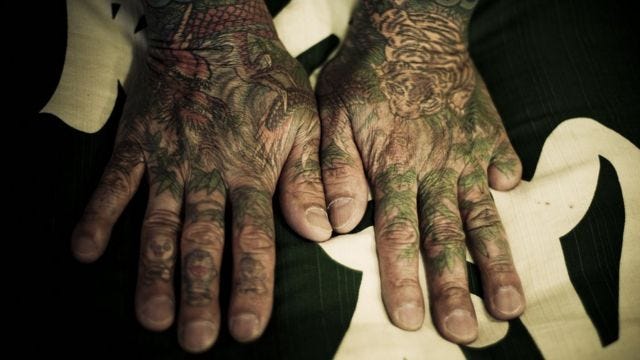
Yakuza Tattos | Source: BBC

Some of the Yakuza began to blend in with ordinary people, taking on day jobs as service or dock workers and even going as far as becoming government officials. During and after World War II, American settlements in Japan found the Yakuza threatening — their occupation meant that they had a strong enemy — but they could not do anything about it.

From 1958 till 1963, the Yakuza were in full force — their membership totaled to about 184,000 members. Around 5200 groups in Japan began marking their territory but so many members also meant that intra-gang wars were bound to happen. They pioneered gambling, smuggling drugs and pornography, and money lending.

The Gang Structure and Hierarchy

Similar to Don Vito Corleone, the Yakuza also have a patriarch known as the kumicho, who is the leader of the whole gang at the top of the pyramid. Under him, many members like the lieutenants, under-bosses and the leaders of smaller gangs answer to him. However, there is no organized structure in the entire gang because the dynamic differs from every clan.

Here is a chart of the hierarchy that has been deduced:

  1. Oyabun/Oyaji — godfather
  2. Anego — wife
  3. Nidaime — heir of oyaji
  4. Kumin — member
  5. Chinpira — hooligan

The most important relationship within the Yakuza is the oyabun-kobun relationship. It is a mentor-mentee relationship where the kobun pledges 100% loyalty to his oyabun in exchange for training and mentorship. The ceremony is marked by each first drinking from their own glass of sake, a traditional Japanese beverage, and then exchanging glasses.

Women are not a major part of the syndicate except as prostitutes or just to give birth, with the exception of a few.

Going International — The Gang’s Global Influence

By the late 1960s and early 1970s, the Yakuza influence had gone international. It started with gang members going to China in World War II to specialize in opium trade. While the majority stayed in Japan, in the 1970s they made their move to South Korea. When the Japanese took control of Korea, many Koreans were already working in Japan and had begun integrating themselves in the hierarchy.

Next, in the Philippines, a country already practicing human trafficking, the Yakuza also set up official headquarters there. Then, their influence began to spread even more until signs of the Yakuza surfaced in Indonesia, Malaysia, Thailand, Hong Kong, Singapore, and Taiwan.

Separating Fact From Fiction

Now, their existence certainly brings about rumors — most of which won’t be true. For example, some people might think they are a hidden crime syndicate that nobody would really know about. However, they are well known, and even have a magazine published with their stories in it.

Others might think that they are evil people — which would make sense considering the nature of their crimes — but the Yakuza have shown that they have a heart; by delivering supplies to victims of the 2011 Japanese tsunami and the Kobe earthquake of 2005.
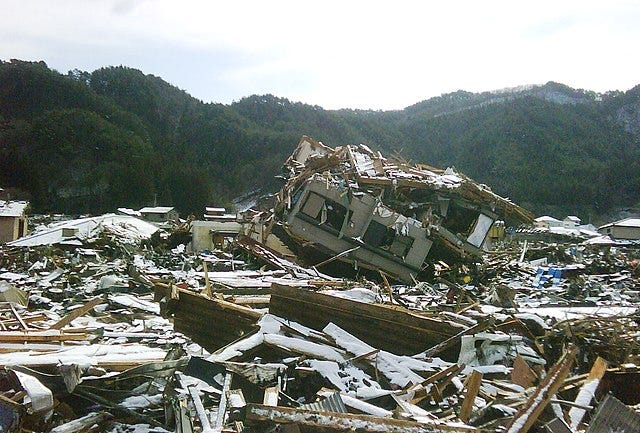
Destruction cause by the 2011 Tsunami | Source: Wikimedia Commons

Some people may also assume that they are murderers — that if anyone crossed paths with them, they would likely be killed. However, the members of Yakuza do not believe in killing unless their lives are in danger. Even with each other, they do not have a death penalty punishment, unless it is a very extreme case.

Where Are They Today?

Their numbers have significantly declined since the 20th century, from 184,000 members to 11,400 members as of 2022. Since the Anti-Boryokudan act of 1992, they are not as visible as they used to be, however they are still active in illegal activities.

Due to some charitable acts on their end, they are considered a necessary evil. For the Japanese state, they can control underworld activities if they want. In the underworld, the Yakuza is the topmost organization, and they have made their place at the top of the hierarchy.

Crime
Fear
Storytelling
Trending
Japan
Recommended from ReadMedium