
Stop Working Like An Industrial Age Worker
Longer work hours ≠ productivity
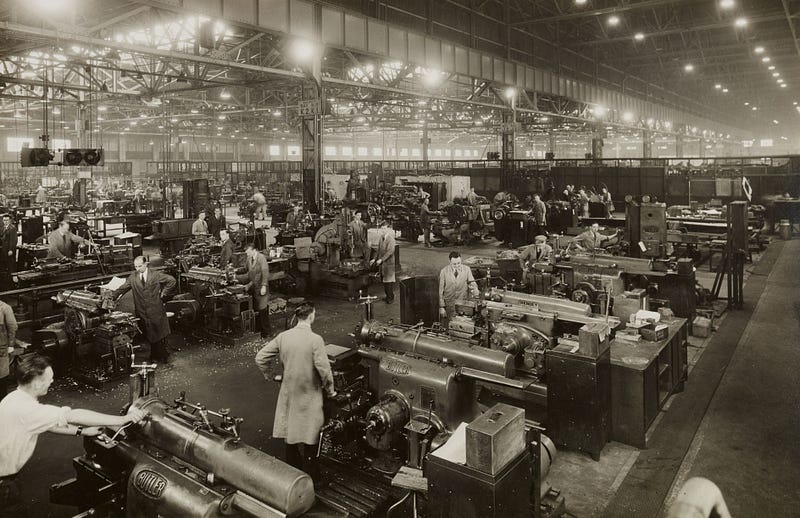
Our ancestors in the 19th century used to work 14–16 hours a day, six days a week, because factory owners were reluctant to let their machines stop rolling. Productivity, then, was equal to how long workers worked at the assembly lines.
In the 21st century, we are supposed to have reached maximum productivity and produced better outcomes with advanced technology. Yet, we worked long hours like our ancestors during the Industrial Revolution.
Of course, modern days’ workplace condition is way better than those during the Industrial Revolution. But, surprisingly, we still work on average eight hours per day as our ancestors in the 19th century.
The history of eight-hour workday
In the history of the Industrial Revolution, a man named Robert Owen suggested that workers should only work eight hours instead of ten or more. He posited that workers should only work eight hours and use the rest for recreation and rest.
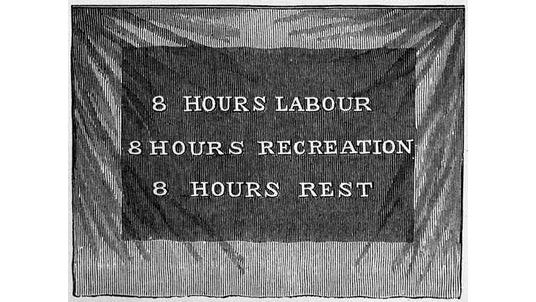
The campaign started in the 1810s and went on for decades before finally making progress in 1886 when workers held the first Labour Day parade to protest for the eight-hour workday.
The rest was history as it slowly became common practice or even regulation for most jobs to set their workhour at eight hours.
Modern workplace: The illusion of eight-hour work
The OECD reported the average work hour for an American is around 34 hours per week. But this statistic hardly reflects the truth as many employees leave the office on time but never get off work until they hit the pillows.
Technology innovation enables 24/7 connectivity, which contributes to involuntarily prolonged working hours. We check work-related emails and messages on the dinner table or replying work emails on weekends.
In other words, we trade our recreation and rest time for work. But is it worthy? Why do we still work like our ancestors from the Industrial Revolution era?
Productivity vs workhour
We are still working around the clock because we falsely believe that longer work hours are related to higher productivity.
While that might be true for a machine — the longer it works means, the more it can produce. But could we still apply this to human workers when production often requires skills, knowledge and experiences?
According to a study, the effect of workhour on productivity comes in two directions. When workers face a fixed set-up cost and a specified unproductive time, their productivity should improve with longer work hours. Besides, they produce more if longer workhour lead to better utilisation of resources. But humans are different from machines as fatigue would wear off productivity, and thus, prolonged workhour eventually lead to decreased productivity.
We are supposed to work smarter, not harder, so to say.
But, exactly how we could achieve higher productivity with fewer work hours?
The Illusion of Productivity
Not long ago, people still believe in the power of multitasking. I was one of the many fools who believed in multitasking. Indeed, some tasks are innocuous to conduct simultaneously, like listening to an audiobook while washing dirty dishes.
Many studies have shown that multitasking hurts productivity. In an article titled How Multitasking Erodes Productivity and Dings Your IQ, Steinhorst pointed out that an individual who multitasks has his attention spread thin between tasks. The more jobs he wants to accomplish at once, the less attention each task will get.
We only have that much attention to use at a given point, and our concentration ability reduces when we get tired.
The solution? Stop multitasking and focus on one task at a time!
What to do instead?
Prioritise Tasks Using Bullet Journal.
Designer Ryder Carroll developed the bullet journal, a methodology “ designed to help you organise your what while you remain mindful of your why” and to help you “live intentional lives, ones that are both productive and meaningful.”
You can learn more about Bujo (short-form for bullet journal) here:
Indeed, Bullet Journal helped me to stay organised and enabled me to prioritise my tasks.
I set my tasks for the next day in the evening as part of my evening routine. I will go through the tasks list again the following morning and decide which one is the ONE task that I must accomplish.
Then I use the Pomodoro technique to stay focused on the ONE task until I accomplish what I set forth yesterday.
There are, of course, a few caveats in this Bujo method to keep in mind:
- Write tasks in a specific and achievable manner. For instance, you need to prepare a PowerPoint slide for the upcoming training session. You can write your task for tomorrow using words like this, “outline the content, cover the first two topics.” In this way, you have a clear indicator telling you when you know you have accomplished the task — i.e. when you have outlined the content and covered two topics!
- Plan B thinking. Life is full of chaos, and we can’t control everything. Plan-B thinking could save us from spinning out of control and let those unfinished tasks get on our nerves. In Bujo, one can use “>” as a status indicator for an unfinished task. “>” on a task means I will update the unfinished task in the following day column.
- Avoid writing self-deceptive tasks. I get it; it feels good to slash out item after item on the to-do list. This slash-it-out spree is self-deceptive, not productive. Avoid at all costs writing those teeny-weeny tasks, like “put dirty laundry into the washing machine” or “walk the dog”. Your Bujo is supposed to help bring value into your life, and as Carrell mentioned on his website, Bujo is to help you to “live intentional lives, ones that are both productive and meaningful.”
Stay Focused For Your Priorities.
You don’t need innate talent to stay focused. Ironically, I often heard people telling me that they “are not good at staying focused”.
“Oh, You mean you get distracted easily?” I would reply.
A study at Harvard showed that most people have their minds wandering for approximately 47% of their waking time.
We deliver lousy results when we can’t stay focused on a task or work half-hearted.
I don’t rely on my self-discipline to stay focused; I use tools.
- The Pomodoro technique. The Pomodoro technique was developed by business consultant Francesco Cirillo in the late 1980s. I have been using this technique for many years, and it has helped me stay focused on my priorities. You can use this technique by setting a timer of 25-min. Then start the session without leaving the work until the time’s up. Give yourself a 5-min break from your work before beginning a new cycle. Have a long rest period after a few cycles of Pomodoro.
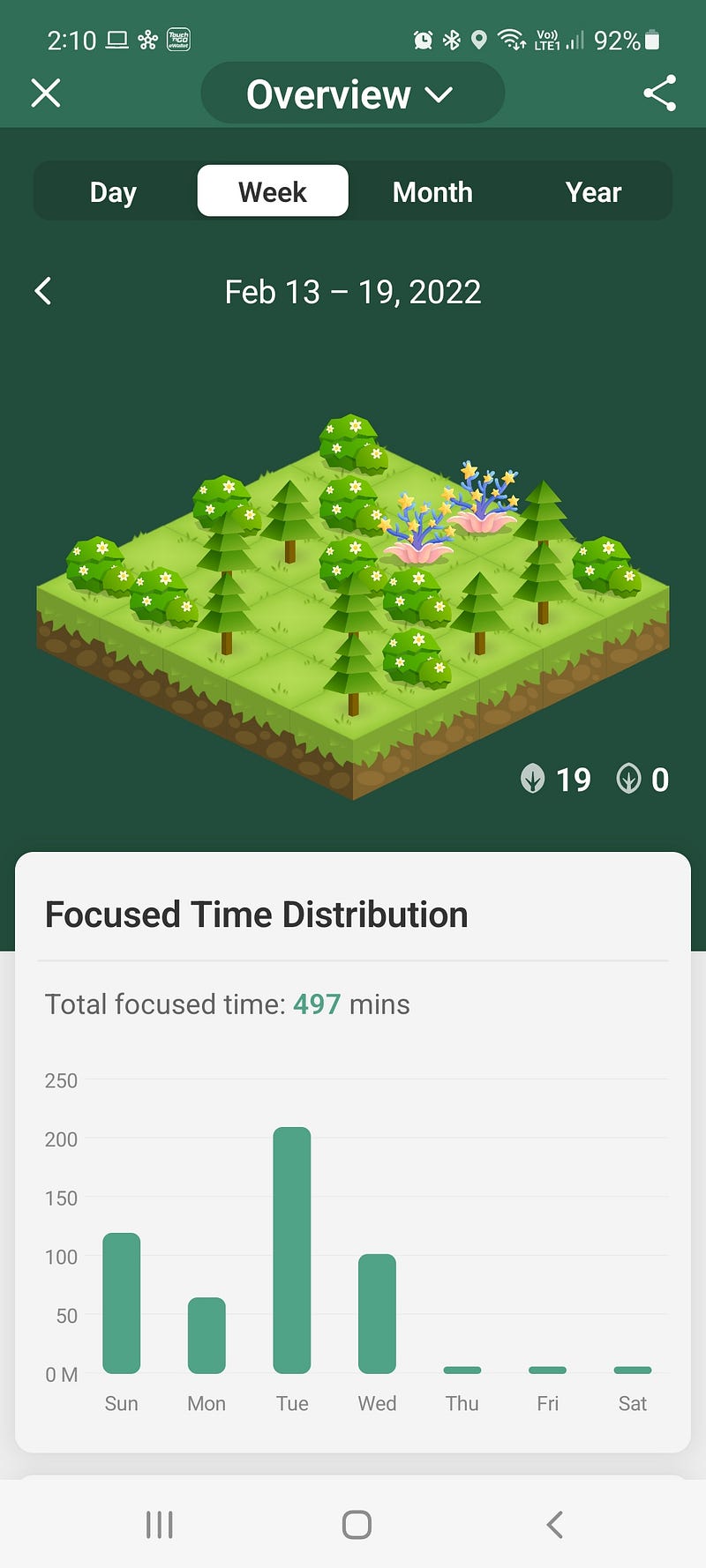
- Use mobile apps that help block distractions. Yes, I am aware that the most significant source of distraction is our smartphones. On average, we checked our smartphones 344 times a day. Yet, I would recommend you use your smartphone because it is a more reliable tool than we are. I recently used a focusing app named “Forest” to help me block all distractions on my phone so that I don’t have to smash my broadband router or terminate my data plan.
Conclusion
We need to ditch the mindset where more hours in work equals productivity.
Productivity in a modern workplace means staying focused throughout accomplishing our top priorities.
One could prioritise his tasks list by looking for the task that creates the most value instead of urgency. Bullet Journal is a great system that I have been using for years to organise my life.
The author “Grit: The Power of Passion and Perseverance”, Angela Duckworth, said human attention is a more valuable commodity than money.
Indeed, attention is what we need to get things done, but we all know how easily we get distracted. Yet, the solution might be as easy as installing a mobile app that blocks away distractions.
Our ancestors in the Industrial Age have worked hard to make life easier; now, we need to work smart to create a meaningful life. The first step is to learn to produce more by working less.