
Stop the merry go around … I wanna to get off
Understanding how the drama triangle is impacting your leadership and business

Have you noticed how often we complain about drama, to only be caught up in the next drama filled situation a moment later.
Drama feeds our ego.
We get caught up in the emotion and all too easily find ourselves slipping into roles, which if we calmly contemplated might be otherwise unacceptable to us.
From CEOs, administrative staff to Boards of Directors, we all have the same tendency to unconsciously engage in and even create drama. These interactions and dynamics can make us feel important. For some it might bolster a own sense of importance, power, control, or soothe our feelings of shame and accountability as we relinquish responsibility for ourselves by embracing victimhood. Sometimes drama is our ‘normal’: the environment in which we feel most safe and confident.
We manifest this dynamic– in different ways and with differing levels of frequency — in every aspect of our lives — personally and professionally.
Over two decades of leading global and domestic corporate, government and social gain organisations, I have learnt that our workplaces are some of the most drama filled spaces in our life.
From the dynamic around the board table, to team meetings, client interactions and market position, aspects of the drama triangle infuse every aspect of organisational life.
And If you stop and detangle conversations, actions and mindsets — I think you will start to see for yourself, how often you or others adopt one of the roles on the drama triangle and the impacts that it has had (and continues to have) on how the situation/decision unfolded.
What is the “Drama Triangle”
A social model introduced by Robert Karpman in the 1970s, the drama triangle illuminates destructive patterns of people in conflict.
In any conflict, there comes a moment where an individual, team or even organisation has the opportunity to engage, typically by assuming the victim, rescuer or persecutor role. In some conflicts, the evolving narrative and the roles others have embraced has the effect of typecasting or forcing participants into a role, even if they are endeavouring to remain apart from the dynamic.
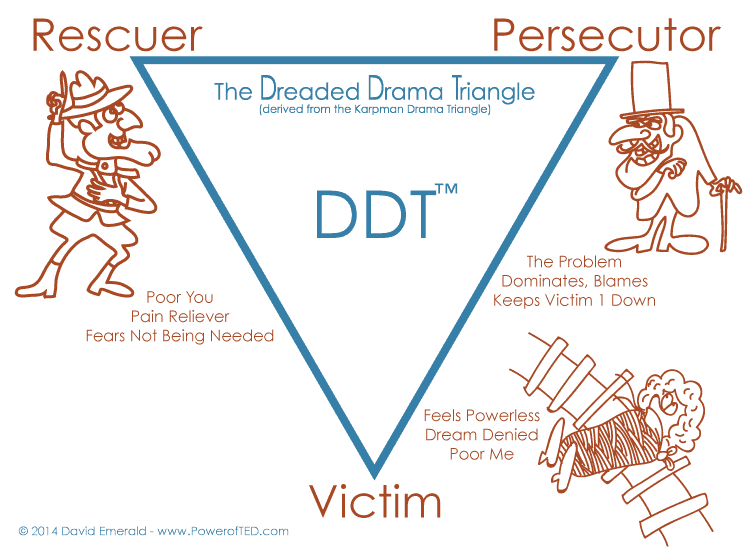
Sneakily, the dynamic of conflict can rapidly change, tipping participants out of one role into another before they have even realised that they have morphed into persecuting behaviour and mindsets instead of being in the victim role.
Recently, I was mentoring a individual (let’s call them John) through a particularly difficult conflict in the workplace between himself and another staff member (let’s call them Dianne).
Essentially, John, a relatively new staff member wanted to change how the workplace dealt with external client trauma based on his own lived experience of trauma, however Dianne, a veteran employee argued for the status quo due to their grounding in evidenced practice and globally accepted standards. The situation spiralled out of control when John had challenged Dianne in front of an external client, following up by telling the client post their clinical appointment that they could follow his advice contrary to the way things had always been done under Dianne. Dianne then wrote up some performance feedback and actively sought to have John placed on a performance management plan with very limited supervised contact with external clients, until such time as his performance improved or he was fired.
John bought a bullying and harrassment claim against Dianne and a formal internal mediation session was identified as the most appropriate next step.
In order to ensure the meeting between himself and staff member remained focussed and effective, another more senior staff member (Sue) was asked to facilitate the meeting.
However, unbeknownest to Sue, John consistently saw himself as a victim in the workplace and in life. So when faced with the victim persona adopted by John during the course of the meeting with Dianne (a confident communicator and assertive clinician), Sue unconsciously assumed the role of rescuer.
After the meeting Sue even went so far as as assuring John that his conduct wasn’t “all that bad” and that he“remained a highly valued member of staff”. However what Sue hadn’t realised she was doing was reinforcing the role of Dianne as the persecutor — even though objectively, Dianne was proactively doing everything she could to avoid this role and dynamic.
From my perspective as mentor, I had to intentionally call out John’s victim behaviour and the somewhat overt way he had manipulated the situation to his own ends, even though he truly believed he was the injured party. And of course my work couldn’t stop there.
Now that the dynamic had been conflated, my role as an organisational mentor and Trusted Adviser meant I had follow up work with both Sue and Dianne as well as with John.
This work included:
- understanding the meeting dynamic
- identifying their own role and triggers
- considering how they could have managed the situation differently
- determining next steps.
Staying out of the drama requires conscious mindful engagement.
It requires emotional and social intelligence and a willingness to undertake the necessary emotional labour to appropriately:
- assess your own and others’ needs/wants/expectations and triggers
- identify the dynamics at play
- remove yourself ie let go of your ego.
How to move past the Drama Triangle to the Empowerment Dynamic
You might ask — why? Why is this important? Why do I care and why should I change?
The answer is quite simply because it is not helpful or healthy for yourself and others — whether they be clients, co-workers, leaders or external stakeholders.
The empowerment triangle developed by David Emerald is viewed as the alternative to drama. This dynamic seeks to engage, empower and enable yourself and others to take responsibility and action.
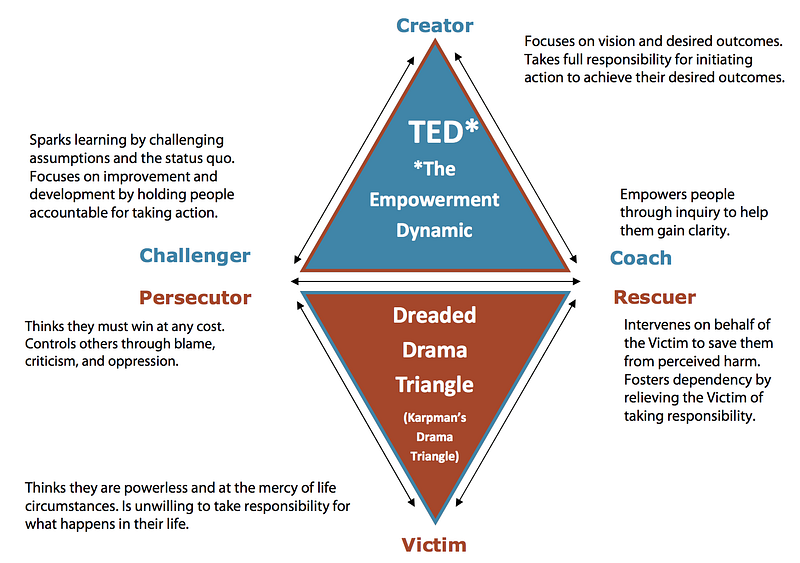
In the empowerment triangle, the focus is on empowering participants to effectively problem solve with responsibility, transparency and collaboration. As compared to Karpman’s model where participants are pushed to see themselves apart from one another Emerald’s empowerment dynamic builds collaboration and connection to resolve the conflict.
Unfortunately John was unable (and unwilling to attempt) to step away from his victimhood, which made resolving this and another series of conflicts impossible. Rather than confront his vulnerability and step into a dynamic that was simultaneously supportive, challenging and accountable, he instead chose to leave the employer.
However the experience both Dianne and Sue accepted the challenge of the Empowerment Dynamic and actively chose to dive into it, feet first. Working together, I helped them explore how the Drama Triangle was showing up throughout their respective teams, including in their clinical work with external clients.
As they peeled back the onion layers of their individual roles and dynamics, they identified how they triggered themselves and other internal colleagues especially given the organisational culture. From my perspective, I quickly realised that I had the opportunity to collapse the mentoring work I was doing with Dianne and Sue (and a number of others), into the Trusted Adviser work I was doing in a more holistic sense on trust and change.
Our organisations are riddled with perversions of the Drama Triangle and our lives, personally and professionally are typically drowning in a the backforth exhausting dynamics of victimhood, rescuing and persecution. How often do you hear yourself and others complain about exhaustion, stress and anxiety, and however often do you find yourself part of a toxic dynamic that is all drama and very little substance.
Dare I suggest that you consider Victor E. Frankl’s insight from his seminal work, Man’s Search for Meaning:
“When we are no longer able to change a situation, we are challenged to change ourselves.” — Viktor E. Frankl
Overt and yet unobserved, this dynamic is one of the greatest risks to both organisational and individual resilience and performance.
In this age of disruption, change and increasingly networked and connected global community — our individual and collective capacity for self-reflection, self-awareness and deep emotional intelligence will determine our and the organisation’s health, resilience and sustainable ability to successfully deliver timely and impactful services.
Isn’t time you got off the merry go round and chose to create a culture that strengthens resilience rather than decimates it?