
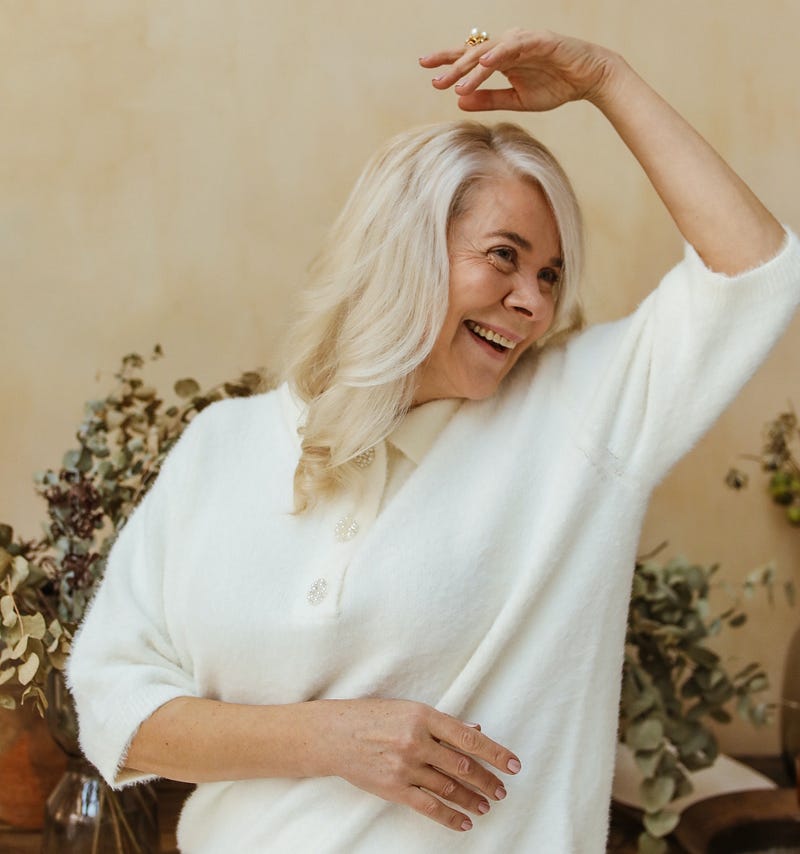
Stop Telling Older Women That They’re Invisible
It’s damaging to women’s physical, emotional, financial, romantic and sexual health
You might not know it if you met me now, but I was a shy, quiet, insecure, people-pleasing teen who didn’t think she had much to say. Although I started to bust out of that in my late 20s, it wasn’t until I was much older that I fully came into my own.
Like 47.
I was newly divorced with two young kids and a new full-time job that I loved but paid me what is considered extreme poverty wages around these parts. I had given up the safety and security of the life I had for 15 years for an uncertain future.
My former husband and I parted relatively amicably and we traded weeks having the kids. As much as I missed my two boys the weeks they were with their dad, I slowly came to appreciate having time all to myself —something I never had when I was married. I could do things I wanted to do when I wanted to do them with no apologies or guilt; I had time to care for myself. Despite how hard things were at times, this was a saving grace.
I tapped into an inner strength I didn’t realize was there, and developed a newfound lust for life and, well, lust. When I had time to myself, I worked through my baggage, nurtured my friendships, became a better mother and editor/writer, and dabbled in dating and casual sex focused on mutual pleasure— I was not looking to get back into a relationship anytime soon. When you don’t “need” anything from a romantic interest, you discover how freeing it is just to enjoy the moment and the person.
I had never felt more confident, interested and interesting, vibrant and juicy — just at the age when most men would consider me, a post-menopausal woman, invisible and irrelevant.
Excuse me?
I’m just hitting my prime and you’re going to tell me that I’m no longer desirable? That I have nothing to offer?
The truth is, I was and, at the risk of sounding full of myself, still am a decade and a half later. And I am not alone in feeling that way; many older women are enjoying relationships, casual or long-term, with men and, increasingly, women. More women in their 40s are having babies — surely they’re not all immaculate conceptions.
But beyond romance and sex, older women are increasingly appearing on magazine covers, advertising, fashion runways, in presidential elections (six Democratic women ran this year) — there even was an older woman (although 38 is hardly old!) cast on “The Bachelorette.”
So why do we continue to tell women that they become invisible at midlife?
Clearly we are not. However, we have a long way to go to fight sexism, misogyny and ageism.
And we must. From the research that I’ve begun to do on my book, I have learned that those messages are more than just a meme — they’re damaging to women’s physical, emotional, financial, romantic and sexual health.
Enough.
We need to change the narrative on a societal level, and on a personal level so we can age well and show younger women that becoming older is not a problem to solve. In so many ways, things get better. And we get better.
Women are now living well into their 90s and 100s; we are not going to spend more than half of our lives being dismissed.
When I first wrote about changing the narrative about who older women are, how we live and what we want, I noted that it took me four decades to ask myself for the first time ever, “Vicki, what do you want?”
I’m still figuring it out, but it damn sure isn’t being invisible or irrelevant.
Hey, I’m working on a book on changing the narrative about middle-aged and older women, “Not Too Old for That: How Women are Changing the Story of Aging.” Interested? Follow me here, on Medium, and on Twitter, Facebook or Instagram. If you want to support my work and have unlimited access to my writing and the writing of all Medium writers, please become a member here. And if you’re interested in changing marriage, please check out the book I co-authored, The New I Do: Reshaping Marriage for Skeptics, Realists and Rebels. You can support your local indie bookstore (please do) or order it on Amazon. We’re also on Audible.
For more of the good stuff, follow Fourth Wave, where we’re changing the world for the better, one story at a time. Got one of your own? Submit to the Wave!
For more by this author, try:


