Stop Sending Email and Get out the Stationery
The handwritten letter is a dying art
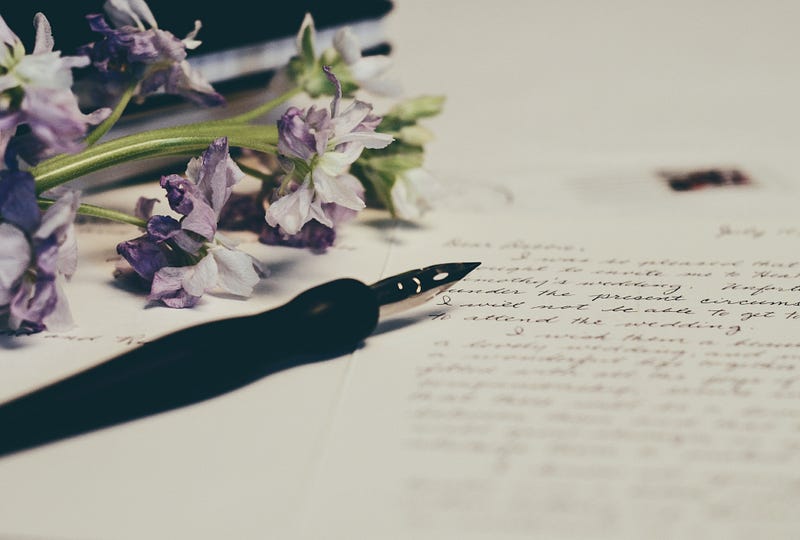
For Christmas, my daughter signed us up for one of those letter services. It is one of those deals where every couple of weeks you get a letter from history and an explanation of its context. The letters are in the original form, whether typed or handwritten and so it is pretty cool.
Old school that I am, I love the lost art of letter writing. An email does not have the charm of a handwritten letter that comes to your mailbox. An email is just pixels. It has no personality.
My father had a cousin whose wife wrote the loveliest letters. She was from South America but had lived in the United States for many, many years. She spoke in heavily accented English and sometimes her syntax was a little more like her native language than English; this came through in her letters so that when I read them, I could hear her voice in my head.
Her letters were never too long, never too short, and always made you feel you had just ended a conversation with her over a cup of tea. I treasured them and still have some of them.
There is something special about a letter that someone sat down in a quiet moment to write just for you… something personal.
In this age of email, don’t we always compose a bit cautiously? Isn’t there always the awareness that what you write could be shared, forwarded, downloaded? This is also true for letters, I suppose, but it somehow seems different.
When I was doing research a few years ago, I relied on primary sources for much of my information and this included decades of handwritten letters by my research subjects. What I loved about this was how much like the individual each letter always was. For example, Lyle Saxon was a journalist for the New Orleans Times-Picayune in the 1920s and 30s. His letters were often, but not always, typed, which made perfect sense. They always reflected his dry sense of humor and often made me laugh out loud. Sometimes his letters took me along on stories he was working on for the paper, like the 1927 flood. He wrote about life in New Orleans, in Baton Rouge, Mardi gras, and his work.
Lyle Saxon wrote letters to Caroline Dormon, a self-taught Louisiana botanist and naturalist who was well known in her day. Carrie Dormon was a former schoolteacher and extremely frugal. Her letters were almost always written on recycled scraps: the back of receipts, the back of other letters, whatever she found sitting about. Oddly, she often folded her paper in half, then half again, and then numbered the squares so you had to follow the numbers to read each section in proper order. She wrote about stories she was working on, painting she had done, but mostly about plants. She writes extensively about her cabin in the piney woods and the native plants she cultivated there. Sometimes her letters included pressed flowers, seeds, or leaves she wanted to share.
Ada Jack Carver was from Natchitoches, Louisiana, and was well known for her short stories in the 1920s. She was a lovely, fragile, stylish woman from a locally prominent family. Her letters were almost always handwritten, and it took me forever to get accustomed to reading them because her handwriting almost looked like calligraphy, filled with loops, whorls, tall spikes, and elegant curves flowing all across the heavy stationery she always favored.
And finally, the subject of my research, Cammie Henry, a patroness of the arts and a widow who opened her plantation home up to artists and writers of the day so they could come to work and create in the semi-tropical Cane River region of Isle Brevelle. Cammie was always busy: she had eight children, her husband had died, and she had this immense home which was a working cotton plantation and pecan orchard. Cammie did not spend her money on expensive stationery, and she had little time to compose long letters. Her letters are rushed, almost telegrammic. “Irises blooming! Come paint!” Sometimes she scratched them out with a pencil in one hand and a garden hose in the other.
These friends, Cammie, Lyle, Carrie, and Ada Jack wrote to each other frequently over many years and the letters were often shared among the group unless there were directions not to. “Read, then destroy!” I loved reading the letters because I felt like I knew these people when I was finished. I felt like I had spent time with them. I felt part of their group.
I cannot imagine email evoking this same feeling for anyone, ever. And think of the letters, the moments, the information lost to future generations by the practice of email. Nobody will have letters to hold in their hand to research or learn from because everything is digital. Who prints emails?! We read the quick, soulless note typed out and sent to us through fiber optics, then delete. Gone.
Some of my favorite books are collections of correspondence, like The Letters of E. B. White, for example.
For this reason, I will always have a soft spot for the handwritten letter, and I try to keep up the practice in my correspondence. Not that I think I have something so valuable to say that generations from now people will clamor to read my letters, but it has a bit more permanence, and it is certainly more personal.