
Your Routine Self-Assessment: A How-to Guide to Add Heathy Habits to Your Day
Before you start the chic, trending morning routine, take a look at the one you have established, whether you are consciously aware of it or not.
What is the very first thing that you do when you wake? What do you do after that? Is it what you want to be doing?
Regardless, start your self-assessment. This takes a mindful effort to focus on what you are doing so you can figure out what you would like to change. It’s important to come from a pragmatic point of view rather than one of judgement. You are simply an observer.
Ideally, this assessment lasts about a week. There is no additional task on your to-do list other than using your power of observation and some tools to help you record those observations.
Your Routine Self-Assessment
Notice your habits around your wake-up.
- Do you use an alarm? What kind of alarm is it, standalone or your phone? Do you hit snooze?
- What time do you wake up? How much sleep did you get the night before?
- Do you lie awake in bed before you start your day?
Notice the set of actions you take for your hygiene.
- How long do you brush your teeth? How much pressure do you apply to your teeth when you brush them?
- Do you shower? Or did you shower before your bedtime? Perhaps you do both?
- Do you have a skincare routine? If so, what kind of products do you use?
Log what foods and beverages you consume.
- Whether you use MyFitnessPal, CarbCounter, MyPlate, Ate Food Journal, or even just a pen and paper and just take pictures of the food you eat…start tracking what goes into your body (no, this isn’t forever).
- Log how you feel after each meal/snack, no matter how short, i.e. “felt bloated” or “energized.”
- Start noticing the pattern of the types of food that you eat, and log that in whichever way you prefer.
Track your movement throughout the day.
- No, this does not mean just track your workouts. It means movement overall.
- Notice your attitude around movement. How do you feel after a walk or before one?
- Walking during the lunch hour at work, parking further from the store entrance, pacing during a phone call…this is movement. It does not need to be a scheduled workout at the gym.
- You can take notes on your movement habits on the notes app on your phone, use data from a wearable device, or even just take a picture every time you move your body.
Take note of how your mood and stress levels fluctuate throughout the day.
- When you wake up, are you anxious to start the day?
- When you are at work, do you dread going home?
- Maybe you sit in your car in the parking lot, gathering the courage to show up today?
- It is helpful to journal your moods at this part of your self-assessment.
- If you have thoughts of suicide, please use the Suicide and Crisis Lifeline: 988.
Do some self-reflection of your sense of purpose.
- Do you know why you were put here on earth?
- Oddly enough, most people cannot answer that.
- Studies show that people with a sense of purpose and belonging live longer, healthier lives, but many humans in the modern world find themselves lost with feelings of overall helplessness and discontent.
- Are you doing what you want to be doing on a daily basis?
- What are goals that you want to accomplish in the next month, three months, six months, year, three years, etc.?
- You may also want to journal for this part of the self-assessment.
Notice your habits around your bedtime.
- Does your mind race the moment your head touches the pillow?
- What time do you go to bed?
- What are you doing before you fall asleep? Watching TV? Reading? Scrolling?
- Do you eat around your bedtime?
- How do you feel when you wake up? Do you immediately reach for coffee or have breakfast first? Do you have morning malaise?
- You may also want to observe what kind of sleeping environment you have. Is your bed comfortable? Is your bedroom dark or well-lit?
All of these actions are a part of an intentional, mindful assessment of what you do regularly. This sounds like a lot, but there is no better way to move forward than to assess where you’re starting. This step is important because you really get to identify what you are doing consciously and unconsciously. You may find that you have to keep doing some tasks you currently do throughout the day but also have some self-sabotaging habits that linger around for no good reason.
Our bodies have the intelligence within us to respond accordingly to what we eat, how we live, and what we feel. If we continually give our bodies inflammatory foods along with our inflammatory schedules, we will continue to grow sicker, fatter, more anxious, and more depressed.
Let’s get into some habits that you may be doing that could be working against you. You might be doing one or even all of them.
You’re not prioritizing your rest.
You probably have so much on your plate that getting to bed before 11 P.M. seems impossible. You wake up tired. You go to bed exhausted or you stay wide awake, waiting desperately to fall asleep.
Nevertheless you push through. You do the fitness class because it is the “right thing” to do instead of doing more restorative movement. You stay up late working or unwinding from the day with devices and/or alcohol.
Whether you are the person who needs nine hours of sleep or the one who only needs six and a half, you have to make this a priority or it just will never happen. There has to be something that you can let slide so you can make it to bed or simply just recover your body from the hard work you put on it over the week. You know what that is.
If no one has told you this, then I will: you are not lazy if you sleep.
Quick tip: assess what you are doing before bed; push one or two of your more menial tasks that you do late at night to the morning or a break at work.
You’re relying on caffeine/stimulants.
The Food and Drug Administration recommends no more than 400 milligrams of caffeine in a day, which comes out to be four to five cups of coffee. The average daily consumption of caffeine by adults in the U.S. is about 300 mg per person, which is about three times higher than the world average, according to the American Academy of Sleep Medicine.
Even if you have only two or three cups a day, you may be relying on that afternoon pick-me-up to get you through the rest of the work day, a habit that Americans have picked up over the years with high work demands and competing personal interests.
Sure, coffee and tea reduce appetite and have been linked to healthy aging and weight loss, but relying on stimulants to get you through the day can disrupt your sleep if taken too close to your bedtime (wait at least 6 hours, though many argue for 8), and drinking it immediately upon waking could cause issues with excreting cortisol, your stress hormone, because it is at its highest when you wake up. Waiting an hour after waking lets your cortisol reach that natural pattern of rise and fall.
Quick tip: drink water after you wake up to re-hydrate your body after a night’s sleep and delay your caffeine intake by at least an hour upon waking.
You snack a lot.
As much as I love a tasty afternoon treat, the snacking epidemic that exploded in the modern era led to a habit of overindulgence. According to the Frontiers in Nutrition Journal, the American caloric intake increased 18% from 1909 to 2010. Another study published in January 2022 showed that over a period of 10 years, 51% of test participants gained 5% or more body weight, 36% gained 10% or more, and 16% gained 20%.
While there isn’t really an issue with grabbing an afternoon snack a few hours before dinner, your body can start to develop digestion and blood sugar balancing issues when you regularly do not give your body the time to digest the food you just ate. Your body does not reach a post meal state until about four hours after eating and a fasted state until about six hours.
Quick tip: prioritize your protein intake to maintain satiety.
You don’t balance your meals.
This one is linked to your snacking habit. Each meal has to be balanced in macronutrients if you want to be satisfied in between meals so that you can avoid snacking! Unfortunately, this habit leads to blood sugar issues (to be discussed later) that wreaks even more havoc on your endocrine and digestive systems.
An easy way to do this is: Protein, Fat, Fiber; 40–30–30. Be sure to have each meal consist of 40% fiber/carbohydrates, 30% protein, and 30% fat. I’m also going to take this as an opportunity to say that your food sources matter. You can eat as little as you would like, but if all you eat is cheese, crackers, and cookies, you might be in trouble if you are not suffering already.
Quick tip: have a veggie starter then work your way into your proteins, fats, and lastly, your starchy carbohydrates.
You overindulge on the weekends.
Sometimes we forget that the weekend is about 40% of the week, a fairly significant portion of our time eating particularly palatable foods. It takes days to recover from rich meals and alcohol indulgence, so by the time we do, it is happy hour on Friday already.
This is not to say that you should never indulge, but it is a vital part to your self reflection. Certain foods and activities ought to be considered treats, but if we give ourselves a “treat” everyday, then it is just a part of our daily routine than anything special.
Quick tip: choose one to two meals over the weekend to indulge instead of the entire weekend, ideally make them the times you have to go out to eat.
You don’t move throughout the day.
Even if you get that extremely tough workout done at the end of the day, if you spend the majority of it sitting at a desk then do an intense HIIT class, you’re likely not getting the most you can get out of that movement. Sure, it is better than doing nothing at all, but being sedentary for hours at a time is linked to several lifestyle-related diseases, i.e. cardiovascular diseases, obesity, diabetes.
While you don’t need to move every second of the day, it is important for your circulation and metabolic processes happening inside your body that you are moving regularly. Your body will see that one HIIT class as a huge stressor, especially if your day is stressful already.
Quick tip: park further out at the store parking lot, take a call on a walk, get a mini trampoline for the living room to watch your shows, try a new dancing video, join a gym with movement you’re curious about like Jiu Jitsu or Muay Thai.
You overexercise.
Maybe you move too much. You are into all the wellness and fitness trends, so you find yourself doing your 12,000 steps a day along with leg day three times a week on top of your boutique fitness classes you take the other days of the week. It’s wonderful dedication, but you really can have too much of one thing. Your metabolism follows the Goldilocks rule — everything has to be just right.
Prolonged overexercise can lead to weight gain (so unfair, I know) amongst other health issues like trouble sleeping and fatigue.
Quick tip: start doing a mindful cooldown after a workout or trade that hard HIIT class for a Yin yoga flow.
You’re stressed out, burned out, and feel like you can’t recover.
Your schedule is packed. You work, manage your household, take care of kids or elderly relatives, have family drama, and feel like you have no time for yourself. You also probably have no stress outlet or have habits that may seem like they relieve stress but actually cause more.
Your body has two parts to your nervous system: your sympathetic nervous system and your parasympathetic nervous system. Your parasympathetic system is your “rest and digest” response. Your body is relaxed. Your heart rate and blood pressure lower, and your digestion is strong.
On the other hand, under the sympathetic nervous system, your body is under a state of emergency, otherwise known as the “flight or fight” response. Your blood pressure and heart rate increases, your body breaks down the glycogen into glucose to rush to your muscles, and your digestion slows. Do this long enough, over time, and you’ll get a litany of chronic ailments from a suppressed immune system such as cardiovascular disease, obesity, chronic fatigue, diabetes, arthritis, etc. This is not to say that all stress is bad — positive stress, or eustress, helps your body improve mental and/or physical performance.
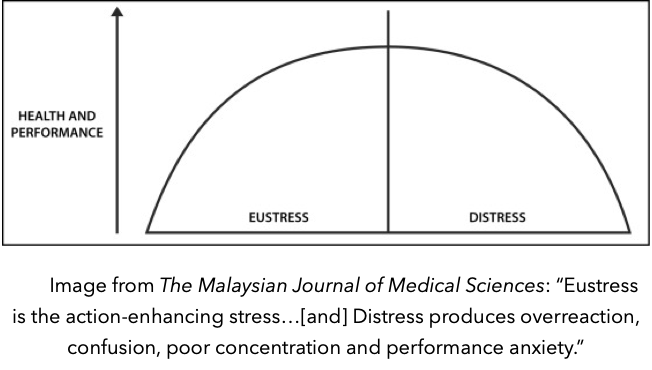
This short-term stress can come from a variety of sources like a high intensity interval training (HIIT) workout, ice baths, saunas, a new job, a life change or simply a roller coaster. In the image above, the middle line on the curve is your personal point in which your eustress becomes distress because, like all things, you can have too much of a good thing. You are probably familiar with the sentiment, i.e. planning a wedding while moving into a new house after getting a new puppy and finding out that your partner is pregnant.
The thing is, there are controllable and uncontrollable factors in this. We tend to get tunnel vision and think everything is going wrong, and there is nothing we can do. Therein lies the rub — there is always something you can do about it. From taking a breath or a pause during the work day to quitting your job and moving out of state, there is always a choice that you can make, even if that means just changing your perspective.
Quick tip: do a mindful 10 breaths, light stretch, and/or a body scan in the morning.
You are not part of a community.
Health cultivated in a community has such a profound impact on human health that the Center of Disease Control and Prevention (CDC) funded a program called the CDC’s National Center for Chronic Disease Prevention and Health Promotion (NCCDPHP) that funds programs that help communities promote healthy behaviors, such as the High Obesity Program (HOP), State Physical Activity and Nutrition (SPAN) and Racial and Ethnic Approaches to Community Health (REACH) programs.
While you do not necessarily need a government funded program to have a healthier community, start thinking about the energy of the people and activities that you invite into your life. Does a friend’s company bring you joy or leave you mentally drained? Does going home for the holidays every year make you feel included or outcasted?
The community that you have right now very well correlates to the habits you carry. If your friends are eating fried foods with sangria, you are most likely doing something very similar. On the other side of the coin, if your friends are going to yoga and drinking green juice, you probably make healthier decisions.
While not all cities and towns have the same accessibility in regards to pedestrian-friendly walking routes and fresh food markets, everyone does get to choose their own friends. Oddly enough, a person’s chances of becoming obese increases by 37% if they have a spouse who is obese, 40% if they have a sibling who is obese, but the probability magnifies to 57% if they have a friend who becomes obese in a given amount of time. All this shows is that the company we keep has a profound effect on us. If your friends encourage you to consistently make poor decisions, it may be time to start finding new ones.
Lastly, community is not just your close friends and family. Studies show that we are happier and feel more connected when we engage in minimal social interaction with strangers. This means striking up a conversation with the person who sits next to you on the plane or smiling at the runner passing by.
However, it is a bit challenging these days as there is a general lack of trust of fellow citizens, and this trust is 71% less than it was 20 years ago. While there are many factors in play like geo-political instability and many staggering Netflix series about serial killers as your next-door neighbor, many Americans still hope for a better future.
Quick tip: invite a friend with similar goals as you have on a regular morning walk or make it your objective to be kind to at least one stranger a day.
You lack a sense of purpose/meaning.
This one is tricky because it is intrinsically linked to your mental health. If you are burnt out, there is little chance that you are looking into the deeper meaning of your life. While you don’t need to be spiritual or religious, humans tend to find overall satisfaction in their lives with a feeling of purpose. People with this sense of meaning in their lives tend make healthier choices and lead a lifestyle conducive to their version of success.
This may be one of the most important factors out of all issues listed. Without meaning, it will be a struggle for you make any sort of lifestyle change.
For some of us, this purpose is hidden in complacency, and others, in hardship. Both instances make it difficult to identify what we feel our mission is during our short time on Earth. Sometimes that mission is to raise children to the best of that ability. Other times that mission is to work our passion as much as we can. Whatever that is for you, that is a journey that you have to take alone.
You may want to embark on a journey of self-discovery if you do any of these actions that foster negativity (this is not a comprehensive list):
- Complain
- Gossip
- Lash out on loved ones
- Lash out on strangers
- Get jealous
- Lie
You might be thinking: it seems like all of us need this journey to discover meaning then. And you’re right…we do. We all have an area of our lives that will always be a challenge for us, but fostering negativity is the fastest way to lose sight of your purpose.
If you learn nothing else from this article besides realizing that you need to go on a soul-search and find yourself, then wonderful. There are plenty of resources I personally use on my journey that you may find helpful on yours listed below.
Books/Audiobooks:
- Break The Habit of Being Yourself by Joe Dispenza
- Think Like A Monk by Jay Shetty
- Happy Mind, Happy Life by Dr. Rangan Chatterjee
- The Gene Keys by Richard Rudd
- Transcend by Scott Barry Kaufman
Podcasts:
- Know Thyself by Andre Duqum
- The Highest Self Podcast by Sahara Rose
- It’s Fucking Spiritual by Rachel Gibler
Actionable tips:
- Walks in nature without technology
- Travel (even if it’s just to the next town over)
- Trying something new (outside of your comfort zone)
- Meditation/prayer
Save this comprehensive guide for later! It is a lot to take in! Maybe send this to a friend who is looking to make some lasting changes in their wellness routine.
Whether you are doing one or all of these habits, it does not mean you are doomed for poor health; rather, it means you have a choice. You can choose to make a change or not.
This is your life, and it is up to you to live it how you want it.