
The “Bi” in “Bisexual” Doesn’t Mean “Two Genders”
When I explain my bisexuality, I say that someone’s gender isn’t a dealbreaker when dating, that I can be attracted to them no matter what it is. Why? Because that’s a definition of bisexuality. (The cheeky explanation of “I’m attracted to attractive people” is also a personal favorite.) Without fail, though, people will retort:
“But ‘bi’ means ‘two.’”
This is the most used “gotcha” used to “prove” bisexuality is exclusive and binary — and one of my biggest pet peeves. “Bi” can be a misleading prefix to those unfamiliar with bisexual history (we’ve been describing bisexuality in terms of attraction regardless of gender since the 1970s). With context and the community around it, though, we can better understand it. If we only look at semantics (and ignored all other meanings for the prefix), “bi means two” is a no brainer, but identities aren’t just strings of letters. Even if they were, not every word is precise and literal.
Two Letters, Two Genders?
Centipedes never have exactly one hundred legs, and October isn’t the eighth month of the year. There are plenty of words that used to refer to specific numbers that don’t anymore, like “myriad” (previously “ten thousand,” now simply refers to a very large number), “quarantine” (previously “forty days,” now used for any period of time where people are isolated to prevent a disease from spreading), and “decimate” (previously “to kill one in every ten of [a group of soldiers or others] as a punishment for the whole group,” now just means to destroy in general). This obsession with the prefix in “bisexual” is foolish if you don’t also obsess over other Latin roots.
Even if bisexuality was ever historically defined as specifically “attraction to two genders” (it never was; a quick Google search — and then extensive historical research, if you’re up for it — would tell you that), insisting that it must always keep this definition is like saying that “they” can never be a valid singular pronoun because people haven’t always used it that way.
People can say “bi” implies “two genders” all they want, but people also say that “pan” implies attraction to everything, including animals (which it has been defined as in the past). Do we need to always align ourselves with the perceptions of people unaware of context, though? I don’t think so. Words change meanings. If they didn’t, we’d still call intersex people or unisex clothing “bisexual,” too.
Most organizations and activists currently define bisexuality as either “attraction to more than one gender” or “attraction to similar and different genders.” Both indicate attraction to all. The American Institute of Bisexuality — which also defines bisexuality as “regardless of gender,” “all sexes and genders,” and “love beyond gender” — makes this quite clear: “attraction to both same and different means attraction to all. Bisexuality is inherently inclusive of everyone, regardless of sex or gender.” It also states that “bi people’s attractions aren’t limited by sex or gender.” Even if some bisexuals refuse “all genders” descriptions, bisexuality itself is simply not inherently limited.
Camille Hotlaus points out in “The Future of Bisexual Activism” that “the ‘bi-’ in ‘bisexual’ refers to ‘self’ and ‘other.’ This usage is more in keeping with bisexual being part of a spectrum that includes heterosexual and homosexual, since the prefixes ‘hetero-’ and ‘homo-’ indicate ‘different from’ and ‘same as.’” The “two” that “bi” refers to then, isn’t a gender quantity but a reference to those two directions of attraction. Concluding that “bi” means “only two genders” instead of “attraction to similar and different genders” when compared to “homo” and “hetero” is illogical, and translating it to “both genders” only makes sense if one recognizes just one gender similar to theirs and only one different from theirs.
In “Bisexuality and Binaries Revisited,” Julia Serano proposes another interpretation of the prefix.
Here is another potential interpretation of the word bisexual: The prefix “bi” can mean “two,” but it can also mean “twice” (e.g., as in bimonthly). So while monosexual people limit their potential partners to members of only one sex, bisexual/BMNOPPQ folks challenge the hetero/homo binary by not limiting our attraction in this way, and are thereby open to roughly twice as many potential partners. My main point here is that the prefix “bi” has more than one meaning, and can have more than one referent. […] The bisexual-reinforces-the-binary accusation is an attempt to fix bisexual to single meaning, one that is an affront to how many bisexual-identified people understand and use that label.
We tend to focus heavily on language, especially in social activism. We should. It’s essential, and some of it could be more respectful than it is now. Still, we’re more than words, and the English language is riddled with enough holes as it is. Pedantic obsession with linguistics does little to improve social situations. Some people gloat about how inclusive their language is, yet never put effort into actually including people. What good does that do?
Etymology
Like “homosexual,” the word “bisexual” was not created by those to whom it applies. Its first use in an orientation context (it was used in other ways prior, primarily to describe a combination of “male” and “female” traits into one organism) came about in 1892, when Charles Gilbert Chaddock, a neurologist, translated Richard von Krafft-Ebing’s 7th edition of Psychopathia Sexualis into English. Psychopathia Sexualis is a collection of studies of sexual behavior that essentially claimed any non-procreative sexual acts to be perverse.
Like “homosexual,” the orientation “bisexual” (then “bi-sexual”) started as a pathological term. It described people who had both same-sex and different-sex (then simply “opposite-sex”) attractions, which was understood as a combination of hetero- and homosexuality (hence “both sexualities”) or attraction to “both sexes.”
It was picked up by Freud in the early twentieth century when he argued that all humans were innately bisexual — anatomically (essentially “part man” and “part woman”) and sexually — but became heterosexual through psychological development. Arguably, he also gave rise to the beliefs many still have about bisexuality today, most notably that it’s a stepping stone towards a more “stable” orientation (i.e., gayness or straightness).
One of the first reclamations of the word as a personal identity comes from Maggi Rubenstein in the 1950s, but the earliest reclamation that most are familiar with comes from Stephen Donaldson in 1966. Bisexuality did often mean “attraction to both genders” then, and yes, that does imply there are only two. But we must keep in mind this was simply a product of that point in history.
The binary model of gender was the only model Western psychologists knew (thus there was seemingly only one gender to have “opposite-gender” attraction to and one to have “same-gender” attraction to), and they defined sexual orientations to reinforce it and classify non-heterosexuals as mentally ill. It makes little logical sense to argue that “bisexuality” was ever previously defined as “attraction to two genders” when saying “two” rather than “both” implies the existence of more than two genders, which few Westerners in the nineteenth century believed. Nobody defines their attraction solely in terms of “attraction to one gender”; the “only two genders” definition similarly lacks useful information.
Regardless, the history of the word “bisexual” is not bisexuals’ fault. People reclaimed and repurposed it for community building and the pursuit of bisexual liberation. When we move on from semantics, we see that the lived experiences of bisexuals have permanently changed the label from its pathological origins. Arguing otherwise relies on prioritizing prefixes over history and the very people who use the word. A number of bisexuals feel the word they use is somehow limiting due to its perceived literal definition, but those concerns yet again show that bisexual attraction isn’t arbitrarily exclusive.
“I’m Bi, But Not Attracted to Wo/men”
A consequence of the “bi means two genders” declaration is the recent notion that bisexuality doesn’t require attraction to men or women — just “any two” genders. Some people claim bisexuality for being attracted to “men and transgender men” or “wo/men and nonbinary people.”
This shows a misconception about gender and excuses transphobic thinking. Transgender men are simply men, and “nonbinary” isn’t a third gender one can section off. It’s an umbrella term by which no sexuality can explicitly define itself by. All of them include some of us by default, just like they all include transgender people, even if certain individuals exclude us from their dating pool.
Keep in mind that this doesn’t mean one is actively attracted to every single identity out there; I don’t know how many exist (I doubt anyone does), but I do know that as a bisexual, gender isn’t a barrier to my attraction. I simply point out that nonbinary people who aren’t wo/men are a part of all sexualities and can only necessarily be taken in on a case-by-case basis, rather than one surrounding the identities themselves.
If someone says they’re only attracted to nonbinary people but not wo/men, they would have to exclude swaths of us anyway because nonbinary wo/men exist. Professing attraction to nonbinary men but not “actual” men is a bit nonsensical and possibly fetishizing. The difference between me (a nonbinary man) and someone who fully, exclusively identifies as male is negligible. We’re both men.
Furthermore, while the language around this sexuality has clearly changed, we must remember how gender and sexuality operate in our society. People first coined orientation terms to institutionally enforce heterosexuality. “Man” and “woman” are not merely individual identities — they’re in a systemic power dynamic. There’s a reason they’re assigned to us at birth, why men establish their masculinity through heterosexuality. As Monique Wittig remarks in her essay, “The Category of Sex,” “The perenniality of the sexes and the perenniality of slaves and masters proceed from the same belief, and, as there are no slaves without masters, there are no women without men.”
Sexuality, like gender, remains political, and whether or not someone is openly attracted to men or women (or, God forbid, both) determines how society treats them. This doesn’t mean nonbinary identities don’t matter, but we must acknowledge this. Sexuality labels predate widely conceived notions of nonbinary identity in the West.
Bisexuality, since the term came about over a century ago, has long referred to just two genders (we could say the same about heterosexuality, yet nobody accuses straight people of being binary). Still, the fact that those genders were “man” and “woman” holds extreme political relevance. The doctrine that men and women are opposites — thus so are gayness and straightness — renders bisexuality “impossible.” This is why society scrambles to erase us every time we pop up.
Lifting this rift between the two “acceptable” sexualities and genders gravely endangers the oppressive systems segregating them. This postulation has driven bisexual politics from day one. We cannot defang it and act like orientation terms are apolitical. I don’t experience oppression for my willingness to date a neutrois person — I experience it because I’m not straight. Biphobia happens to me because I like men and women.
Commenting on the pressure to explicitly include nonbinary people in discussions about biphobia, activist Verity Ritchie reminds us:
Parents don’t worry that you might date a nonbinary person, they worry that you’ll date someone whose gender appears to be “wrong”… I’m nonbinary, but my internal experience of my gender hasn’t had as much to do with my experience of the world as people might think. I was seen as a man — then later as a man dressed in women’s clothing — then as a woman. Whether I’m seen as a man or a woman has impacted my everyday life far more than the fact that inside I feel myself being neither. But when I date another nonbinary person, no one gives a flying fuck that we’re nonbinary. They worry about whether it looks straight or gay. It’s that duality that makes up my experience of bisexuality — there are no in[-]betweens. […] No matter that my experience of discrimination is based on the duality of man and woman, I have to say “nonbinary” to be inclusive, even if nonbinary really isn’t the issue.
While it’s understandable that some people wish to treat nonbinary identities as equally influential on one’s desire, adding on to the already oppressive system of gender seems like the opposite of what we should be doing. The term “bisexual” arguably stops being useful and erases the reality of biphobia if we say that “male and agender” or any other two-gender combination besides “men and women” (keeping in mind that bisexuality is not limited to people who identify as fe/male) constitutes bisexuality. Nonbinary identity, unfortunately, does not prevent patriarchy from gendering us, and it’s futile to pretend it does.
How “‘Bi’ Means ‘Two’” Gets Used In Transphobic Ways
Some bisexuals today do define their sexuality as “attraction to two genders.” However, this definition often relies on harmful rhetoric. Even if it were perfectly acceptable, we still cannot uphold it as the only one.
As the two main genders prioritized in this description remain “male” and “female” (for some reason), it reinforces the idea that it’s possible to not be attracted to nonbinary individuals. Some use this to further imply that it is fully acceptable to reject transgender people. These conclusions come from transphobic rhetoric and ignorance about nonbinary identity.
(Interestingly, most people who use this definition and acknowledge their attraction to men, women, and some unaligned nonbinary people, seem unable to identify which gender identities they aren’t attracted to — it’s almost as if nonbinary identities can’t be neatly divided into distinct gender categories, especially not when many of us see our identities as combinations or variations of the binary genders.)
Most people seem to use “‘bi’ means ‘two’” to either accuse bisexuality of transphobia or defend their professed lack of attraction to transgender people. Claiming that “two-gender” bisexuality excludes transgender people, however, is transphobic in and of itself as it implies transgender wo/men aren’t “real” wo/men. If it isn’t transphobic to only be attracted to men (which it isn’t; transgender men are included in that attraction), then it’s nonsensical to act like attraction to more genders would yield a different result. Saying that attraction to cisgender men and transgender men is “attraction to two genders” is similarly transphobic. It once again deems transgender men a different gender than cisgender men.
That said, significant issues remain with the idea of “attraction to men and women” excluding nonbinary people. Many of these issues are shared with the notion that bisexuality can exclude men or women; they stem from misunderstandings about what it means to be nonbinary.
As mentioned earlier, “nonbinary” is an umbrella term rather than merely a third gender, and some nonbinary people are also wo/men. All sexualities include some of us by default. (I talk more in-depth about nonbinary identity in regards to sexual orientation here. Taking these identities into account, it becomes more useful to navigate sexuality with a subtractive approach. As an example, lesbianism is attraction to women and a lack of attraction to male-aligned genders.)
Keep in mind that this doesn’t mean one is actively attracted to every single identity out there; I don’t even know how many exist, and all but two of them (male and female) societal framework. However, as a bisexual, gender isn’t a barrier to my attraction, so it doesn’t matter how many there are. Nonbinary identities unaffiliated with wo/manhood are a part of all sexualities. They can only necessarily be taken in on a case-by-case basis, rather than one surrounding the identities themselves.
Even someone doesn’t believe in nonbinary genders, there’s a chance they’ve found a nonbinary person attractive without knowing. The only concrete difference between “genderfluid” and “neutrois” and “bigender” people are the words they use to describe themselves — which is also the only thing these individual groups have in common. We can look and dress and act like anything.
For those who insist nonbinary people as a whole are simply unattractive, I must ask: How? Why? Do wo/men stop being attractive if you find out they’re also nonbinary? What is so wildly different about nonbinary people that makes fancying us unfeasible? What exactly do you think “nonbinary” means?
Speaking of which, Ritchie points out:
I have seen a few bisexuals online say “I’m not attracted to nonbinary people”, but when pushed on it they a) got that definition from pansexuals, not bisexuals, and b) actually mean they don’t fancy androgyny, which isn’t at all synonymous with nonbinarism, and just serves to perpetuate the idea that nonbinary people, women, and men should be conforming to their three respective gender expressions which… no.
“‘Bi’ means ‘two’” has led people to believe that
- One can be bisexual if, for instance, they’re only attracted to “men and nonbinary men” and
- Gay and straight people are incapable of being attracted to nonbinary people because then they’d be attracted to more than one gender.
Both mindsets are false. The first is problematic for the same reason that saying bisexuality can be “attraction to cisgender men and transgender men” is transphobic. One’s nonbinary identity does not negate any other gender(s) they may have. The second ignores nonbinary wo/men and the fact that nonbinary identity and gender variation have always been notable elements of non-heterosexual culture.
The push for “two” as a way to distinguish between bisexuality and pansexuality, in particular, encourages and validates transphobic misconceptions Many people in these discourses also neglect the reality of language. It doesn’t exist in a vacuum. Defining a label in a certain way can and does impact how we define others.
Is “Two (or More)” Ahistorical?
The “two” and “two or more” definitions are staggeringly recent and internet-based — which isn’t inherently problematic, but it’s most likely a result of people forcibly redefining bisexuality to reference its prefix. One bisexual interviewed for Bi Community News in 2015 points out that, when she came out as bisexual in the 1980s, “the ‘bi’ in bisexual didn’t get talked about as having some great limiting weight of ‘two’, it was an ‘and’ in a world that saw things as strictly either/or.” Another in the same article says, “Since I came out in the late 90s, I haven’t seen one bi activist organisation define bisexuality as attraction solely to men and women.”
Searching for the “two (or more)” definition myself, it’s essentially nowhere to be found — at least not in any literature archived online — until the 2010s. For the 1990–2010 screenshots, the pictured results are the only ones that pop up.
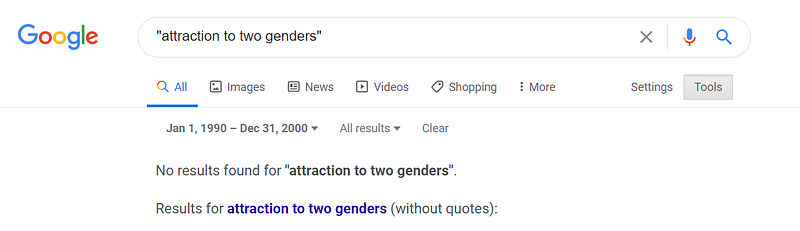
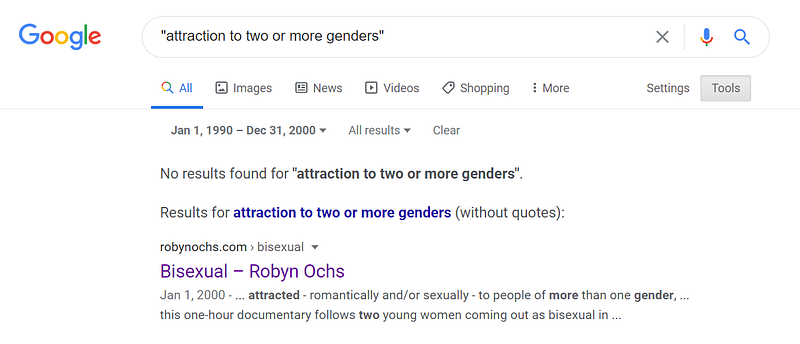
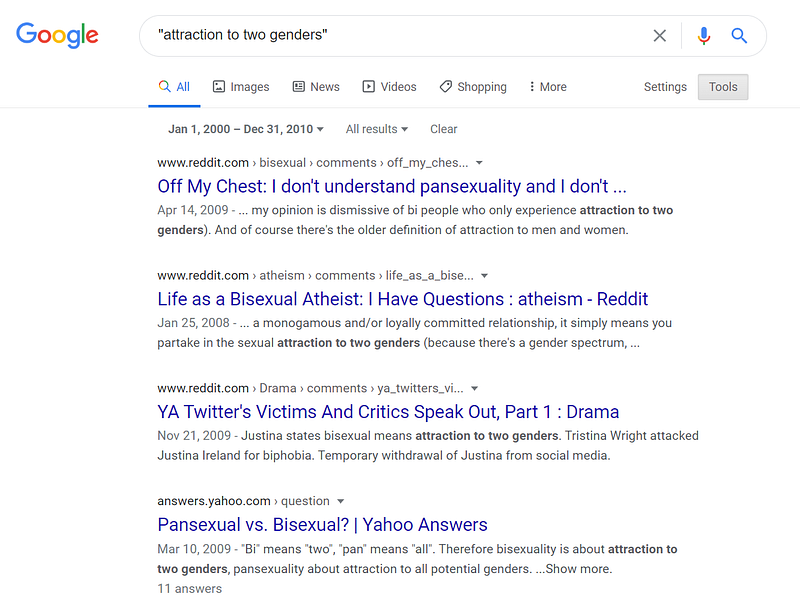
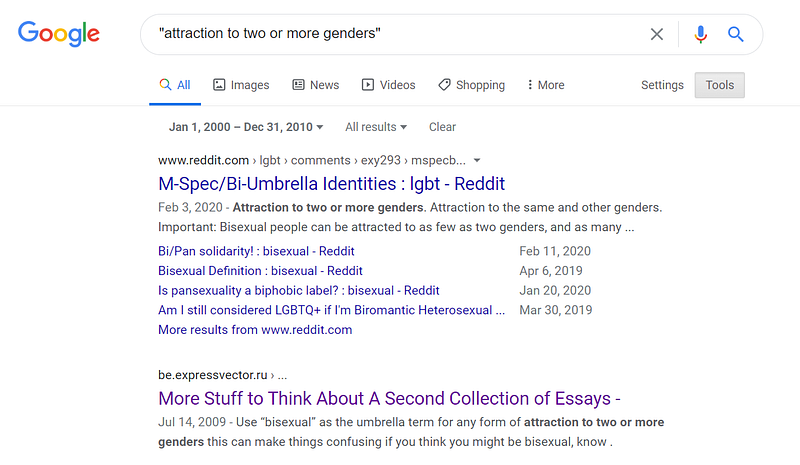

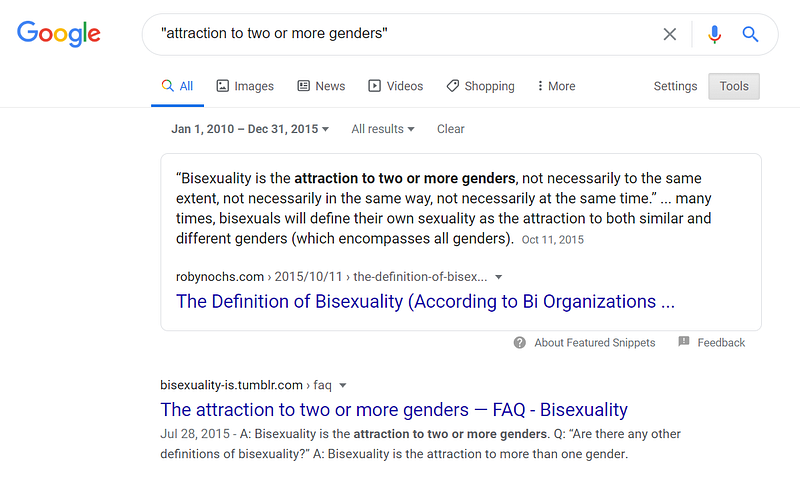
Note how the vast majority of the results are from internet forums. I’ve seen “two or more” exactly once in print, and it was in a book from 2018. I have yet to see a single bisexual organization or activist say bisexuality is attraction to “two (or more) genders.” It’s definitely possible at least one defines it that way, but the vast majority still don’t, and I highly doubt that any would list it as the only one.
One could also argue that “two (or more)” expresses the same concept of “more than one.” The fact remains that most bisexuals do not use the former phrasing — yet almost everyone insisting bisexuality is binary or limited does. It all goes back to “‘bi’ is ‘two.’” Not to mention, some bisexuals consider “more than one” too vague of a definition to be truly useful.
Bisexuality was only recently (and arguably forcibly) redefined as “two (or more)” to make way for other terms like “pansexual,” where many pansexuals insist that attraction to all genders is exclusive to their label. However, what people call “pansexuality” now was bisexuality then — and is still bisexuality now. If labels like “pansexual” hadn’t entered the mainstream, “attraction to all” and “attraction regardless” would likely remain the prevailing definitions of bisexuality.
The fact that it was largely the internet that shifted the way many people understand bisexuality is not a coincidence. Online spaces are very often insular. Isolation from real-life LGBTQ communities and history almost always causes people to hyper-analyze the only two things they have online: language and themselves. That’s why people started having these “if ‘bi’ means ‘two,’ then ‘bisexuality’ is ‘two genders’” conversations in the first place. You develop a rather warped, disconnected idea of things if your main (God forbid, only) source of information is Instagram stories or BuzzFeed articles.
Now, it’s important to note that history is not static. What we call “ahistorical” today will likely be history thirty years from now, and we don’t need to blindly obey tradition. That said, recognizing bisexuality’s political and communal past remains crucial. We have never stopped using our expansive definitions, and the shift from “both/all/regardless” to “two (or more)” largely happened from outside our community. Not only that, but the revisionism has gotten to the point where I now witness people confused about us “suddenly shoehorning” the “all” definition into bisexuality when it has always been there. That’s a huge issue.
Conclusion
Claiming that “bisexuality” necessarily boils down to attraction to only two genders — or even “not all” genders — depends on linguistic falsehoods, historical revisionism, misunderstanding nonbinary identity, and speaking over bisexuals. Even if bisexuality didn’t have such a history of including attraction to all genders, why wouldn’t we be able to claim that definition today?
Obviously, individual bisexuals will have a variety of definitions for their own attraction, and I am not saying that bisexuals who describe their sexuality in terms of “men and women” or even “cisgender people” aren’t “actually” bisexual. No single explanation of bisexuality will be universally agreed upon as The Official Definition. Still, it’s far more accurate to say that the “bi” in “bisexual” refers to “two variations of attraction” or “all available genders” rather than any arbitrary number. Language doesn’t determine who we are. We invented it, thus we can (and do) reinvent it all the time.
It’s gravely upsetting that bisexuals today will describe our bisexuality and get told that we’re wrong about ourselves. We’ve spent decades fighting for our label, for the right to describe ourselves on our own terms, for people to see our sexuality as a possibility. At every turn, though, someone’s there to deny our reality. Countless bisexuals suffer from internalized shame over their own attraction because of the lies others have fed them.
Trying to arbitrarily limit our sexuality spits in the face of decades of bisexual activism and perpetuates the dangerous lies that contribute to our stigma. If you aren’t bisexual, you do not get to define us.


