
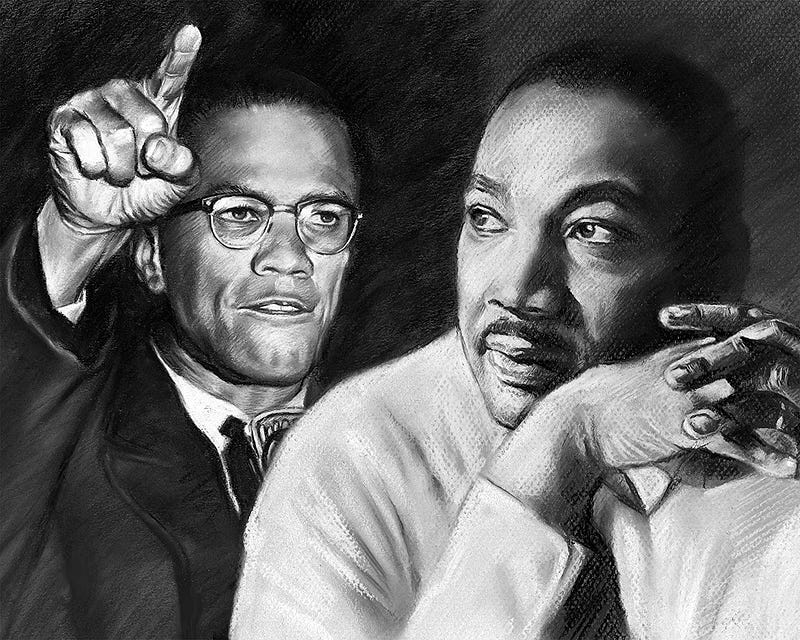
Stop “Pimpin” Dr. King & Malcolm X to Fit Your Narrative
It’s ignorant, uneducated, & neither of them would agree with you.
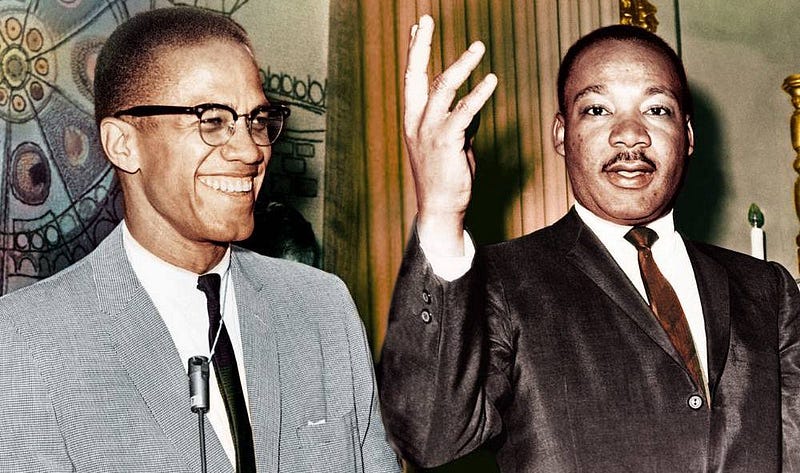
With all that is currently happening in America, I’m noticing a trend.
In the wake of divisiveness over COVID-19, and the killings of George Floyd, Ahmaud Arbery, Breonna Taylor, & Rashard Brooks, and the protests & riots taking place across the nation, social media has exploded with posts citing quotes from Civil Rights activists Dr. Martin Luther King, Jr. and Malcolm X.
There’s a major problem with this. Nearly all of these posted quotes have nothing to do with the calls for much-needed structural reform, or an end to systemic racism, or wealth inequality, or oppression that MLK & Malcolm X fought so hard for. Instead, they’re supplements to talking points and clickbait, more often than not from MAGA followers, right-wing think tanks, and liberal sympathizers, to somehow justify 45’s sentiments, undermine protests, and condemn riots.
It’s annoying, especially because it’s clear that these quote-spammers honestly have no clue about the real Dr. King and Malcolm X. To assume knowledge of their messages’ intended purpose without context is pure ignorance. It also undermines their messages.
It’s often assumed that Malcolm X was an extremist & domestic terrorist (which makes no sense why people would choose to quote him), while Dr. King was mild-mannered and amenable to reason.
Sadly, the Malcolm X that most have grown to hate has been whitewashed. The MLK that you’ve probably grown to love has been sanitized. Their rhetorical approaches have been cherry-picked & appropriated, forced into their respective legacies, and placed into our textbooks to cleanse America’s self-serving narrative. The same level of whitewashing explains the “Lost Cause” narrative, which claims the Civil War wasn’t fought over slavery & the Confederates only lost because they were outnumbered.
Let me make this perfectly clear, both Malcolm X and Dr. King were radicals.
“The question is not if we will be extremists, but what kind of extremists we will be. Will we be extremists for hate or love?”- Rev. Dr. Martin Luther King, Jr.
It is true that Malcolm X was, at times, critical of King. Regardless, they both fought hard for radical change. Unfortunately, their lives met the exact same fate just three years apart, and far too soon.
Consider these two quotes:
“Ignorance of each other is what has made unity impossible in the past. Therefore, we need enlightenment. We need more light about each other. Light creates understanding, understanding creates love, love creates patience, and patience creates unity. Once we have more knowledge (light) about each other, we will stop condemning each other and a United front will be brought about.”
“The majority of white Americans consider themselves sincerely committed to justice for the Negro. They believe that American society is essentially hospitable to fair play and to steady growth toward a middle-class Utopia embodying racial harmony. But unfortunately this is a fantasy of self-deception and comfortable vanity.”
The majority of people would attribute the first quote to Dr. King and the second to Malcolm X solely based on how their personas have been taught. This is incorrect. Malcolm X wrote the first in his letter to the Egyptian Gazette in 1964, and Dr. King wrote the latter in his 1967 book, Where Do We Go From Here: Chaos or Community?
“Let me make this perfectly clear, both Malcolm X and Dr. King were radicals.”
Rev. Dr. Martin Luther King, Jr.
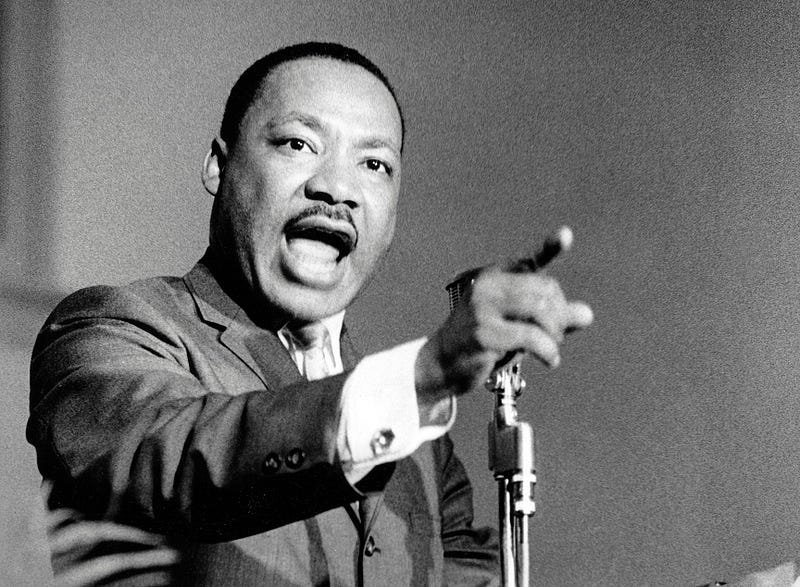
“The hottest place in Hell is reserved for those who remain neutral in times of great moral conflict.”
Martin Luther King, Jr., today, is the most quoted & revered Civil Rights leader in American history. His birthday is a national holiday. His name is mentioned in every call for civil rights action in the past half-century. His 17 minute “I Have A Dream” speech at the March On Washington is as infamous & iconic as the man himself. However, while Americans have shaped Dr. King as a martyr & a hero, it took years after his assassination for most to acknowledge him.
While he was alive, he was literally one of the most hated men in America.
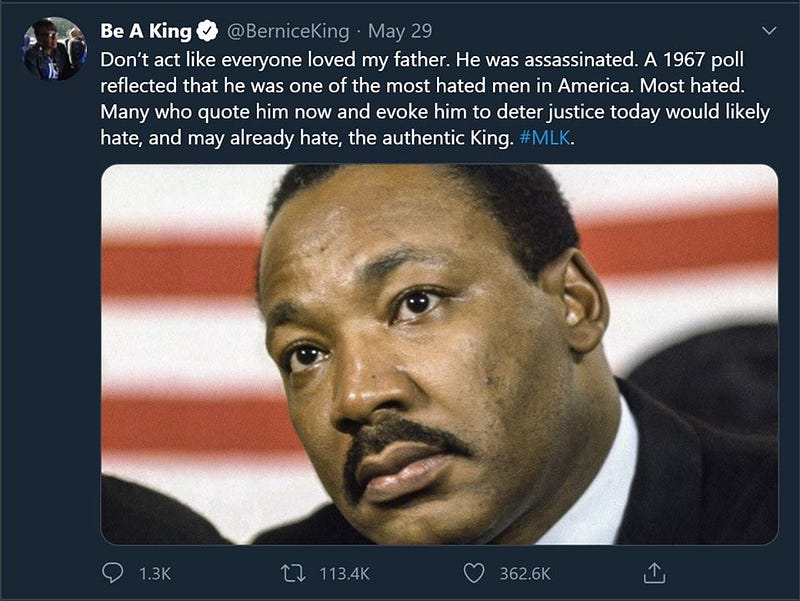
In a 1968 Harris poll, King had a public disapproval rating of 75%. Just one in every four people supported Dr. King in his final year of life. As heavily quotes as the “I Have A Dream” speech is today, even he understood years after that speech just how far his vision still had to go. He also recognized that he probably wouldn’t be around long enough to see his dream come to fruition.
“I must confess… that dream that I had that day has in many points, turned into a nightmare. Now, I’m not one to lose hope, I keep on hoping… but I’ve had to analyze many things over the past few years, and I would say over the past few months, I’ve gone through a lot of soul searching & agonizing moments, and some of the old optimism was a little superficial and now it must be tempered with a solid realism, and I think the realistic factor is that we still have a long, long way to go…” — Dr. King (1967, four years after his “I Have a Dream” speech.)
So much of King’s ideology has been misappropriated, taken completely out of context, wrongfully purposed, or simply ignored. Remember, King was a radical. Most people recognize Dr. King’s work in promoting equity, but have no idea about his most controversial positions.
Dr. King advocated for a guaranteed income, a stance that he outlined in his previously mentioned book, and one that many that have quoted King’s peaceful stances recently would probably be against. He was very openly critical of capitalism, the fiscal ideology of the Republican Party, due to its history of overwhelmingly exploiting black people and the poor.
“Again we have deluded ourselves into believing the myth that Capitalism grew and prospered out of the Protestant ethic of hard work and sacrifice. The fact is that capitalism was built on the exploitation and suffering of black slaves and continues to thrive on the exploitation of the poor — both black and white, both here and abroad.” — Dr. Martin Luther King, Jr.
When he died in 1968, he was working on the “Poor People’s Campaign,” another march in D.C. geared to shed light on a wealth inequality gap that nearly 60 years later, still hasn’t changed. Dr. King did not appreciate the government’s willingness to throw large sums of money at big businesses that exploited Blacks for profit and political power, all while neglecting those in poverty. This same government decades earlier engaged in a Civil War out of economic policy over slavery and not the morality of holding black people captive, then subsidized former slave owners and never the newly freed Black people. This enraged King. His outrage at government actions was non-partisan, as both Democrats and Republicans contributed to the exploitation.
You know the “pull yourself up by your bootstraps” phrase? King’s not a fan.
“Through an act of Congress, our government was giving away millions of acres of land… in the West and the Midwest… which meant that it was willing to undergird its white peasants from Europe with an economic floor. But not only did it give the land, they built land-grant colleges, with government money, to teach them how to farm; not only that, they provided county agents to further their expertise in farming; not only that, they provided low interest rates in order that they could mechanize their farms; not only that, today, many of these people are receiving millions of dollars in federal subsidies not to farm, and they are the very people telling the Black man that he ought to lift himself up by his own bootstraps.”
Dr. King’s most controversial stance, however, was his opposition of the Vietnam War, and how America’s political “obsession” with the war was taking away from social justice and anti-poverty efforts at home. King’s attack on the war went against the wishes of the NAACP. King saw hypocrisy in a country that weaponized its desire to spread “democracy” around the world yet never fully granting it to its own citizens. With his harsh criticism, he openly defied the Civil Rights establishment, the administration of President Lyndon B. Johnson, and even his closest advisors.
“Perhaps the more tragic recognition of reality took place when it became clear to me that the war was doing far more than devastating the hopes of the poor at home. It was sending their sons and their brothers and their husbands to fight and to die in extraordinarily high proportions relative to the rest of the population. We were taking the black young men who had been crippled by our society and sending them eight thousand miles away to guarantee liberties in Southeast Asia which they had not found in southwest Georgia and East Harlem. And so we have been repeatedly faced with the cruel irony of watching Negro and white boys on TV screens as they kill and die together for a nation that has been unable to seat them together in the same schools….”
King was labeled a communist, and went on to spend the final year of his life detested by the Liberal Establishment due to his denouncement of the war.
Nearly everyone knows Dr. King’s peaceful protest stance, but not so much the fact that his “peaceful” demonstrations were often acts of civil disobedience.
“One has a moral responsibility to disobey unjust laws.”
King was arrested 29 times for acts of civil disobedience & other petty crimes. His demonstrations were often met with violence. He was stabbed at his own book signing. His camp was pelted with rocks in Chicago. His Birmingham Campaign was met with police clubs & fire hoses. His brother A.D. King’s house was bombed. The Sixteenth Street Baptist Church was bombed by the KKK, killing four young girls. No Klansman was tried until 14 years later.
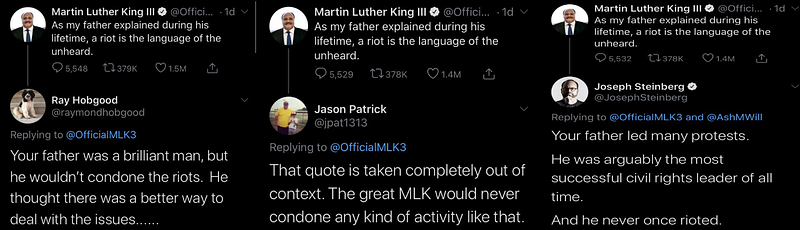
Despite the violence, King persisted. He did openly condemn riots, as the race riots of 1967 struck 159 different cities. But he also stated, in the same exact speech, that “a riot is the language of the unheard,” showing empathy for those who were hurting and didn’t know how to properly voice their frustrations.
Not actually having knowledge of the real Dr. King is troubling, but what may even be worse than the misinterpretation of his messages is this…
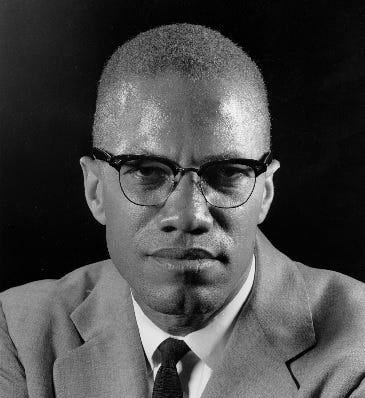
Malcolm X
“There is no better than adversity. Every defeat, every heartbreak, every loss, contains its own seed, its own lesson on how to improve your performance next time.”
For decades, people have been fed a false narrative on Malcolm X. He is the most misunderstood activist in our history. His father was murdered by White supremacists when he was six, and his mother was placed in a mental institution before he reached 13. He converted to Islam in 1950, and denounced his oppressor-based surname. They labeled him a perfect villain, a demagogue who fostered hatred & divisiveness in his teachings and should be written out of history.
Malcolm never taught or provoked violence of any kind. However, he found demands for Blacks to commit to non-violence hypocritical, especially when they were constantly on the receiving ends of violence by people and by the state. He advocated for Black people to be able to defend themselves in the face of violent altercations from whites that occurred daily.
“Concerning nonviolence, it is criminal to teach a man not to defend himself when he is the constant victim of brutal attacks.” — Malcolm X
Add this common misconception, as well as his calls for Black unity against injustice, to the fact that his position was dangerously threatening to the White political establishment, and you have the man who garnered a full detail, a wiretap, and a 10,000 page file from J. Edgar Hoover’s FBI.
The most common misunderstanding in the message of Malcolm X is that he fueled racism in his own people, when in reality was fueling his own people to unite against the racism they faced, as well as the internalized racism that crippled them and left them open to constant oppression. Overcoming internalized racism was paramount to achieving liberation.
His message was aggressive, but necessary: bring Blacks together against its oppressors in a time when those oppressors sought to teach Blacks why they should hate themselves.
“Who taught you to hate the texture of your hair? Who taught you to hate the color of your skin, to such extent that you bleach, to get like the White man? Who taught you to hate the shape or your nose & the shape of your lips? Who taught you to hate yourself, from the top of your head, to the soles of your feet? Who taught you to hate your own kind? Who taught you to hate the race that you belong to, so much so that you don’t wanna be around each other? No, before you come asking Mr. Muhammad does he teach hate, you should ask yourself who taught you to hate being what God gave you.” — Malcolm X
His message was simple, you are enough to invoke real change in the world. Malcolm’s message was one of racial equality, human rights, and pan-African solidarity.
“Nobody can give you freedom. Nobody can give you equality or justice or anything. If you’re a man, you take it.” — Malcolm X
Malcolm X’s “Black Nationalism” was often viewed to be directly parallel in ideology to that of White Nationalism & White supremacy. White Power is color superiority that deemed any other race inferior. Black Power was about having pride in one’s African roots to steer Black people away from the constraints of their oppressors, and to bring the race together as a whole, even if that meant that Blacks and Whites needed to be separated from each other. He spoke out on the “white flight” that occurred after Brown vs. Board of Education in 1954. However, the separation of Blacks & Whites in the eyes of Malcolm X meant that each race controlled their own means.
“To him, segregation, as we’re taught by the Honorable Elijah Muhammad, means that which is forced upon inferiors by superiors. A segregated community is a Negro community. But the white community, though it’s all white, is never called a segregated community. It’s a separate community. In the white community, the white man controls the economy, his own economy, his own politics, his own everything. That’s his community. But at the same time while the Negro lives in a separate community, it’s a segregated community. Which means it’s regulated from the outside by outsiders. The white man has all of the businesses in the Negro community. He runs the politics of the Negro community. He controls all the civic organizations in the Negro community. This is a segregated community.
We don’t go for segregation. We go for separation. Separation is when you have your own. You control your own economy; you control your own politics; you control your own society; you control your own everything. You have yours and you control yours; we have ours and we control ours.”
Contrary to popular belief, Malcolm X and Dr. King were not polar opposites. Malcolm respected King as a “fellow leader of our people,” despite disagreeing with King’s messages of nonviolence. “Dr. King wants the same thing I want. Freedom,” Malcolm stated. His only other opposition to Dr. King was in his lobbying for Blacks to be separated from Whites in society.
Malcolm began distancing himself from the Nation of Islam in 1963, as he became aware of Elijah Muhammad’s extramarital affairs, and stated that he had been “blinded” by its rigid teachings. He officially left the Nation of Islam in March of 1964, and took a pilgrimage to Mecca in April that changed much for him, including his name, which became El-Hajj Malik El-Shabazz. His vision evolved, and his evolving political and religious stance moved him further away from the Nation of Islam. His new movement sought to gain international attention.
“For the Muslims, I’m too worldly. For other groups, I’m too religious. For militants, I’m too moderate, for moderates I’m too militant. I feel like I’m on a tightrope.”
Malcolm began tackling broader issues after leaving the Nation. He became an advocate for women’s rights and interracial marriage, and embraced the possibility that one day, people of all races may be able to come together against injustice and oppression.
Malcolm’s final year was filled with death threats and FBI surveillance. The legendary image of Malcolm looking out of his window while holding an M1 Carbine rifle is often misused and captioned “By Any Means Necessary.” While Malcolm did say “freedom by any means necessary” in an earlier speech, the image was not a call to arms for Blacks to start using force. The image was taken in September 1964, as a warning against the constant death threats Malcolm had received by members of the Nation of Islam. His house was firebombed a week before his death. The bomb was thrown in the nursery where his children slept.
Malcolm was killed on February 21, 1965. He was shot 20 times. The Smithsonian documentary “The Lost Tapes: Malcolm X” provides a no-narrator view of Malcolm’s story and his life. The Netflix documentary “Who Killed Malcolm X?” exposes the facts that only one of the three men arrested for his murder was actually present, that the shooter was never arrested, that the FBI had nine informants present at the Audubon Ballroom that day, and that both the NYPD and the FBI were complicit in his killing.
Dr. Martin Luther King, Jr. was killed three years later, on April 4, 1968. Prior to Malcolm’s death, Dr. King began to echo and articulate some of the positions that made Malcolm X highly detested and unpopular. Their similarities far outweighed their differences. The messages of Malcolm X and Dr. King began to merge into one.
They were both 39 at the time of their assassinations.
“As concerns Malcolm and Martin, I watched two men, coming from unimaginably different backgrounds, whose positions, originally, were poles apart, driven closer and closer together. By the time each died, their positions had become virtually the same position. It can be said, indeed, that Martin picked up Malcolm’s burden, articulated the vision which Malcolm had begun to see, and for which he paid with his life. And that Malcolm was one of the people Martin saw on the mountaintop.”
— James Baldwin
The Partisan Misquotation of Both Men
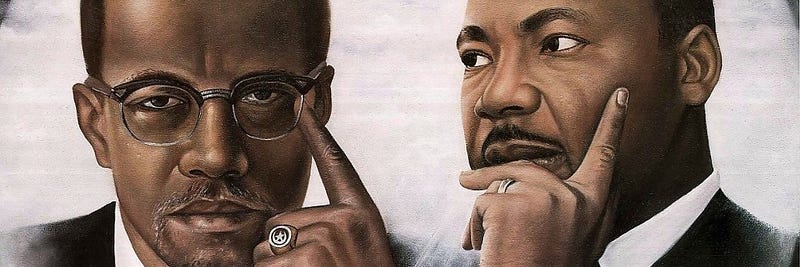
The stances of Malcolm X and Martin Luther King came with much political commentary, though neither man ever fully aligned with any political party.
Don’t tell this to modern-day pundits and politicians, however, as they all have tried consistently to claim both Malcolm X & MLK as their own through the partisan twisting of the Civil Rights leaders’ own statements, despite the fact that late 19th & early 20th century Republicans like the “Lily-Whites” pushed Black leaders out of the party’s power structure to gain more White voters while Democrats were enacting Jim Crow laws in the South.
There are quotes from each man that are often thrown around like “political footballs” & grossly misused in current political context.
“I have almost reached the regrettable conclusion that the Negro’s great stumbling block in his stride toward freedom is not the White Citizen’s Council-er or the Ku Klux Klanner, but the white moderate, who is more devoted to “order” than to justice…” — Dr. Martin Luther King, Jr.
Note: If you haven’t read King’s “Letter from a Birmingham Jail” in its entirety, you probably should’ve never used this quote in the first place.
“The white liberal differs from the white conservative only in one way: the liberal is more deceitful than the conservative. The liberal is more hypocritical than the conservative. Both want power, but the white liberal is the one who has perfected the art of posing as the Negro’s friend and benefactor; and by winning the friendship, allegiance, and support of the Negro, the white liberal is able to use the Negro as a pawn or tool in this political “football game” that is constantly raging between the white liberals and white conservatives.” — Malcolm X
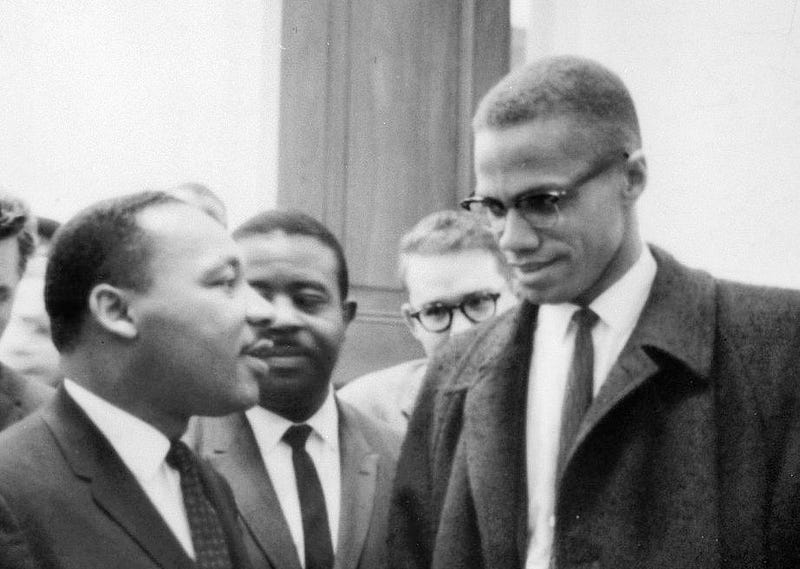
Keep in mind that both quotes were delivered in speeches given in 1963.
A year later, The Civil Rights Act of 1964 became a pivotal turning point in the political landscape of America.
The following backstory may hurt a few feelings…
Modern-day Republicans champion, quite often, that their party was the party that abolished slavery and fought for civil rights. However, they leave out the fact that Northern Republicans during the Civil War were just as racist as their southern Democrat counterparts, including President Abraham Lincoln himself.
“I am not, not ever have been, in favor of bringing about in any way the social and political equality of the white and black races.” — Abraham Lincoln (1858)
Eventually, slavery was abolished, not to grant equality to blacks, but to limit government control in Southern states that rapidly gained extreme power & wealth from slave labor. Lincoln sought amnesty for Confederate soldiers, and although he died just days after the war’s end, his predecessor Andrew Johnson, a Democrat, pardoned every Confederate soldier for treason against the U.S. to solidify Lincoln’s primary goal of bringing the Union back together.
Fast forward to the 20th century:
Political ideologies in America began to shift further right as economic opportunity and comfort became the norm for the majority in the 20th century. The Great Depression & Civil Rights Movement accelerated that shift. In acts of resistance, schools named after Confederates skyrocketed in number after Brown v. Board of Education in 1954, as did other Confederate landmarks to promote a White future. Dwight Eisenhower became the first Republican since the Reconstruction era to win a plurality in the South in the 1956 election.
Malcolm X never classified whites as Democrats or Republicans. He classified them as Liberals and Conservatives, noting that there were liberals and conservatives in both parties, and he heavily criticized liberals and conservatives, regardless of their partisan alignment.
“In America there is no such thing as Democrat or Republican anymore… but white people are divided into two groups, liberals and conservative. The Democrats who are conservative vote with the Republicans who are conservative. The Democrats who are liberal vote with the Republicans that are liberal. The white liberals aren’t white people who are for independence, who are moral and ethical in their thinking. They are just a faction of white people that are jockeying for power. The same as the white conservative is a faction of white people that are jockeying for power. They are fighting each other for power and prestige, and the one that is the football in the game is the Negro, 20 million black people. A political football, a political pawn, an economic football, an economic pawn… The white conservatives aren’t friends of the Negro either, but they at least don’t try to hide it. They are like wolves; they show their teeth in a snarl that keeps the Negro always aware of where he stands with them. But the white liberals are foxes, who also show their teeth to the Negro but pretend that they are smiling… One is the wolf, the other is a fox. No matter what, they’ll both eat you.” — Malcolm X
In 1964, Malcolm X & Dr. King met just once, on Capitol Hill for the Senate hearing on the Civil Rights Act of 1964, eleven months before Malcolm’s assassination. That hearing was the straw that broke the camel’s back.
Ideologically conservative Southern Democrats, like Senator Strom Thurmond of South Carolina, began resenting the party’s intervention in civil rights and left the party altogether. Southern Democrats embraced the core beliefs of classical liberalism, economic freedom and civil liberties such as free speech, but only wanted to grant these liberties to Whites, not Blacks.
This abrupt shift solidified a move that helped Republicans overwhelm the South. The closeness in ideological proximity between liberals and conservatives made party-switching easy, and often. This “Southern Strategy,” which sacrificed black people’s well-being for political gain, gained its first major victory in 1968 with the election of Richard Nixon as president. By Nixon’s election and inauguration, both Malcolm X and Dr. King were dead. Now, the KKK, most White nationalists, and nearly everyone you see wielding a Confederate battle flag, once seen as staunch Dixiecrats, now align with the modern Republican Party.
Meanwhile, the Democratic Party would go through an identity crisis that still affects its decisions today. The party’s progressive wing is gaining followers, especially among younger voters, but is still ideologically distant from the more liberal & moderate Democratic establishment. The political ideologies of both parties would continue their shifts further right along the political spectrum over time as the Democratic establishment sought to build strength & bipartisanship despite consistent racial tensions. The GOP would win 8 of the next 13 presidential elections with strong Southern support.
The war on drugs that targeted minorities for mass incarceration, the rise of the Tea Party in direct opposition to the first Black President, and the birtherism claims against him, came from this newly-transitioned Republican Party. The “tough on crime” bill that aided in increased police militarization and mass incarceration was written and sponsored by Democrats, all while Democrats began exhibiting a covert, “colorblind” sense of racism in the 70’s and 80's.
This presidential election, Dr. King’s “white moderate” certainly aligns with Joe Biden given his track record. Biden’s current stance is vague, but caters moderately enough to rally enough of his base in an effort primarily focused on getting rid of 45. King’s mention of “more devoted to order than justice” aligns with both Biden and Trump, the latter of which was a Democrat until the late 80’s, and is now “the President of Law & Order.”
Malcolm’s message exposes the deceitfulness in both candidates.
Biden earned his deceitfulness long before his “you’re not Black” sentiment during a segment on the Breakfast Club. This liberal deception comes from a passive acceptance of oppressive values and laws, rather than a constructive battle for meaningful change. Biden was the primary architect of the 1994 Crime Bill signed by President Bill Clinton, which funneled billions of funds into a policing and prison system that has overwhelmingly harmed communities of color. Incarceration rates of African Americans skyrocketed after the passing of this bill. Joe Biden also has a lengthy history of highly questionable statements regarding race and integration stemming from his tenure in Congress. Biden has only recently given mild apologies and empty platitudes for his part in this bill becoming law.
Trump’s deceitfulness comes from his constant clinging to “Black People” talking points such as “the black unemployment rate is the lowest its ever been,” ignoring the fact that the wealth inequality gap hasn’t changed since the 60’s and many Black Americans work multiple jobs just to make ends meet. He also likes using “the Republican Party is the party of Lincoln, who freed the slaves” to swing more black voters his way. No comment needed. Trump, who often governs as a far-right conservative, acts often as a liberal in his quest for co-opting talking points aimed at minorities simply to acquire political power.
“The present proposed Civil Rights legislation will give the present administration dictatorial powers, and make America a legal police state, but still won’t solve the race problem. The present administration is only using civil rights as a political football to gain more legislation and power for itself. Our people are being used as pawns in the game of power politics by political hypocrites.” — Malcolm X
Malcolm was certainly wise beyond his years. Dr. King was as well.
All the while, people are out here pimpin’ King quotes as riot deterrent, while police are meeting the peaceful protests with tear gas & rubber bullets, similar to the same use of force during Dr. King’s actual protests in the 1960’s. Republicans constantly pimp the Malcolm X “liberals” quote to draw further divisiveness against the left (which really does not include liberals) while blatantly ignoring their party’s own deplorable history of exploiting Blacks for political and monetary gain.
Malcolm X was right, possibly more now than ever. Democracy is hypocrisy. Political talking points have now become nothing more than a power struggle between elitists and the establishment, and the country loses because of it. This is why Malcolm openly denounced the two-party system, and expressively voiced his opinion that Blacks should have their own party.
Therefore, kill the noise. Neither Martin Luther King, nor Malcolm X, would align themselves with your party. They would especially feel resentment toward the Elites and the Establishment within both parties.
These men were wired for activism, not partisanship, and the truth is that they would’ve blasted you for using their quotes as political fodder to undermine protests, riots, or Democrats, or Republicans, or really any effort that was not their messages’ intended purpose.
“Actually, the Negro has been betrayed by both the Republican and the Democratic party. The Democrats have betrayed him by capitulating to the whims and caprices of the Southern Dixiecrats. The Republicans have betrayed him by capitulating to the blatant hypocrisy of reactionary right wing northern Republicans. And this coalition of southern Dixiecrats and right wing reactionary northern Republicans defeats every bill and every move towards liberal legislation in the area of civil rights.” — Dr. Martin Luther King, Jr.
We have often treated Dr. King & Malcolm X’s stories as if they were eons ago, but nearly all of us have relatives still living that were also alive to witness that time in our history, and still just 60 years later, not much has actually changed in terms of how we treat cries for real, genuine, concise, civil rights reform.
“The practical cost of change for the nation up to this point has been cheap. The limited reforms have been obtained at bargain rates. There are no expenses, and no taxes are required, for Negroes to share lunch counters, libraries, parks, hotels and other facilities with whites. Even the psychological adjustment is far from formidable… The real cost lies ahead. The stiffening of white resistance is a recognition of that fact… Jobs are harder and costlier to create than voting rolls. The eradication of slums housing millions is complex far beyond integrating buses and lunch counters.”- Dr. Martin Luther King, Jr.
As things change, they remain the same.


