
Stop Holding Onto the Treadmill!
It reduces the effectiveness of cardio. And, the same goes for holding yourself up on the stairclimber.

A common sight in many gyms and health clubs is people using cardio equipment whilst holding onto the rails.
I don’t know where everybody got the idea that it’s beneficial to hold onto the handles on a treadmill whilst doing cardio… Especially when on an incline!
Yet, despite the popularity of holding the handrail on the treadmill, it’s not a good idea.
In this article, I’ll explain why holding onto the treadmill rail is a bad habit to get into.
“The least fit… are most likely to utilize handrail support, even when instructed otherwise…” — Wicks & Oldridge, 2016
Less effort = Fewer calories burnt
If you want to make cardio easier, hold onto the treadmill handrails.
If you don’t mind reducing the effectiveness of cardio, keep holding onto the handrails.
To impress your friends, share a post on Facebook about how much cardio you did today. Who likes putting in the effort anyway? If people THINK you burned 500 calories, that’s the main thing, right?
Now I’ve finished being patronising, the first reason you shouldn’t hold onto the treadmill handrails is that it reduces the effectiveness of exercise.
A common technique for cardio is walking on the treadmill on an incline, holding the front bar and tilting the body back. However, doing this means our bodies then become perpendicular to the incline — essentially cancelling out the incline and the extra effort it would normally require.
“…This will result in a statistically significant reduction in metabolic cost. This may be partially explained by that fact that leaning backward creates a near-perpendicular angle between the body of the exerciser and the surface of the treadmill, similar to walking upright with no incline.” — Hofmann et al., 2014
When exercise becomes easier, it requires less effort. However, less effort results in fewer calories burnt. A 2014 study found that holding onto the rails and leaning back on the treadmill decreases your calorie burn by almost 32%.
“Continuous light or continuous very light handrail support attenuate physiologic responses during step treadmill exercise, thereby reducing aerobic requirements and gaining suboptimal benefits from exercise.” — Christman et al., 2000
Bad for technique
The whole point of walking, jogging, or running on a treadmill is to mimic your natural stride, but in a convenient setting.
Holding on to the handrail eliminates your ability to exercise with your natural stride. The swinging of your arms is necessary for your gait — a key aspect of driving your body forward.
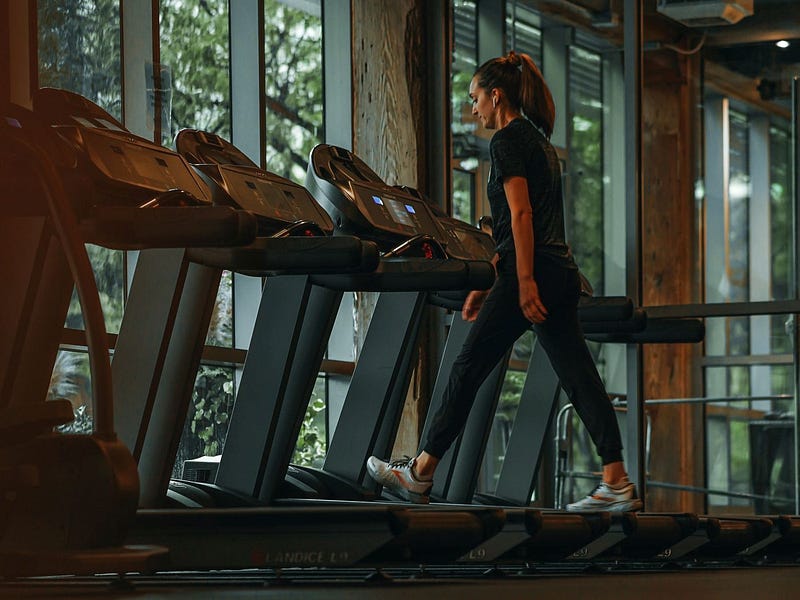
When exercising on a treadmill, you should always try and replicate how you move in a natural setting such as running on a sports field or power walking with friends.

Bad for balance and coordination
Holding onto the treadmill handrail results in less weight being put on our lower bodies, and can negatively impact our balance and coordination.
A 2019 study found that able-bodied people holding the handrail whilst walking on a treadmill reduced their locomotor learning.
“The findings of this study imply that balance support during gait training reduces locomotor learning…” — Buurke et al., 2019
To help us balance, our brains are consistently signalling through our spinal cord to help us navigate where our body is in space.
Holding onto the treadmill changes our centre of gravity and thus interferes with these signals. Deactivating our body’s balancing mechanism during cardio reduces the need for our neuro-musculoskeletal system, negatively impacting our balance.
Bad for posture
Holding onto the handrail or propping yourself up on a stairclimber puts pressure on the upper body. Repeated over time, this practice can negatively impact posture.
Our erector spinae stabilises our spines and keeps us upright while walking or jogging. If we repeatedly hold onto the treadmill handrail, our lower back no longer needs to work as hard. Key core muscles aren’t activated, often leading to muscle imbalances.
Tall people are even more at risk, as they have to lean over even further to grasp the handrails. Over a prolonged period, a slumped posture can often be the result.
Concluding Thoughts: Slow Down!
In summary, holding onto the treadmill handrails reduces its effectiveness for cardio. When you do so, you burn fewer calories, and balance, coordination and posture can be impaired.
The handrails on a treadmill should only be used for safety reasons. For anybody with an injury or disability, there can be a huge benefit to holding on.
However, for everybody else, maybe you should slow down. Or, reduce the incline to a level you feel more confident exercising at. Then increase the incline or speed as you improve your fitness and ability.
Holding the rails is doing nothing but your ego favours. Exercising correctly means your body mechanics and postural muscles benefit as well as your cardiovascular fitness.
Thank you for reading.
If you enjoyed the content, you may be interested the learning about six common mistakes people make when trying to lose body fat:
Read More Medium Articles
Non-Medium members can only read 3 articles a month — become a Medium Member for unlimited access.
If you would like to read more articles like this one, sign up to become a Medium member for only $5 a month.
Subscribe to be notified when I publish new content.