
Stop Apologising and Giving Away Your Confidence and Value
I’m noticing a trend, one that I catch myself stuck in as well.
We over apologise. I’ve apologised too much this week, but I’ve done nothing that truly merited an apology. Do these sound familiar?
“Sorry, can I get through here…” “My apologies boss, but you’ve got that wrong…” “I’m sorry, can I ask a question…” “I apologise, but I don’t think that’s right…” “I’m sorry, is that seat taken…” “Sorry to ask, but can I lead that project…” “Sorry, I’m not sure you saw the line…” “Sorry, I have a meeting to get to…” “My apologies, but I’m going to take Friday off work…” “I’m sorry to bother you, but can I get another napkin…” “I’m sorry, can you clarify…” “Sorry kids, no dessert tonight…”
It has to stop, and I’ll tell you why.
The Sorry Epidemic
Everything is offensive to someone, so start apologising…
Sorry, that’s the wrong change I gave you fifty, but you cashed it as twenty I am sorry you have kept my money I apologise for asking for it back But thirty is thirty and I can’t believe I have to say sorry Because you were way off track.
— Leon Purton
It has gotten to the point were you can barely offer a personal perspective, ask a questions, correct an answer, or discuss your life — without offending someone. Or feeling like you may have.
Some people have a lower threshold to what they perceive as offensive behaviour. Because of this, we have started to say sorry all the time. Just in case.
We have an inbuilt, genetically encoded, requirement to maintain our community. The isolated member of the tribe is the most at risk, the most unsafe, for that reason we try to keep people on side.
If you take out some peoples colourful vernacular, the most often adjective to start or end a sentence with is ‘Sorry”. We aim to reduce any offence we may cause with every interaction.
This is a lie…
The funny thing is, it is normalising behaviours and languages… It is becoming part of our cultural fabric. The reason why is just as fascinating — its because of Reciprocal Altruism. A term normally applied to favours.

Reciprocal Altruism
A researcher into evolutionary biology and sociobiology; which included the topic of reciprocal altruism, R.L. Trivers postured that sorry started as a superficial altruism.
Reciprocal altruism is applied like true altruism — doing something for someone else — but unlike its purest form, reciprocal infers that it will come back round. The act of being generous, under the implied acknowledgement that at some time the favour will be repaid — hopefully in dividends that outperform your investment.
Reciprocal altruism is important for community building. Communities built on a foundation of reciprocal altruism or inferred generosity are successful. People are happy, and contributors feel like an integral part of the community. Do something for someone, or the community, at some cost to yourself and know that the goodwill will come back. Karma…
Trivers believes that the requirement to apologise stemmed from this reciprocal requirement. Trying to apologise your way out of a debt, is easier than acting to reduce the Karma. Based on this, the Sorry Epidemic has snowballed to a point where we apologise for everything.
This is magnified by an ever growing reduction in what is deemed offensive behaviour.
The Threshold for Offensive Behaviour
You do not need to apologise for everything. Most of the time an apology was not necessary at all.
In a 2010 study by Schumann and Ross into why it appeared that women said sorry more than men they found out that, if both sexes identified that an apology was necessary, they both apologised. Men do not avoid saying sorry when it is deemed necessary. Here’s the thing that is different, men have a higher threshold for what they deem offensive behaviour. Because of this, they issue less apologies. For some reason, biologically and environmentally, women have been conditioned to apologise for lower infractions.
It has now reached a point where other peoples behaviour also warrants an apologies. “Sorry the pizza was late being delivered”, “Sorry I know you’re busy, but you’ve put milk in my coffee”, “Sorry, could you move your feet of my chair, sorry”.
Somehow, interacting with someone has now been deemed offensive behaviour that warrants an apology.
It is time to start catching it, and using different language instead. Because, believe it or not, it actually is hurting you.
Want to cut down on your apologies? Thank you is a good start.
When to apologise and when to say something else
The thing about starting a sentence with an apology is — you devalue whatever comes out of your mouth next.
If you have an idea during a meeting, starting with “Sorry, I know you were talking, and this will just take a minute, but have you considered that a parsley farm is a bad short term investment for our IT company?”
Of course parsley is a bad idea!
By saying Sorry — your perspective now needs forgiving rather than agreement.
This is the exact situation where sorry should be replaced. Something like; “I see your point, but have you considered…”, or “I’d be interested in your opinion on this perspective”.
Daniella Balerezo wrote about Maja Jovanovic and her TED talk to women highlighting the problem, she gives some examples of alternate things to say.
- Instead of saying “Sorry for complaining” — say “Thank you for listening”.
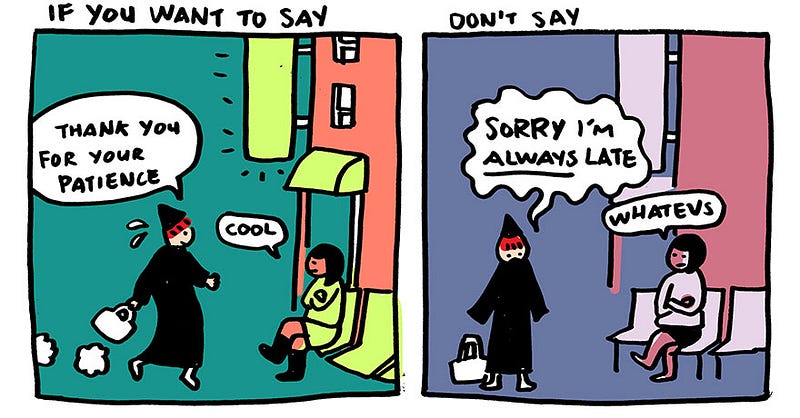
- Instead of saying “Sorry I’m late” — say “Thanks for waiting”, or “Thanks for starting without me”.
- Instead of saying “Sorry, did you not see there was a line” — say “Excuse me, perhaps you did not see the long line here”.
- Instead of saying “Sorry, have you got a minute” — say “I’d really appreciate a moment of your time”.
- Next time someone bumps into you, you could say “Go ahead”, or “After you” — you certainly shouldn’t say sorry.
- If you happen to bump into someone, you could say “Pardon me”, or smile and say “Your turn”.
If you use the word too often, you give away your confidence. Everything you do has put someone out, you are a pain, you are inconvenient, you are nervous, you are always taking peoples time.
YOU ARE NONE OF THESE THINGS. So stop acting like it.
I know that it seems courteous, it seems like the right thing to do to advertise that you’re leaning across the table for the salt. But sorry should be reserved for those genuine times where you need to repair relationships and grievances.
If you overuse the word — you will diminish your ability to succeed.
And no, I am not talking about generic success. I am talking about your version of success — whatever it is. If you diminish everything you say and do by apologising your way into and out of it, you will never achieve your goals and aspirations.
There is even a Google plug-in called ‘Just not Sorry’ that will detect when you are using words in your email that will undermine your message.
So….
This article is just to let you know you definitely say sorry too much. Changing will be hard, but hopefully you will start realise and catch yourself. You attach your self-worth and confidence to how you think about things and the way you communicate to others.
Instead, remember how valuable you are. Remember how much you contribute. And most importantly, remember to not diminish either of these things when you speak.
Get comfortable saying Thank You. Get comfortable catching your needless apologies. Work at changing your words.
Catch your friends and family and ask them, what was that apology for?
You can lift the confidence of everyone around you if you cut needless apologies from the environment.
Apologies are necessary, but should be used sparingly. Stop saying sorry unless you really do need too.
Stay safe and keep smiling,
Leon.
I’m a new writer with a keen curiosity for people, human nature, leadership and growth. Originally published on leonpurton.com


