
Stop Airing the Academy Awards
The ceremony is out-of-date and irrelevant to the broader public, just as its members want
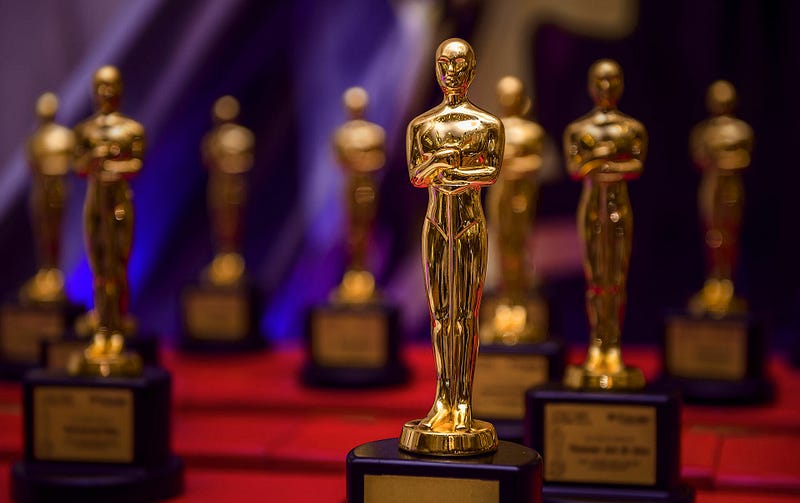
Hollywood Awards shows are unique. Nearly every industry has some sort of awards ceremony, but only the entertainment industry thinks its awards shows should be actual entertainment. Nobody cares who wins — to pick a random industry that in no way symbolizes the general uselessness of awards ceremonies — the Green Leaf Award International Fertilizer Awards, for instance.
And among all the Hollywood awards ceremonies — and there are quite a few — the Academy Awards (aka the Oscars for their statue) are the most prestigious, the most important, and generally the most-watched. But in recent years this film awards ceremony is facing a uniquely TV problem: declining ratings.
The immediate reason why is easy — people don’t care. The question is why the general population cares less about what the Academy of Motion Picture Arts and Sciences (AMPAS) considers great than in previous years. To put it perhaps too simply, there are four main trends that have emerged over the past decade that have changed the entertainment landscape:
- The rise of streaming services. Services like Netflix changed the way the industry functioned. Streamers have different ideas of how to define success; without box office figures, it’s hard to quantify how popular a Netflix, Amazon, or Apple film is and whether it’s successful. Because their metrics are different, the streamers have also been willing to fund passion projects like The Irishman that “traditional” studios were unwilling to produce.
- The advent of franchise filmmaking. Let’s be clear: Hollywood has always loved franchises and sequels. But such films were still the clear legacy of individual filmmakers, people who put an indelible mark on their creation. The original Star Wars and sequels were undoubtedly a franchise with ridiculous merchandising potential, but they were also driven by the creative vision of George Lucas. Since Disney acquired Lucasfilm Star Wars films have lacked a similar creative focus, for better and (largely) worse. This is the distinction between cinema and movies.*
- The acceptance of non-English filmmakers. While the Academy Awards has always recognized foreign films, it has done so by siloing them in their own category. In recent years, improvements in subtitles and dubbing technology in addition to better access via the aforementioned streaming services have allowed consumers to engage with non-English content far more. Watching a K-Drama or Telenovela is far more common than it would have been in years past, and entertainment has become more global as a result.
- The increasingly blurry line between Television and Film. Traditionally, film was a more “serious” medium than television, which had lower production values and star power. TV began to rebrand itself as it matured over the years, and premium cable providers (primarily HBO) sought to make a more “elevated” form of television, using higher budgets and better-known actors. That division decreased as streamers emerged, and now top TV shows have budgets rivaling blockbuster films and A-List actors move seamlessly between TV and Film projects.
*This terminology comes from a speech Steven Soderbergh gave almost a decade ago, but it’s perhaps even truer today. He deems “cinema” films that come from a filmmaker’s specific vision. Other films that are made by a committee with careful focus-testing to maximize return-on-investment and franchise opportunities he calls “movies.” This is a value judgment, but it does not automatically mean all movies are expensive/bad and cinema is good/cheap. Christopher Nolan has been making high-budget versions for years. And movies — for all they might lack a singular version — can be enormously entertaining and quite well produced (see the entire Marvel Cinematic Universe, where the key creative force — Kevin Feige — has not written or directed anything).
AMPAS is made up of people in the industry, so they’re certainly aware of and impacted by these trends, but how they’ve reacted to each of them. Before the pandemic, The Oscars (here represented by influential old-guard director Steven Spielberg) were at odds with the streamers (primarily Netflix), mostly in arguments boiling down to how films were only “films” if they had a theatrical release. However, the pandemic in addition to lucrative streaming deals seems to have made this a moot point, such that nominees did not need a theatrical release to qualify for this year.
Similarly, the acceptance of non-English filmmakers has improved. Roma — a Spanish/Mixtec film released by a streamer — was tied for the most nominations at the 2019 Academy Awards. The next year, the Korean film Parasite won both Best Picture and Best Director, a first for the Oscars. This year features another non-English nominee among the Best Picture hopefuls (the Japanese film Drive My Car) in addition to other signs of increased acceptance like the cross-category appeal of Flee (as an animated Danish documentary, it is nominated in Best Documentary Feature, Best Animated Feature Film, and Best International Foreign Feature Film).
The stickiest point has been when it comes to the acceptance of big, modern franchise films. Historically, the Academy has rewarded big spectacle cinema in the past — Lord of the Rings: The Return of the King won 11 Oscars, a record it shares with Titanic and Ben-Hur. However, that was almost twenty years ago and winners since then have tended to be smaller prestigious cinema (often termed Oscar-bait). Sure, the occasional big-budget superhero film can enter the conversation (The Dark Knight, Black Panther) but Academy Award winning films fit a certain mold those films do not.
The problem is, of course, those sorts of films are the things the general population is most likely to have seen, and their exclusion prevents the sort of rooting interest that draws people to the Oscars telecast.* Fewer viewers is a problem for ABC, which broadcasts the Academy Awards as a piece of entertainment and wants to maximize ratings.
*The rest I assume are here for the fashion which is amazing, but largely happens before the ceremony itself
Efforts have been made to offset this decline. The latest innovation from this year has been to not air some of the awards live on the telecast. Done presumably to save time, this measure annoyed many members of the Academy and is unlikely to fix the flagging ratings. An attempt to recognize a “Fan Favorite Film” during the telecast seems unlikely to help, especially with Amazon’s quickly-forgotten reboot of Cinderella leading the polling so far.
All of these are fixes that fail to solve the underlying issue. The Academy is, by all accounts, happy with its winners — after all, they voted for them. It’s just that the public isn’t really interested in what AMPAS members think is great. Similarly, the Academy doesn’t really seem to want to change how it views films given recent trends.
It’s this conflict that brings about the central conundrum: who are the Oscars for? For years the Academy Awards have been presented as a bellwether for what movies are “good” or “worthy.” That no longer seems true. By my reckoning, it is for the people in the industry. Accordingly, recognize the evening for what it is: a chance for entertainment industry members to catch up, reflect on the year, and reward peers for their accomplishments. Like all the other awards ceremonies.