
Stone Remains
Are We Becoming the People My Father Fought in 1945?
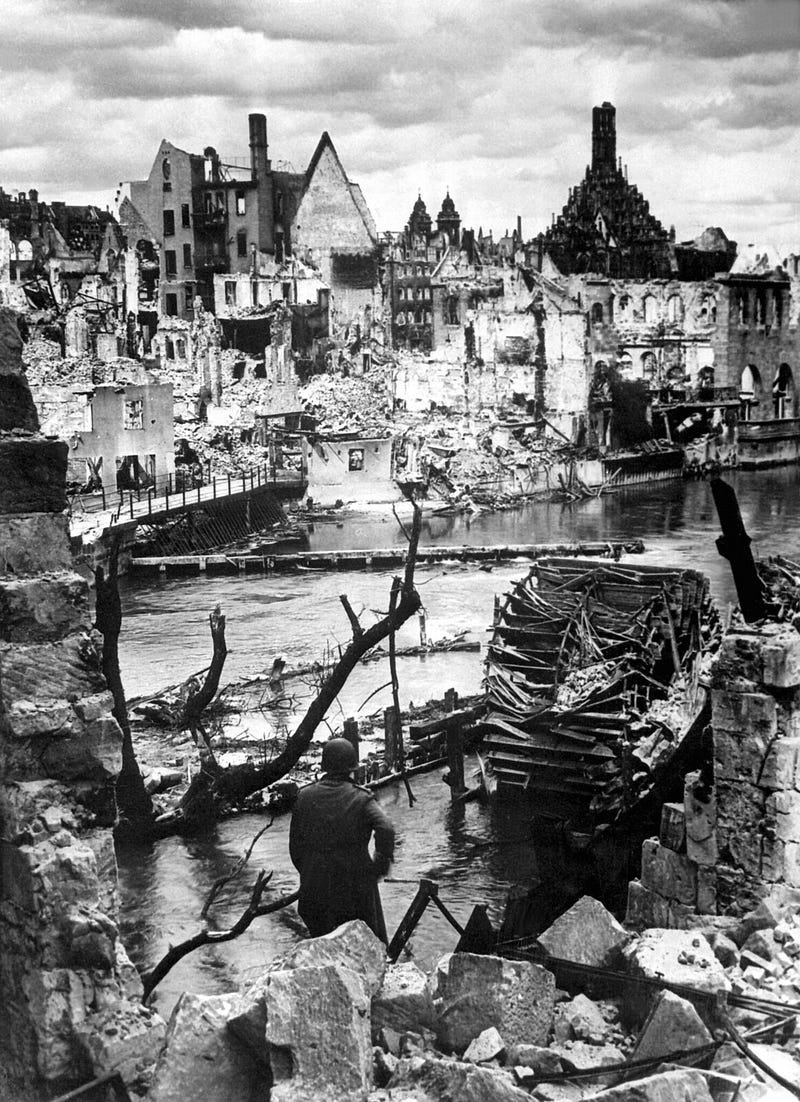
In photographs of Nuremberg in 1945, there are very few people. Sometimes you see the backs of soldiers walking in. Sometimes you see the faces of citizens staring out from among hills of broken stone.
There was a time, not really that long ago, when the number of enemies you’ve killed in your life would have been something to brag about. But things change. People change. As a personal accomplishment, killing your enemies has been losing its appeal for at least the last few centuries.
I imagine the allure of keeping count with notches on your belt finally ended around the time when the machines took over the work. The meat-grinding guns and gas attacks that mass-produced bodies in the first world war may have removed whatever romance had remained in it. I think that’s about the time people stopped talking out loud about the number of people they’d killed. My dad, for instance, fought in Europe during World War II, a pilot in command of a B-24 at age 19.
He never said anything about what he did over there.
When we were packing my parents' belongings for my mother’s move to a graduated care facility in Maryland, we found a cache of documents from his career in the Air Force. Among them was a list of the 35 missions he flew over Germany in the winter of 1944–45.
Each entry gave only the date and the target.
“A rock pile ceases to be a rock pile the moment a single man contemplates it, bearing within him the image of a cathedral.” — Antoine de Saint-Exupery
In the 12th century, Europeans returning home from the Crusades brought with them many spoils from the Holy Land. It is thought that the confluence of two of these treasures in particular — wealth, and an elevated understanding of mathematics — was the advent of what would later become known as “Gothic Architecture.”
In this way, at least in part, the great cathedrals of Europe were born of war. Perhaps they were a response to it. An impulse to peace inspired by pain. Perhaps.
If you take a hammer to crafted stone, what remains is still stone. It was there before the crafting. It will remain after the hammer to be crafted again. Even if you strike until stone turns to dust, the dust can be collected and turned to mortar, to concrete, and used again to make something new.
In this way, we may forget what came before and why that crafted stone was broken in the first place.
For the flight crews of the 446th Bomber Group, ‘notches on the belt’ took the form of bomb-shaped decals on the sides of their planes. Each decal represented a mission, not a kill. It represented the thing they could count. And, like scratched lines on a prison wall, it kept track of how long they’d been there, and how long before they could go home.
“I call architecture ‘frozen music’ — W.A. Mozart
Construction of the first of the great Gothic Cathedrals of Europe, the Basilica of St. Denis began in 1140 just to the north of Paris. The term “Gothic” originated in the 16th century when Giorgio Vasari used the term “barbarous German style” in his Lives of the Artists, attributing various architectural features to “the Goths” whom he held responsible for destroying the ancient buildings after they conquered Rome. (1)
Mission Log: February 21, 1945 — Nuremberg
Katharinenkirche, or St. Catherine’s, was founded in 1295 in Nuremberg by Konrad von Neumarkt and his wife Adelheid, patricians of the Pfinzig family. In the Middle Ages, it had an important medieval library. After the Reformation, it became a Lutheran church. The convent was closed in 1596 after the last inhabitant died. Although destroyed by air raids in 1945, it was partially restored (1970–71) and is used for events such as open-air concerts. (2)
Mission Log: Oct. 30, 1944 — Hamburg
The original wooden chapel at St.-Nikolai-Kirche was completed in 1195 in Hamburg. It was replaced by a brick church in the 14th century, which was eventually destroyed by fire in 1842. The church was completely rebuilt by 1874 and was the tallest building in the world from 1874 to 1876. The bombing of Hamburg in World War II destroyed the bulk of the church. The removal of the rubble left only its crypt, its site and tall-spired tower, largely hollow save for a large set of bells. (3)
It grew like a crystal inside his head. On an X-ray, it appears as a stain, spreading beneath the skull across a corner of the mind like spilled ink.
I remember him as a deeply good man. Honest, intelligent, accomplished, respected by all, who led a life full of friendships, utterly without enemies, and free of even a hint of scandal.
I wonder about the things he must have thought about that never became words, whether those thoughts might need expression somewhere, whether they might choose a spot to crystallize, where flesh meets mind, where the words might have come from if he had ever wanted to let them out.
I wonder, when we thank veterans for putting their own lives in danger, whether it might be better to apologize for the lives we ask them to take.
It took away many of his memories before it took the rest of him. It seems, in one way or another, we can always forget.
I helped my mother move into the assisted living center she had picked out for herself years ago, not too long after he died. Independent and unselfish, she wanted to plan ahead for the Alzheimer’s disease she always thought she would get, and did. She forgets, sometimes, that he is no longer alive. Sometimes she thinks he’s just late for dinner.
She doesn’t watch TV very much anymore, but at the time of her move, she did. She liked to watch the news. I remember watching together on her 50-inch screen as women and their families marched in the streets of cities all around the country to raise their voices for justice. And then again as children and their parents marched to protect the innocent. She wondered at the girl who stood silent in front of a microphone for six minutes and 20 seconds, the precise length of time it took for her friends to die in their school. I watched my Mom trying to understand. I watched the girl stand silent and still.
It felt like a new moment. Neither of us had ever seen anything like it.
I wept in secret for both of them, my mom and that girl. And for my father, who fought for this moment so long ago.
Mom and I watched together when they began putting the parents and the children into separate camps near the southern border. It was a new moment that felt very old. It carried the weight of history, of things we’ve seen before, of things we aren’t supposed to forget, of the reasons why he killed so many people so long ago.
My Dad’s younger brother is a lovely man who lives in Alabama and inside my phone on Facebook. He posts pictures of the sun rising behind his magnolia tree.
I wonder, sometimes, if my father had ever had the chance to wrap his head around the fact of my phone, what he would think of the world inside it. I think he would have loved it, too. But I wonder if he’d worry that it might be helping us to forget something he once knew.
Inside my phone, babies are born, people live and die, nations emerge and crumble. So much that happens in there is hopeful and new, and so much of it is ominous and familiar.
Mission Log — Oct. 19 1944 — Mainz
The church of St. Christoph in Mainz was originally built between 1240 and 1330. The church is known as the Parish Church and Baptistry of Johannes Gutenberg. During World War II it was razed except for the external walls. (4)
“We say nothing essential about the cathedral when we speak of its stones. We say nothing essential about Man when we seek to define him by the qualities of men.” -Antoine de Saint-Exupery
I was in my car, stuck in a desert traffic jam between Las Vegas and Los Angeles. My phone told me there was an overturned tanker trunk and a bio-hazard spill fifteen miles ahead. It told me how long the standstill would last, how to get around it, and that the United States Senate said the President was guilty of the crimes for which the Congress had impeached him, but would never be removed from office or prosecuted as long as his party held power.
My phone makes no judgments. It doesn’t truly remember or forget.
Long before I was born, they seized the sky over Germany and held it through the long ending of the war. My father and his crew flew 35 missions in the winter that spanned 1944 and ’45. When I look at the pictures on my phone, I see the backs of soldiers walking in. I see the faces staring out from among hills of broken stone.
There is comfort in indignation, strength in fear of the future, and a certain kind of safety in having someone else decide. It is easy not to know where such things lead. People can forget how we come to such times.
Those are some of the people he killed where they waited and watched and let someone else decide.
I was born in Virginia after my father had moved his family close to Washington DC where he worked in the years leading up to his retirement from the U.S. Air Force.
I was watching baseball on my TV in California when my phone told me that a 22-year-old man had been sentenced to life in prison for the murder of a young woman in Charlottesville. He had been one of the hundreds of white supremacists who were demonstrating and he drove his car into a group of counter-demonstrators.
My father was a full Colonel and still a young man when he retired from the Air Force. He worked another 20 years for a defense contractor that specialized in radar guidance systems and missile technology. I don’t really know what that meant to him. He never talked about it. But I do know, if you add it up, that he spent most of his life, in one way or another, doing what he started at age 19 in the skies above Germany in the winter of ’44 and ’45.
I was 50 miles from the border between Arizona and Mexico, thinking about the cost of concrete and whether it would be worth my while to put a pool in my back yard when the President of the United States deployed American soldiers on American soil. He said it was an emergency. I don’t remember what the emergency was… he told us it was necessary because we were being “invaded.”
I suppose I could google it if I really needed to.
My father flew when the Allies had an official strategy to end the war and make the ending permanent.
In attack waves of more than a thousand planes at a time, they fought to never have to fight again. They hit wider and harder than anyone had ever imagined possible, to strike it all down, the whole thing, the machines, the roads, the people, the stone walls. All of the weapons that were built when no one was looking, and everything alongside.
The hammer would pound the standing and the fallen alike until they couldn’t even say ‘no more’ because no one would hear them over the thunder.
They hit cities. There were civilians. There were many who had looked the other way when facing up would have mattered.
And others, most certainly, who did no such thing. Those who waited and watched. Old, young, guilty, innocent.
All of it came down.
I’m not able to leave the house much these days. None of us are. There is a pandemic, an emergency that is putting more and more people out of work. There is talk of another depression coming if we don’t find a way to help each other soon.
The war my father fought in Germany began that way. With an economic depression. With stoked anger turning despair into hatred.
I was on the couch with my feet up when, inside my phone, the people marched, again. Encouraged by the President of the United States to “liberate” themselves from efforts to slow the pandemic, white men wearing body armor and carrying assault rifles demonstrated the anger born of their despair.
Beneath their armor, they wore a kind of uniform. They wore colorful, floral print Hawaiian shirts.
It is a meme on the internet. A lighthearted symbol for their anger, their despair, their contempt, and their hatred. Almost like a joke. Like it could be funny if you just let it into your heart.
I wonder.
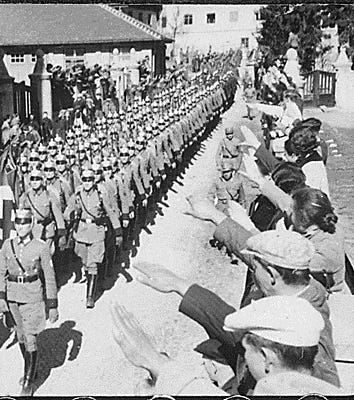
Is that what it was like in the years before my father flew his plane? Is that what it was like on the ground before the sky fell? Is that what it had come to in ancient Cathedrals before they were smashed to dust?
The survivors were there at the beginning and there at the end.
Usually, the image is of one person or two, sometimes a man in a fireman’s uniform, sometimes a woman in a middle-class coat, sometimes a child with no adults present. They all have the same blank stare, stand oddly upright, hands down, the way you might if someone had told you to stand still and then just left you there for several minutes. Lost, nowhere to go, and nothing really to do. Because all around them, there was nothing left but rocks, crafted stone broken to rubble where the buildings and all the other people used to be.
There was nothing left for them to ‘look the other way’ from.
They could not help but see it all now.
In photographs of Nuremberg in 1945, there are very few people. Sometimes you see the backs of soldiers walking in. Sometimes you see the faces of citizens staring out from among hills of broken stone.
Footnotes:
- https://en.wikipedia.org/wiki/Gothic_architecture
- https://en.wikipedia.org/wiki/Category:Ruined_churches_of_World_War_II
3. ibid
4. ibid


