
Stoltenberg: New NATO strategy will see challenges from China, cyber attacks
NATO’s new strategy concept will no longer see Russia as a strategic partner and will recognize China as a growing global adversary to the West and address new threats to member states ranging from cyberattacks, in space and from climate change, NATO general secretary Jens Stoltenberg told journalists in the Latvian capital on November 29.
Speaking ahead of a NATO Foreign Ministers’ meeting in Riga, Stoltenberg emphasized that a new NATO strategy would still be extensively discussed by the foreign ministers and in other forums before it is finalized and adapted at NATO’s next summit meeting in Madrid at the end of June 2022.
Looking to NATO strategy in a changed world
“The world has changed since the last strategic concept was adopted in 2010,” he said, noting that Russia was then considered a strategic partner and the concept “didn’t mention China.”
The NATO head said that “we are developing a strategic concept in a different world” where “China is more and more a global power” that doesn’t share the values of democracy, nor does Russia.
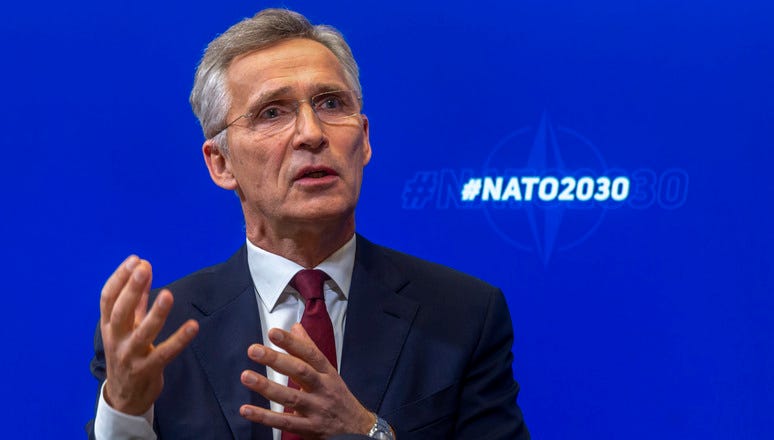
Speaking of space as new area facing threats, Stoltenberg referred to anti-satellite missile capabilities being developed by Russia and other countries, He said that the increased used of cyber-attacks meant that NATO members had to all have reliable electronic infrastructure.
The NATO general secretary spoke at a joint press conference with Latvian President Egils Levits, who said that his country spends 2.26 percent of its GDP on defence, above the desired NATO threshold of 2 percent.
Latvia also hosts the NATO Strategic Communications Center of Excellence (Stratcom), which analyzes and formulates strategies for communicating NATO’s mission, including deflecting hostile informational influence on NATO members from the alliance’s adversaries, the Latvian president said.
Planning a joint statement with the EU
Stoltenberg had been visiting Lithuania and Latvia ahead of the NATO conference and joined with European Commission President Ursula von der Leyen in meeting with top Lithuanian and Latvian officials on November 28.
During press conferences in the Lithuanian capital Vilnius .and hours later in Riga, both von der Leyen and Stoltenberg spoke of soon drafting a joint statement by the European Union and NATO. This would address the continuing attempts to destabilize the EU’s eastern border with Belarus by strongman Aleksandr Lukashenko’s deliberate gathering of migrants by the borders with Poland, Lithuania and Latvia as well as apparent military threats to Ukraine by Russia.
Latvian Prime Minister Krišjānis Kariņš said on November 28 that he would raise the issue of further expanding NATO’s presence in Latvia and the other Baltic countries. Asked about this by a journalist at a press conference a day later, Stoltenberg said that NATO had already bult up a considerable presence in the form of battle groups in each country formed in the wake of Russia’s seizure of Crimea in 2914 and its support of separatists in the Ukraine region of Donbass. He said that in case of a serious military crisis, NATO could quickly bring uo to 40 000 troops to the region.