
Stoicism: A Guide to Living Peacefully
Change your thoughts, change your reality.
Some 2300 years ago, a merchant by the name Zeno found himself shipwrecked and stranded in Athens. With not much else to do, he walked into a book store and picked up a book that happened to be about Socrates.
Fascinated by what he was reading, Zeno set out to find and learn from the finest philosophers the city had to offer. Over the next couple of years, he studied under a wide array of philosophy teachers before eventually founding his own school.
Zeno started teaching by standing on a porch in the central market in Athens and talking to anyone who happened to pass by. Soon, he had a following of men hanging around and discussing philosophy with him.
The Greek word for porch is stoa, and the men who met there to talk philosophy became known as Stoics; the men of the porch. Over time, the ideas they were discussing became increasingly popular and over a thousand books came to be written about stoicism.
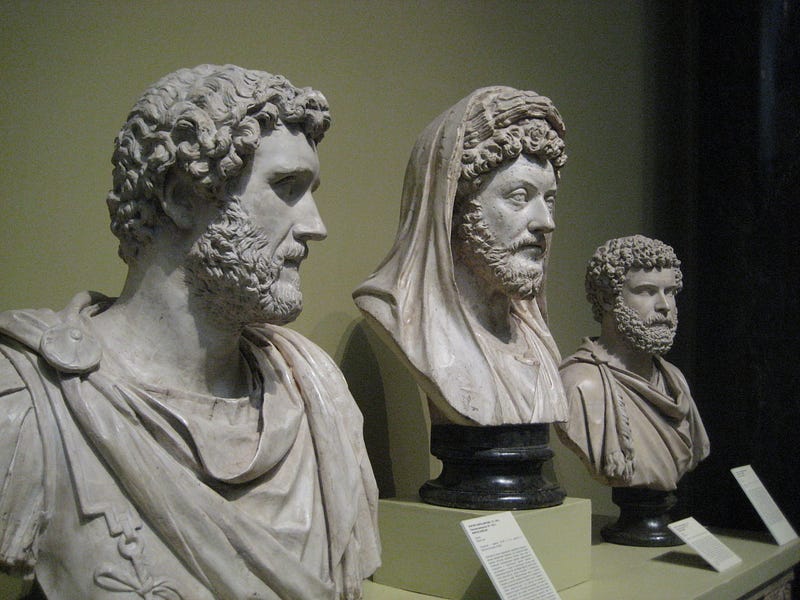
We’ve lost almost all of those books to antiquity, but we still have the works from three fascinating Stoics who are widely influential to this day: Seneca, Epictetus, and Marcus Aurelius.
The Main Characters
Seneca lived right around the year 0 CE, and he was a successful and wealthy statesman and playwright. He is known for the personal letters he wrote in his lifetime, such as Letters from a Stoic and On the Shortness of Life.
Epictetus was born a couple of decades after Seneca, and he was a crippled slave who eventually became a free man and one of the leading philosophers in Rome. None of his texts remain, but one of his students wrote down his ideas in two books called The Discourses and The Enchiridion.
Marcus Aurelius lived shortly after Epictetus. He studied, applied, and developed stoic ideas in his role as emperor of the Roman Empire. We know his wisdom primarily through his Meditations; a private journal that was never intended for publication.
What is Stoicism?
These days, people use the word “stoic” to describe someone who doesn’t feel any emotion at all. But even though the word originates from Stoicism, that was not at all what the Stoic philosophers were trying to accomplish.
What they wanted to do was minimize negative feelings to make as much room as possible for positive ones. They wanted to replace frustration, discontent, and anger with calm, fulfillment, and happiness.
To do that, the Stoics developed a variety of mental techniques to deal with the challenges of life. And many of these techniques have inspired modern therapies like, for instance, Cognitive Behavioral Therapy (CBT). So even though the philosophy itself is very old, modern research shows that the techniques still work very well. Stoicism can help you feel better, perform better, and live a better life.
And it all begins with cultivating a peaceful mind so you can keep your calm no matter what life throws at you.
How to Have a Peaceful Mind
If you’re like most people, you like to think of your mind as objective and rational. But as the ancient Stoics argued, and as modern psychology has confirmed, that’s not the case.
We’re all vulnerable to cognitive biases and logical fallacies; thinking errors in the way we perceive and reason about information from the world around us. All of us filter each experience through our subjective lens that is tainted by our unique disposition, background, and emotions.
The Stoics taught that we can improve our perception of life — to polish our lens, so to speak. By doing that, we can reduce irrational thinking, cut off negative emotions, and approach our lives with equanimity.
Sounds pretty good, don’t you think? Let’s have a look at the Stoic’s best techniques for creating a peaceful mind.
1. Focus on What Is in Your Control
‘We should always be asking ourselves: “Is this something that is, or is not, in my control?”’ — Epictetus
This is the most important practice in all of stoicism. If you take away only one thing from this article, let it be this:
Always identify, and care exclusively about, what is inside your control. What you’ll find when you start doing this is that very few things are within your control. In fact, the Stoics would argue, the only things in your control are your own thoughts and actions.
Everything else — the past, most of the natural world, the thoughts and actions of other people, and even most things about ourselves — are ultimately outside your control. This insight is crucial because, according to Epictetus:
‘There is only one way to happiness and that is to cease worrying about things which are beyond the power of our will.’
So, get into the habit of separating what is within and without of your control, and then act accordingly:
- If it’s inside your control — take action! Spend the time, energy, and focus necessary to create the change you want.
- If it’s outside control — let it go. Repeat the mantra “I don’t care” to yourself until you’ve developed a healthy indifference to the situation.
At all times, strive to focus only on what is in your power. That will make you calmer, happier, and more effective.
2. Choose Empowering Thoughts
‘If you are pained by any external thing, it is not this thing that disturbs you, but your own judgment about it. And it is in your power to wipe out this judgment now.’ — Marcus Aurelius
Imagine that you’re about to give a presentation to a big group of people. As you fiddle with your notes, you can feel your heart pound, your hands getting sweaty, and your mouth drying up.
In this situation, most people will try to calm down. But that’s actually not very helpful. A much better approach is to perceive the stress symptoms as excitement.
If you tell yourself to calm down, you’re nervous. But if you tell yourself you’re excited, you’re ready for action. It’s a small mental shift but it can make a huge difference.
Research shows that people who tell themselves “I am excited!” before giving a speech way outperform people who try to calm themselves down.
What we can learn from that is something the Stoics figured out thousands of years ago: Your emotions aren’t determined by your situation, but by how you choose to perceive your situation.
And that’s a very powerful insight because it puts you in control of your state of mind. At any moment, you have the option to dispute and replace unhelpful thoughts with more empowering ones.
So, whenever you find a negative feeling stirring in your mind, find a positive way to reframe the situation, and your emotional response will follow.
3. Welcome Everything That Happens
‘Let us meet with bravery whatever may befall us. Let us never feel a shudder at the thought of being wounded or of being made a prisoner, or of poverty or persecution.’ — Seneca
The Stoics taught that we shouldn’t wish for things to happen the way we want. Instead, we should wish for things to happen exactly the way they happen. This attitude is called “amor fati”, which means “love of fate”.
To love fate is to make the best out of everything that happens no matter how difficult it is. It’s about courageously meeting life’s challenges head-on and continually getting stronger. Marcus Aurelius used the following metaphor:
‘A blazing fire makes flame and brightness out of everything that is thrown into it.’
In the same fashion, we should use obstacles, setbacks, and hardships as fuel to realize our full potential.
Life will inevitably throw you into difficult situations. That’s outside of your control. But, as we’ve covered, you can always control your reaction to these situations. And poorly chosen reactions will make life very difficult. As Seneca put it:
‘Fate leads the willing, and drags along the reluctant.’
So, when life presents you with a challenge, don’t avoid it or complain about it. Instead, embrace it wholeheartedly, and use it as an opportunity to practice stoicism.
That will make you much stronger and life much smoother.
4. Put Your Life in Perspective
‘Remember: Matter. How tiny your share of it. Time. How brief and fleeting your allotment of it. Fate. How small a role you play in it.’ — Marcus Aurelius
In my work as a writer, I often find that my day-to-day problems get blown way out of proportion. As I sit down at my computer, isolated from the rest of the world, even the tiniest difficulty can appear overwhelming.
A slight drop in book sales, a broken Internet connection or a negative comment from a reader all seem like a big deal. But, of course, they’re not. In the grand scheme of things, these issues are tiny.
Luckily, there’s a quick cure for this irrational inflating of problems, and it’s as simple as quickly contemplating the scale of your life:
Reflect on where you are, then slowly move outward, visualizing the street outside, and the city. Keep expanding further and further to your country, then the world, and finally the entire cosmos.
Carl Sagan’s famous talk about The Pale Blue Dot can serve as a great aid in this exercise. Then, return to the difficulties in your life. From this new vantage point, you’ll most likely find that what was weighing you down wasn’t as heavy after all.
Zoom out to a cosmic perspective, and you’ll find peace and humility.
How to Have a Peaceful Mind, In Summary
- Focus on what is in your control. If it’s inside your control, take action! If it’s outside control, let it go.
- Choose empowering responses. Find a positive way to reframe the situation, and your emotional response will follow.
- Welcome everything that happens. Cultivate a “love of fate” by wishing for things to happen exactly the way they happen.
- Put your life in perspective. When your day-to-day problems appear overwhelming, zoom out, and look at them from a cosmic perspective.
This article is part of my mini-series on Stoicism. If you enjoyed it, you might want to read the next piece on how to build mental toughness.
Mind Cafe’s Reset Your Mind: A Free 10-Day Email Course
We’re offering a free course to all of our new subscribers as a thank you for your continued support. When you sign up using this link, we’ll send you tips on how to boost mental clarity and focus every two days.


