
Stock Picking vs. Index Funds: Which Strategy Gets You to the Top 1%?
Lessons in wealth creation and destruction

You are either a passive champion focusing on simplicity, and diversification, with low-index funds, or an active one chasing those high returns and thinking you can beat the market.
Slow and steady wins are attractive, but there’s a special appeal in stock picking. It’s the road less traveled but it offers a world of possibilities and rewards that index funds just can’t match.
You steer the ship. You research the hell out of the company or project worth investing in. And for those who put in the effort, the rewards can be extraordinary.
But is it the best strategy to get to the top?
Stock picking
Some very renowned people say it’s impossible or ludicrous.
Merton Miller, an American economist and finance professor who was awarded the Nobel Prize in Economic Sciences in 1990, focused on the relationship between a company’s capital structure and its market value. This is what he said about stock picking:
“If there’s 10,000 people looking at the stocks and trying to pick winners, one in 10,000 is going to score, by chance alone, a great coup, and that’s all that’s going on. It’s a game, it’s a chance operation, and people think they are doing something purposeful … but they’re really not.”
Then you have Eugene Fama, another American economist and professor known for receiving the Nobel Prize in Economic Sciences in 2013 for his work in finance. He was more sarcastic on this topic:
“I’d compare stock pickers to astrologers but I don’t want to bad mouth astrologers”
Most say to stick with index funds.
Yes, they offer diversification and lower risk. Yes, they reduce the impact of a single stock’s poor performance. Yes, they typically have lower fees compared to actively managed funds, enhancing long-term returns for investors. And yes, active managers historically underperform the market.
To pick good stocks you need extensive research and it’s hard. You need to do the work, but if you do, the returns are impressive. Stock picking also has other advantages:
- Control and flexibility: it allows you to have direct control over your investments. You can choose stocks that align with your investment goals, values, and strategies.
- Income potential: dividend-paying stocks can give you a regular income. Stock picking enables you to focus on companies with strong dividend histories.
- Emotional reward: stock picking can be intellectually stimulating and provide a sense of accomplishment as you research, analyze, and make informed investment decisions.
The market is driven by a small portion of companies
Let’s take the big giants year to date return (YTD).
- Google: 55.87%
- META: 153.50%
- Nvidia: 222.14%
- Tesla: 120.25%
- Amazon: 67.13%
- Apple: 35.27%
- Microsoft: 41.8%
Consider as a point of reference the Nasdaq with 30.97% YTD and the S&P 500 with 15.91% YTD. And note this, without the top 7 stocks mentioned above, the S&P return would fall to less than 2%. Thus, these stocks generated most of the returns in the past year.
The lesson is that a select group of large technology and growth-oriented companies have delivered significantly higher returns year to date compared to broader market indices.
You have to be on the trains that are growing the fastest or you’ll be left out on the most asymmetric returns.
Lessons from almost 100 years of stock performance
We’ve had thousands of U.S. stocks over the years but only a few have generated most of the value of the whole asset class.
Look at the following.
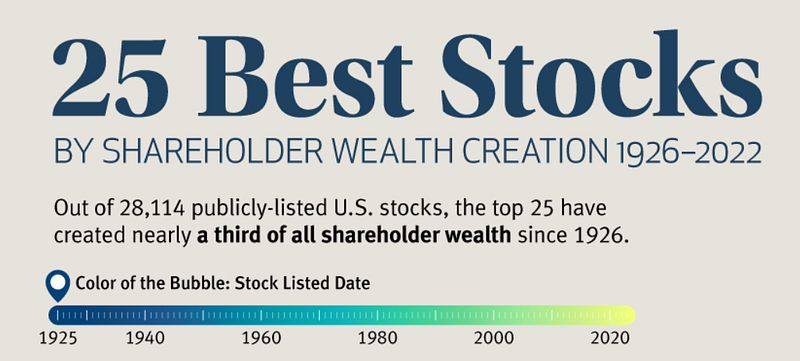
From nearly 30 thousand stocks, only 25 generated a third of all shareholder wealth in the last (almost) 100 years. That’s not even the top 1%, it’s even scarcer. It’s the top 0.3%!
Some of these stocks are Apple (which created nearly 5% of all shareholder wealth!), Microsoft, Exxon Mobil, Alphabet, Amazon, Berkshire Hathaway, and Johnson and Johnson, among others.
I’d encourage you to review the whole web page to get a better understanding of this. But for now, let’s draw the major lessons:
- Wealth is concentrated: A significant portion of the wealth generated in the U.S. stock market comes from a relatively small number of top-performing stocks.
- Getting into the right stock is key: Finding the right one can have a substantial impact on investment returns. Winning stocks return outsized gains.
- There’s a risk of missing out on huge gains: Not holding or investing in these top-performing stocks could result in missing out on a substantial portion of overall market gains.
- Innovation pays out: Many of the top wealth-creating stocks are technology companies known for their innovation and market leadership.
Being on the faster horses will bring gains you’d never imagined.
Even companies in seemingly traditional or non-tech sectors like Home Depot have delivered life-changing returns to investors. Don’t worry if you’re not into tech stocks. Opportunities for substantial wealth creation can be found in a wide range of industries, just as we see with Home Depot, Pfizer, and Walmart.
Be aware of wealth destruction
Warren Buffet’s first rule of investing is to never lose money. And the second rule is never to forget the first rule.
But we often do.
Wealth destruction doesn’t just mean a decline in a company’s market value. It’s something more sinister. In a study by Hendrik Bessembinder, a finance professor at Arizona State University’s W.P Carey School of Business, there’s an interesting approach to this concept.
Professor Bessembinder defines it as how much money you could have made if you had just parked your cash in super-safe one-month U.S. Treasury bills instead of investing in these stocks. Thus, if a company’s stock did worse than these risk-free Treasuries, it’s in the wealth destroyer category.
Sadly, the vast majority of stocks fall into this wealth destroyer category.
Bessembinder's most recent study looked at over 64,000 stocks worldwide from 1990 to 2020 and found that more than half of U.S. stocks, about 55.2%, and even more, 57.4% of non-U.S. stocks, couldn’t even outperform those ultra-safe one-month U.S. Treasury bills in terms of returns.
And here’s the real deal: all the wealth created in the global stock market during that period, which amounted to a mind-blowing $75.7 trillion, came from just the top 2.4% of those stocks. A tiny fraction of stocks were responsible for all the wealth creation.
But what about the worse-performing stocks? Those wealth destroyers where you end up holding the losing bags.
These are the top 20 stocks in the past 30 years that did the worst.
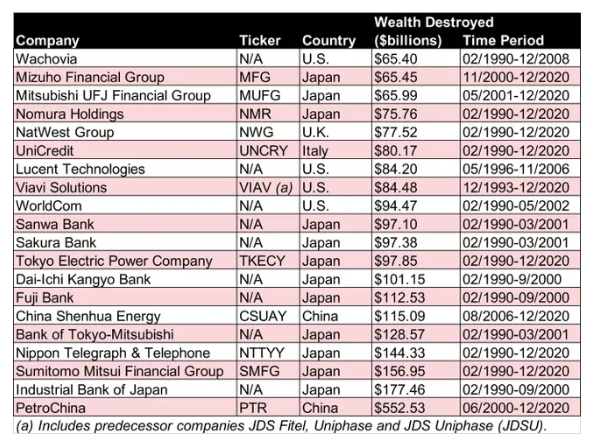
Lehman Brothers and Enron are not even on this list!
Is crypto different?
We have around 22,932 cryptocurrencies today.
According to Bitcoinist, 92% of all blockchain projects have failed already with an average lifespan of 1.22 years.
There’s a growing graveyard of failed blockchain ideas and if we take the stock market’s history performance as a lesson, around 25 cryptos will matter over the long run.
So if you see a YouTuber or influencer saying they know which altcoin is going to the moon next, take it with more than a grain of salt. Just like picking the right stocks, thoroughly researching a cryptocurrency project, (team, technology, real-world applications, etc.) can help separate the gems from the rubble. Knowledge will be your best defense.
Unlike traditional assets like stocks, where custodians and intermediaries handle your wealth, owning and storing your crypto gives you unprecedented control (and responsibility). Cryptos enables us to truly own our assets in a revolutionary way, unlike any other asset class in history.
I have a Trezor wallet and I’d recommend using it whether it’s a Trezor One (cheaper) or a Trezor Model T (a more advanced wallet).
Remember, not your keys, not your coins.
Final thoughts
As the saying goes, to be in the top 1% you have to do what 99% won’t.
It can be a hard journey, especially with stock picking that requires a lot of research, but these actions will set you apart from most.
Most people tend to focus on short-term financial goals and immediate gratification. Go for a long-term plan that includes saving, investing, and retirement planning.
Most will spend all or more than they earn, accumulating debt in the process. So strive to live below your means.
Many are hesitant or uninformed about investing. So educate yourself about investment options, taking calculated risks, and putting your money to work in assets that have the potential to grow over time. And that also includes stock picking.
So do what others do and you’ll end up where they do. But if do what they don’t do, your path will be unique and exciting, and it might end up leading you to the top 1%.
Note: this should not be considered financial advice. Always do your research before making a financial decision.
Note: this article has affiliate links.
Subscribe to DDIntel Here.
DDIntel captures the more notable pieces from our main site and our popular DDI Medium publication. Check us out for more insightful work from our community.
Register on AItoolverse (alpha) to get 50 DDINs
Support DDI AI Art Series: https://heartq.net/collections/ddi-ai-art-series
Join our network here: https://datadriveninvestor.com/collaborate