
Still holding his mud: A day in the life of ‘struggling’ guitarist Merle Haggard
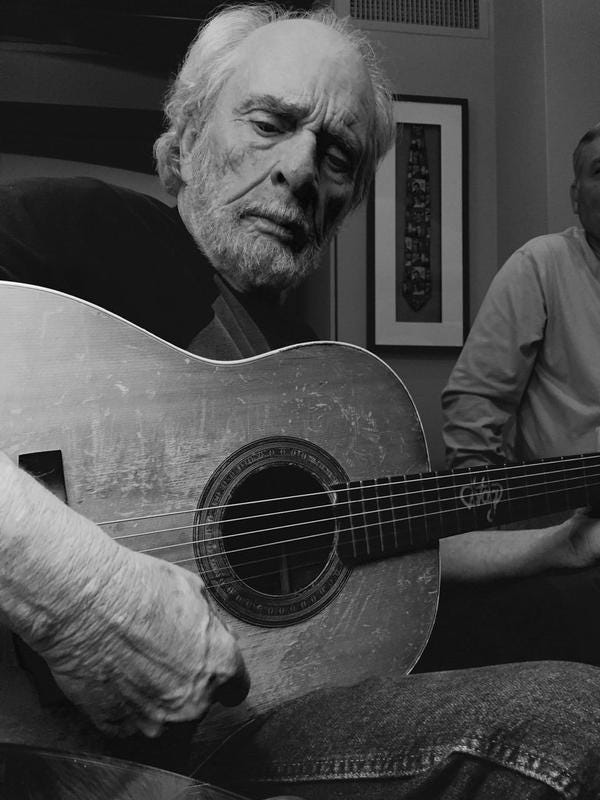
“Are we still holding our mud?” After admitting to Merle Haggard that I had witnessed him on Valentine’s Day 2013 delivering a sold-out, intentionally off-the-cuff concert in Athens, Georgia, that was the first self-effacing remark of many out of the prolific songwriter’s mellifluous mouth.
Over the course of an exclusive phone interview, the music icon waxed nostalgic about learning to play both the fiddle and guitar as a poor but blessed nine-year-old Bakersfield kid in the aftermath of World War II, raising a Fender Telecaster maestro at the dawn of the 21st century, actually receiving inspiration for a song while sauntering towards a London concert stage, his patented songwriting formula, losing anonymity, and whether stage fright can be conquered.
An American treasure and arguably the most influential country songwriter of the past 50-odd years, Haggard exhibited little signs of slowing down, recording new material — not necessarily releasing it in the case of A Tribute to the Troubadour — and playing rowdy honky tonks as far as the eye could see. Eight months after our second and final largely unpublished conversation, Haggard unexpectedly died on April 6, 2016, succumbing to double pneumonia on his 79th birthday.
In the summer preceding his death, the troubadour experienced a number one album on the Billboard country charts which also debuted Top Ten in the crucial pop category, his best chart placing since It’s All in the Game dropped in 1984. The relaxed groove of the commendable Django and Jimmie collaboration with Willie Nelson was accomplished without the support of modern bro-country embracing radio.
Answering the phone himself instead of through the all-pervasive assistant chain of command, Haggard was genuinely curious as to how I was doing, where I was calling from, and exactly what the weather was brewing in my neck of the woods.
Some artists stipulate final approval of interviews before they go to print. Not Haggard. His decidedly encouraging words: “You ain’t gonna make no mistakes. You gotta have confidence in yourself and you’ll do the right thing. Don’t worry about it.” And now, the Kennedy Center inductee takes over the reins.
The Merle Haggard Interview
Whenever I see you in concert, I can’t wait to catch you picking a solo on your custom Fender Telecaster 2-Color Sunburst electric guitar. When did you start playing guitar?
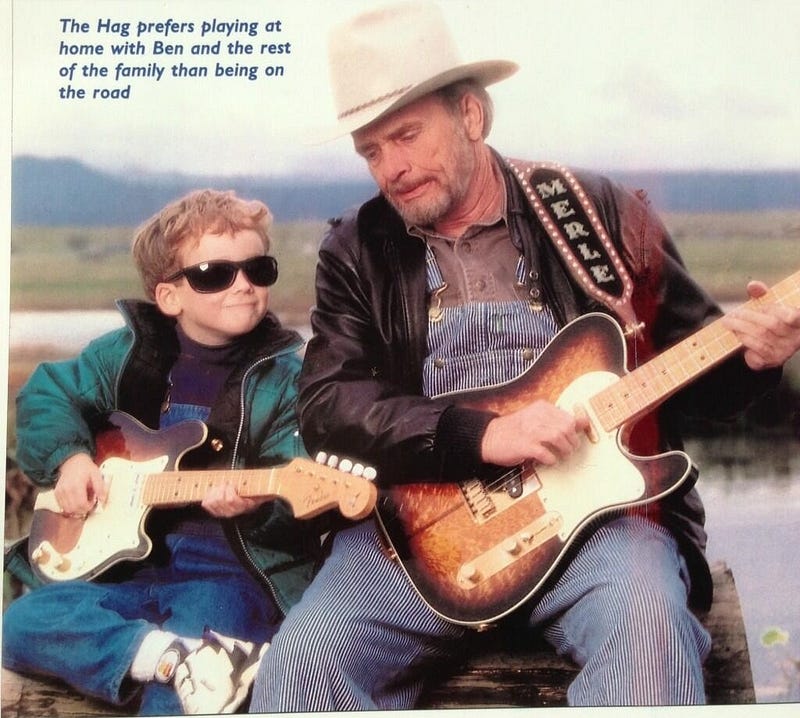
I’ve got a boy playing with me now — my 22-year-old son Ben. He’s my only student. I’m awful proud of him. He’s playing better than his teacher. He really does. In fact, James Burton, who played Fender Telecaster or dobro alongside Roy Nichols on many of my early Capitol sessions, told me one time, “That boy reminds me of myself when I was about 17.”
I first picked up a guitar when I was about 10 years old. I actually took violin lessons when I was nine for about nine weeks. I got a little basic understanding from music just from those few lessons that I had. I wasn’t operating totally in the blind. I had some little schooling on the subject.
I started trying to play guitar and kinda got away from the fiddle for many years. When I was about 33 years old, I started trying to play it again. I finally got it back to where I could play it a little bit [i.e. A Tribute to the Best Damn Fiddle Player in the World (or, My Salute to Bob Wills, Nov. 1970].
Did you buy that guitar and fiddle yourself?
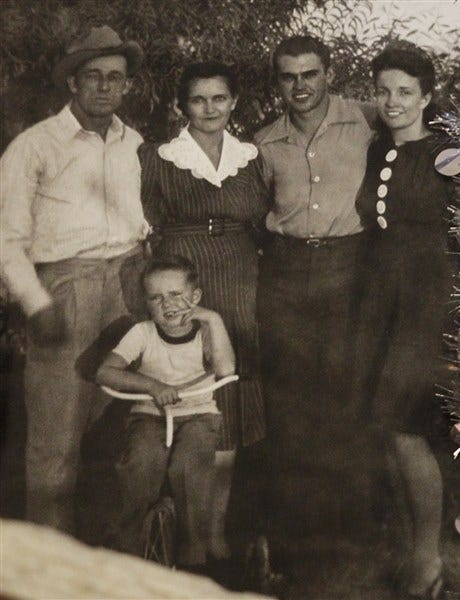
The fiddle came with the lessons. A lady came around to the house and sold my mother, Flossie, nine weeks of violin lessons for me.
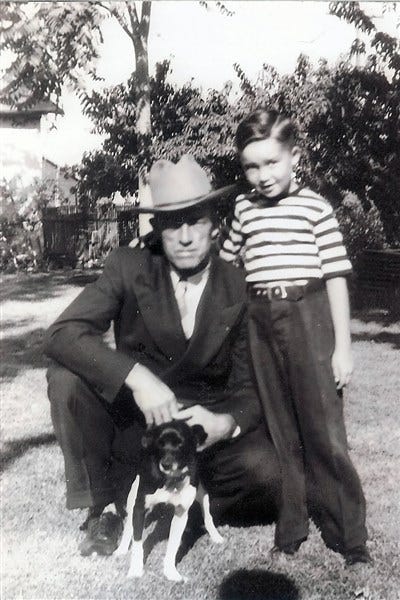
My older brother, Lowell, was running a service station and a guy came in and hocked an old guitar for a couple dollars worth of gas. Lowell brought the guitar to Mama’s. He said, “See if Merle has any interest in this. I took it in at the station.” It sat in the closet for a couple of months.
Mama got the guitar out and showed me a C chord on it. My dad, Jim, succumbed to a stroke when I was nine but she remembered a chord that my dad had showed her. She didn’t know how to play guitar but she remembered that C chord. I was about 10 years old. I’ve gone from that to what I do now.
What happened to your first instruments?
I have no idea where they might be. I don’t even know if I could identify them. That old guitar was a Bronson. It was kinda like a Sears and Roebuck answer to a Stella — same kind of real cheap guitar. The violin was a real cheap student guitar that was a little smaller than the regular one where a kid could play it. It would be great to know where they’re at.
How would you rate yourself as a guitarist?
Struggling [laughs].
You’ve gotta be doing something right if you taught Ben so well.
I know how to play. I’m just not as good as executing it as my son is. He’s got all the attributes. He’s been listening to it since he was in his mother’s womb. He’s been cradled in it. In addition he’s got full use of the Internet and he’s smart. He learns quicker than any kid I’ve ever seen.
I didn’t even know that he could play. He kept it away from me and didn’t let me hear him learn. All of a sudden I’ve got this great guitar player in my family at 15 years old. My mouth just kinda drops open. I don’t know or understand.
Ben’s been playing with me and showing me stuff that he learns. In some way or another I may have influenced the people that he likes. It’s a strange circle. I know a lot more about guitar than I’m able to play because of whatever reason.
We go out for tours in spurts. We’ll go out and play nine days for example. Then I’ll come home and set for three weeks and don’t touch my guitar. It’s kinda like if you were a baseball player — if you did the same thing you’d be in trouble.
I have to really hump and get it when we go back on tour after being off for three weeks because the wrinkle fades away real quick the older you get. But your fingers really do know what to do. They say you start to lose that within 72 hours.
There’s a real war going on between me and the road. I have to do it that way in order to keep my family. If I go out and play all the time I’ll lose my family. They mean everything to me.
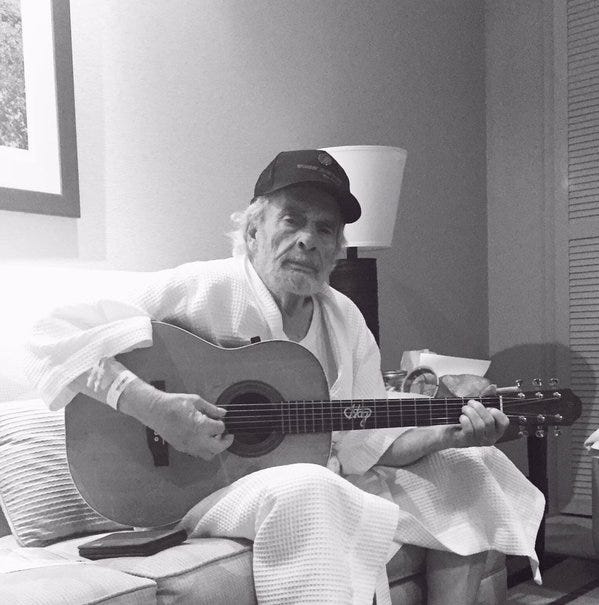
Does arthritis affect you?
My hands are still good. I’ve got some arthritis probably in my back but it doesn’t hurt. The muscle cramps are the biggest thing that I have to keep away from. The charley horse [i.e. a muscle cramp often occurring in the legs] is from developing the muscles to do what I do and then laying off. My body thinks I’m crazy. I may be.
As far as songwriting, do you have to sit down with a guitar and work at it or do songs simply come to you?
You said it right on the end. They come to me. I don’t sit down, sweat ’em out, and try to put ’em together. They’re spontaneous. I have to have somebody that can write real quick help me. If I don’t have nobody around me, I’ll try to keep it in my mind until I write it down.
It comes and it goes if you don’t capture it. I’ve lost as many songs as I’ve captured just because I didn’t have a pen or wasn’t someplace where I could write it down. Then hell it’d go away, and I couldn’t remember how it was supposed to go the next day. I wrote 10,000 songs. Sit down and sweat ’em out like I said I don’t do anymore. But there wasn’t any of ’em any good.
It has to be a gift. Somebody whispers in my ear. It raises chill bumps on my neck. When I write it down I’m just as surprised as the people are that hear it. Maybe it’s not any good to some people but some people like it an awful lot.
Do you know right away that a lyric is good or do you need somebody else’s opinion?
Well, you need confirmation. You can be sure of something that’s probably not like you think it is. You might not be saying what you think you’re saying. But I don’t have that happen anymore. I’m pretty good at identifying something that’s valuable.
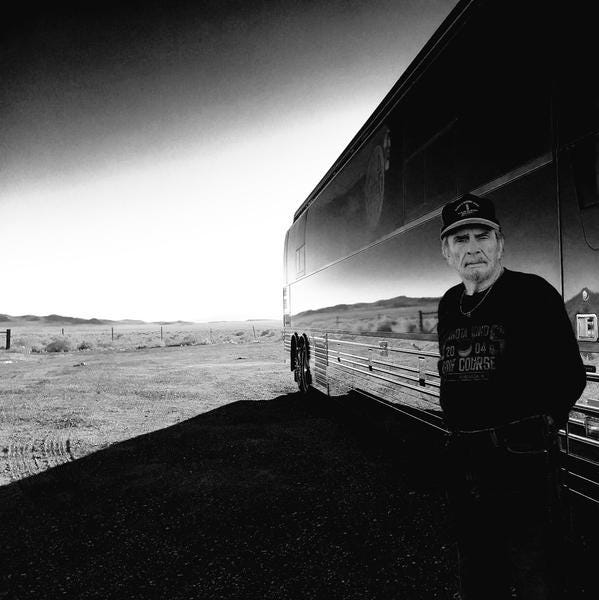
Can you write when you’re touring?
It’s whenever it comes. I’ve had songs come to me on the way to the stage — even walking with three or four other people. In London, England I wrote a song called “A Thousand Lies Ago.” I wrote that song from the bus to the stage.
I gave my saxophone player, Don Markham, one line of it. I had him remember that part of that melody. I gave somebody else another line. Four people had parts of that song to remember until after the show was over.
We were able to do that and later get it down on tape [appears on 5:01 Blues, Haggard’s final album for Epic Records, July 1989].
That’s unbelievable. Maybe it just comes down to capturing a moment.
That’s what it is.
Have you conquered stage fright?
Ah, the ugly head will rise up every once in awhile when you least expect it [laughs]. You’ll find yourself nervous. It’s an effort if you get in front of the people or do things where you’re really under the gun. I think anybody with good sense is gonna get nervous occasionally.
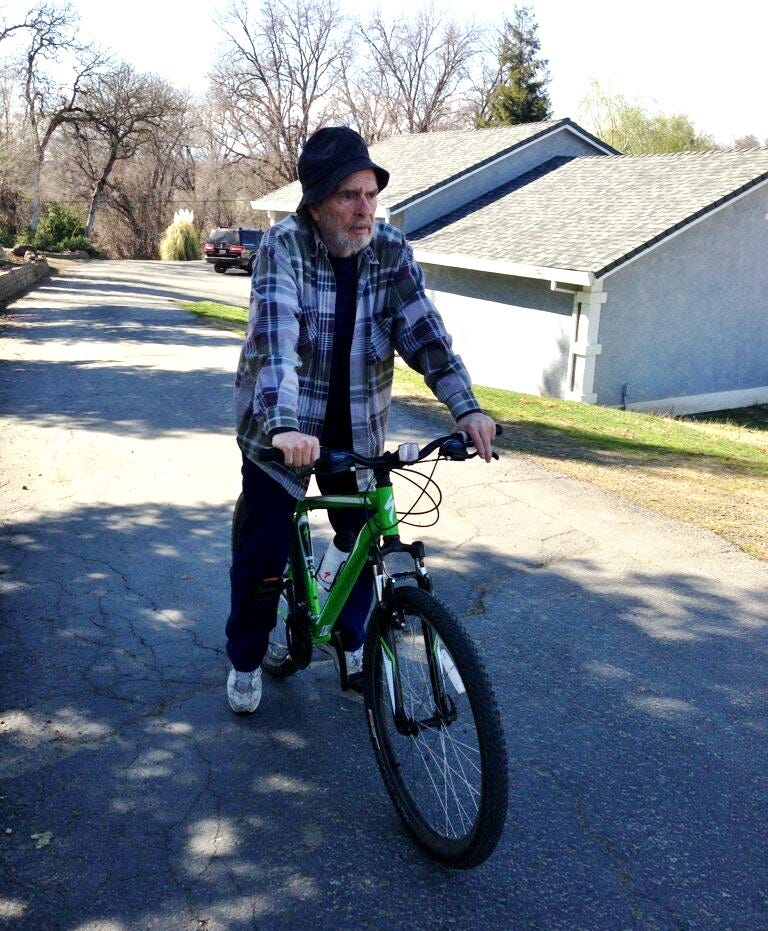
Does it bother you that you can’t go where you wanna go without being recognized?
Oh, it has its pluses and minuses. It’s probably more of a problem with my family. I hate to not be able to take my family everywhere. I can’t go to a carnival or something like that. Taking a photo or giving an autograph starts with one and pretty soon it’s a crowd. It’s just part of the game…something you have to address. Sometimes it’s fun, sometimes it’s a hassle.
What is your perfect day?
I guess just being able to breathe good clean air, wake up with a lovely woman, and have my two youngest children [i.e. Janessa and Ben] with me as well as my eldest four [Dana, Marty, Kelli, and Noel] when they get around.
I’m a family man now. I’m a grandpa, great-grandfather, and a dad all at the same time. So a perfect day would be here in Palo Cedro when the sky is clear, nobody is spraying anything, and I can go small mouth bass fishing behind my house.
© Jeremy Roberts, 2015, 2016. All rights reserved. To touch base, email [email protected] and mention which story led you my way. I appreciate it sincerely.