
Steve Jobs Secrets: The Technique For Forming Good Analogies To Solve Problems
How to form good analogies to solve all kinds of problems.

“Creativity is just connecting things. When you ask creative people how they did something, they feel a little guilty, because they didn’t really do it. They just saw something.” — Steve Jobs
In late September 1507, a curious experiment went awry. John Damian, an alchemist residing at the court of the Scottish king decided to fly off from Stirling Castle.
After having constructed wings made of feathers, Damian leapt off of the castle walls. To his great surprise, and despite flapping his arms as hard as he could, he fell straight to the ground. Luckily, this caused only a few broken bones. The man nicknamed “the leech” lived to see another day.
Damian later excused this failure by stating that it was the type of feathers that he used. Unwittingly, he had used chicken feathers, and everyone knows that chickens don’t fly. Had he constructed his contraption with the feathers of an eagle, he would have soared high up into the sky just like that majestic bird.
In a way, this little story does serve to illustrate a point. Humans often resort to analogies in order to solve problems. Damian wanted to fly. He saw that birds could fly. And what did birds have? Feathers!
Using analogies can lead to bad conclusions like this, but a lot of times analogical thinking can find the right answers. Many world-shattering innovations have resulted from simple insights using analogies.
When Sergey Brin and Larry Page were designing their little search engine, they were still just lowly PhD students at Stanford. As researchers, they were used to the fact that you needed citations in order to progress in the academic world.
The more citations you have, the more successful you are considered. They had the brilliant insight of applying this analogy to the world of the internet. Webpages are like academics, and links are like citations.
The more links point to your site, the more “authoritative” the page probably is. Hence it should be ranked higher. This simple analogy was behind their Google search algorithm.
The rest is history, as they say. Google became a juggernaut, which is now one of the most dominant forces on the planet. Yet, all this started with just a simple analogy.
How to apply an analogy to solve your problem
Analogies can be an elegant way to solve problems in an efficient and effective manner. They can also be a great source of ideas in any type of discipline. The good thing about them is that they don’t require you to expend too many resources to use them.
So how do you go about creating good analogies to solve problems? There are three steps for applying analogies:
1) Mapping Step 2) Application Step (Inference Step) 3) Learning Step
How does this work? You have a problem and you figured out that using an analogy would be a good way to solve it. This means you are comparing two things. You take lessons from one and apply them in the other.
You start off with a source system that you know well. Then you take lessons from it and apply them to solve the problem. This other system is often called the target system.
First, in the Mapping Step, you take the source of the analogy and map it to the system (target) that you are trying to find out more about. Second, in the Application Step, you apply this new mapping in order to solve the problem that you are facing.
The Application Step can also be called the Inference Step, since you infer or form an opinion on the matter based on the information that you have, which then helps you to come up with a solution.
Third, in the Learning Step, you can come up with a generalization of the principles, which you then potentially reuse to solve different types of similar problems.
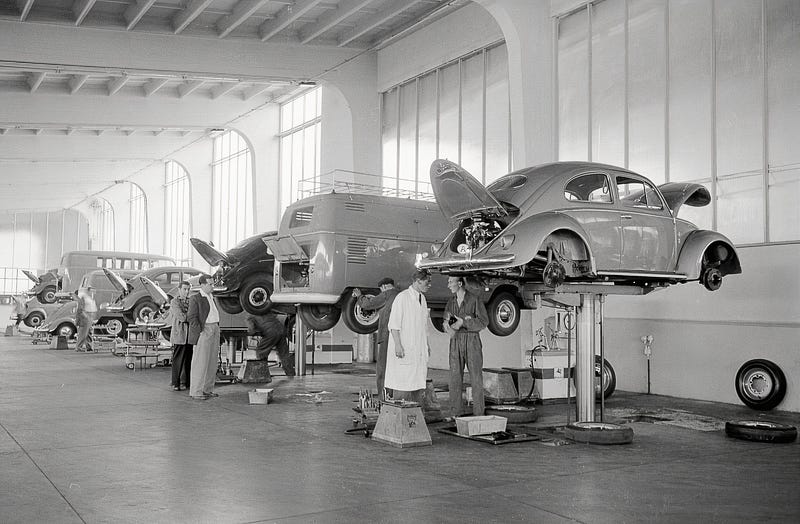
Let’s illustrate this on a familiar example. How did the process for the mass production of cars in Ford’s factories come about? When William Klann (a worker in Ford’s car factory) was visiting a Chicago meat-packing factory, he was inspired by what he saw.
There were conveyor belts that were pulling animal carcasses along, and at certain points these carcasses would arrive at the station of a person who would then strip it of a certain part of meat. So this person would specialize in just that little task.
In his mind, Klann did the Mapping Step. The carcasses are akin to the cars in his own factory. The workers in the meat-packing factory are akin to the workers in the car plant. Once he did these initial mappings, he moved onto the Application or Inference Step.
If the products and workers in both types of factories are equivalent, then you can probably use the same process you use in the meat-packing factory to mass manufacture cars.
You can move the cars along the conveyor belt and have people specialize in only one task, putting in one small part of the car again and again. This would then solve the problem of the mass production of cars.
Once you successfully apply the mappings and start to mass manufacture cars using this process, then you can move onto the Learning Step. This is when a generalization comes in. The conveyor belts and specialization can be used in many different industries in order to do a similar process for many different products.
The key to forming a successful analogy, like in the case of animal carcasses and cars, is what some researchers call the systematicity principle. This is to see beyond the surface and try to find connections which might not be apparent at first look.
What you have to realize is that independent facts themselves don’t matter that much. What is important is the connected knowledge.
How to make a good analogy
The thing is that good analogies can often be quite abstract. What you need to pay attention to are the similarities in the relations of the different actors and elements in a system.
One example that can be used to illustrate this is comparing the flow of electrons in an electrical circuit to the flow of people in a crowded subway tunnel. Here the electrons themselves do not resemble people at all on the surface. However if you take a closer look, then the higher-order relations between these things will become apparent.
Once you grasp these relations between relations, you can apply the analogy to create some interesting solutions to problems. How can you use the analogy of people going through a subway passage to inform you on electron flows?
Imagine a crowded subway tunnel with huge crowds of people going through it on their way to catch their subway train. If you add a very narrow gate in a subway tunnel, then this will act as an obstacle for the people to pass through.
They will have to line up and start passing one by one, which means that the rate at which the people pass through there decreases. You can apply this as an analogy to electrons. If you add a resistor to a circuit, this will cause the rate of flow of electrons to decrease.
Think in terms of higher-order relations
By thinking in terms of these higher-order relations, you can see the linkages on a deeper level. There are several of these deeper level analogies that ended up revolutionizing the way people work in the world.
One of the most ground-breaking ones was when someone decided to compare what you see on your computer screen to a physical desktop. Imagining your screen as being akin to a desktop, automatically gives you ideas on how to organize things.
This is a deeper connection that Alan Kay came up with at the Xerox PARC Laboratories, and one that Steve Jobs saw great potential in. That’s why your computer contains files, sheets, even trash cans.
There are lots of other similar examples. You might not think that water and economics have much to do with each other, but even there you can find higher-order relations that can be exploited for various purposes.
In 1949, Bill Phillips, an economist from New Zealand, tried to simulate the flow of the economy by using the flow of water as an analogy. He started thinking of money as a liquid that was flowing through the economic system. The economic system itself could be described as a form of plumbing.
In order to see what was happening in the economy, Phillips constructed an analog computer called the MONIAC, which regulated the flow of water. This type of analogy came to be called hydraulic macroeconomics.
A similar concept had been used previously in the Soviet Union in a different context. In 1936, Vladimir Lukyanov built the Water Integrator, an early analog computer.
Analogical thinking came naturally to him since he was already primed for it. Lukyanov had spent a lot of time doing analogical thinking. The idea for the water-based machine came to him after he became familiar with several different theoretical frameworks on analogies.
One of these was the work of Nikolai Pavlovsky. The great insight of this Soviet researcher was that in modeling you can replace one physical process with another. If the two things are described by the same mathematical equation, then you can use one in place of the other.
Even when making this switch, the conclusions you come up with are valid for both systems. This has come to be known as the principle of analogy in modeling.
Armed with this theoretical knowledge, Lukyanov headed out to work as an engineer on the construction of a railroad. While at this job, Lukyanov initially got stuck trying to find a solution to one incredibly important problem.
He was facing the issue of the concrete cracking quite frequently. This slowed down the construction work significantly, and caused many issues with its quality.
What Lukyanov did was to use the flow of water as an analogy for the thermal processes that were behind the cracking of the concrete. In order to put this analogy into practice, he built the Water Integrator, which was a complex machine using the flow of water to calculate differential equations.
Once the process proved successful in that specific case, this type of machine was then applied to other problems in a variety of fields, in the Soviet Union and abroad.
With the example of the Water Integrator, you can quite clearly see the 3 steps in practice. Lukyanov combined different types of knowledge on analogical thinking (such as the work done by Pavlovsky), which then gave him the idea to use the analogy of water flows to model thermal processes.
This was the Mapping Step and the Application Step. Later, this analogy was generalized, and applied in many other domains. This was the Learning Step.

Analogies can be abstract
The examples I described show how some very abstract analogies can arrive at pretty good solutions to many types of problems. These can then sometimes be generalized in order to be applied to solve a variety of challenges in different fields.
The key to forming good analogies between things that at first glance seem unrelated is to strip away the factors that are irrelevant and see it all on a more abstract, conceptual level.
For example, think of the analogy of the flow of electric current in a wire, and how in many ways it is physically similar to the flow of fluid in a pipe. This is because heat and fluid follow similar physical laws. These similarities then have been applied in the study of many types of things that are called transport phenomena.
Transport phenomena concern the exchange of such things as mass, charge or momentum in different systems. The basic insight for their study is that you can determine the properties of one of the systems studied by modeling it through a different type of system (electricity and water for example).
You can sometimes get even more abstract, such as with the analogy between the flow of people in a subway tunnel and the flow of electrons on a circuit. However, the more abstract the model gets (the more abstract the analogies are), the less it will most likely be able to explain, and the less applicability there will be to create new solutions.
The ones that have more observable shared features are usually the things, which have the closest parallels (but not always, and also the parallels which are more high-level can also be significant).

Is this a good analogy or a bad one?
When trying to apply analogies you need to keep some things in mind. You have to be realistic about the model you are using and decide what it can and cannot explain.
Which things are really good analogies for this problem and which aren’t? There is a spectrum of analogies, ranging from perfect ones, to ones that are wholly misleading.
What is a good analogy? There are always two things at play here: how well you know the source system and how representative it is. There is a trade-off between these two things. Some things you know well might not be that representative of the problem you are trying to solve and vice versa.
One thing is clear: in order for the source analogy to be a good one, you need to know a lot about it. If you are applying an analogy which you don’t know much about, you risk missing some essential elements of it. This type of misapplication could really skew the results.
So when you are going through the process of deciding whether to apply this or that analogy, you have to go through two steps. These are done in parallel to the three steps of forming an analogy (Mapping, Applying, Learning):
1) Decide 2) Adapt
How to decide whether the analogy fits? Let’s say that we want to use the people in a crowded subway tunnel analogy in order to improve the way we manage the flow of electrons in an electrical circuit.
How do we decrease the flow of people in a subway tunnel? By adding a gate. Can this be applied to the flow of electrons? Yes, you can. What can you use as a gate for this? A resistor.
The important thing here is not whether a resistor is structurally the same as a gate, or a person is somehow the same as an electron, but instead the similarity of the relationship between a subway tunnel, people, and a gate, to that of electric circuits, electrons, and resistors.
If those relationships are indeed similar, then the analogy has the potential to be applied successfully. Here, both the Decide and Adapt steps are good to go.
Now let’s try to see whether we can do something interesting with another analogy, one between the postal system and the internet analogy. With this analogy, people compare the internet to the postal system, where letters are akin to the packets of data that are used to send information on the internet.
In the process of examining this analogy, you determine that at the moment you don’t find any applicability. Maybe this particular analogy can be used only for its descriptive power, but has no practical purposes.
Remember the two main functions of analogies: understanding and problem solving. Maybe the postal system/internet analogy is only good for understanding, while the subway/electric circuit analogy also had applications for problem solving.
This means that the first analogy helped you to solve a particular problem, while the second one could only be used to help you understand how the target system works.
You decided to use the first one, but discarded the other one for problem solving. However, even the analogy you did take on board, you needed to adapt in order to make it fit for your purpose.
Always keep in mind that you should be careful with what types of analogies you use and when you use them. If you use the right analogy, then you can solve the problem. If you use the wrong analogy, you just end up with garbage.

Note: A previous version of this article on techniques for analogies was posted on my blog.