
Sternberg’s Theory of Love (a different story)
Types of Love from a Scientific Perspective
Since love is an ethereal concept, putting it into words is probably one of the hardest things to achieve. This is due to the lack of a widely recognized theory even about the nature of love. In the world of love, there has always been uncertainty and misunderstanding.
Robert J. Sternberg’s theories are notable among the major theories of love. Sternberg proposed a theory in 1987 where he represented love as a triangle. According to him, love consists of three components: intimacy, passion, and decision or commitment.

The three components of love in Sternberg’s theory
The first component of love: Intimacy Sternberg considers this phrase as indicating emotions of closeness, despite its own varied interpretations. Thus, intimacy forms the essence of love. According to Sternberg’s research, ten different components make up intimacy with a loving person: 1- Desire for the well-being of the beloved person 2- Experiencing happiness with him/her 3- Paying close attention to him/her 4- Being able to rely on the beloved person in times of need 5- Mutual understanding 6- Sharing personal matters with him/her 7- Receiving emotional support from him/her 8- Providing emotional support to him/her 9- Establishing an intimate relationship with the beloved person 10- Respecting him/her
The second component of love: Excitement and Longing (Passion)
The second component is longing and excitement, which are motivated by satisfying mental and physical interactions with the beloved and are based on sensual desires and physical attractions. There is a motivating component to this dimension.
The third component of love: Decision/Commitment
The component involves conscious and unconscious decisions to love and commit to maintaining a relationship, including short-term and long-term commitments. It involves prioritizing the relationship over other relationships, ensuring exclusivity and commitment.

Types of love in Sternberg’s theory
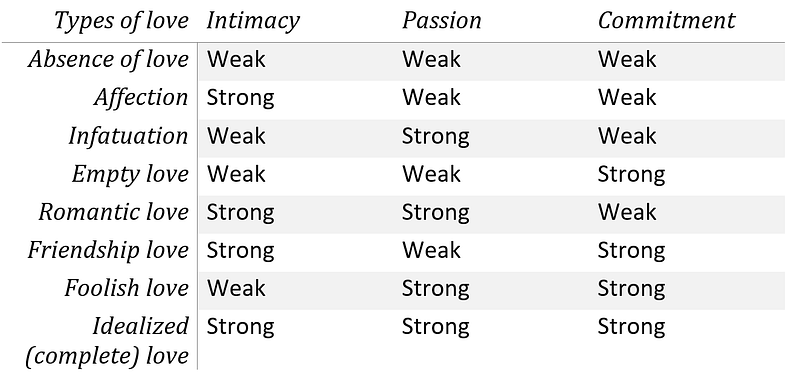
Sternberg believes that the existence of each component varies in romantic relationships and that all three elements of love rarely come together equally in a person. He continues to state that intimacy, passion, and decision/commitment come together to form eight distinct kinds of love, each with unique traits, benefits, and drawbacks. However, some kinds of love are linked to greater levels of happiness than others.
According to Sternberg’s love triangle, the types of love are comprised of:
The subject you must know:
To support me through my investigations you can buy me a book📖 and also For more interesting and engaging facts, subscribe and follow now.


