Stephen King Takes Time In His New Novel to Assure Us He’s a Good White Man(TM): A Review of Fairy Tale
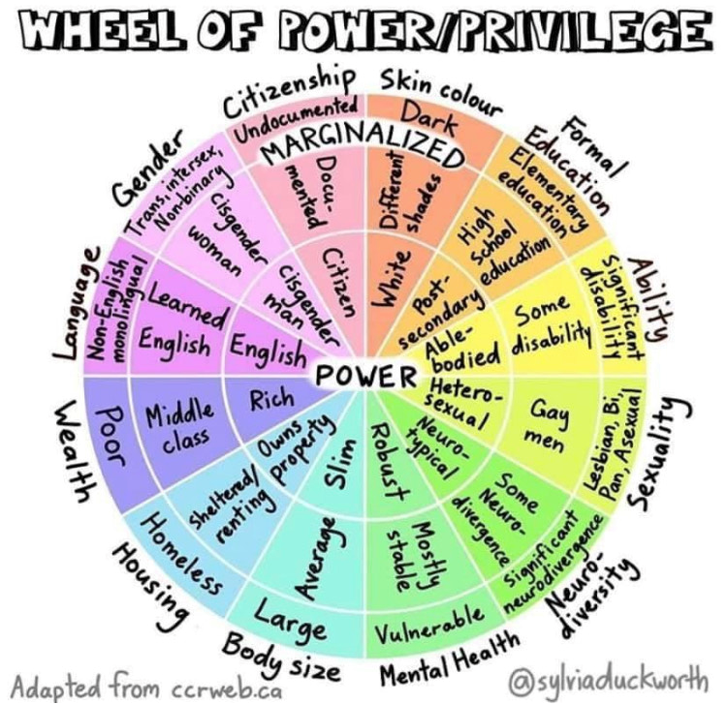
As the political left became increasingly focused on identity (race, sex, sexuality, etc.) as the sine qua non of relationships, politics, scholarship, and art during the past decade, this brought the previously obscure theory of intersectionality to the mainstream. Credited largely to Critical Race Theorist Kimberlé Crenshaw, intersectionality posits that discrimination can overlap in complex ways dependent upon multiple identity categories. Intersectionality has a fair point insofar as understanding that discrimination can be complex, but also had the pernicious, perhaps unintended effect of creating its own moral hierarchies. Various examples, such as the Wheel of Power, or City University of New Yorks’ Hierarchy of Power, Privilege and Oppression, assure us that unfair and unearned advantage can easily be identified based on identity characteristics. Greenpeace’s White Supremacy Pyramid leaves little mystery to who the bad guys are (and among the signs of White Supremacy are colorblindness and, of course, the fingercuffs of denying white privilege). In case it weren’t clear, others put it more directly that power and privilege have been the preserve of “straight cis-gender able-bodied white men.”
This, of course, doesn’t let others off the hook should they criticize this dominant, indeed hegemonic progressive narrative. White women are routinely slapped with “Karen” memes, black male privilege is now a thing, Latinos and Asians informed they are “white adjacent” and non-whites who criticize progressive beliefs are ironically attacked with racist comments. Yet this sense of original sin based in immutable traits has inevitably created various forms of confessional designed to, at least in part, alleviate this original sin. Donations to groups like Black Lives Matters form a kind of indulgence (one must put their hashtag in the bio or on the department web page, no matter how many mansions BLM buys with their endowments). Academics have increasingly turned to positionality statements to confess their identity sins and pledge allegiance to the correct thinking of the political left. Particularly if one finds themselves described to a T in the “straight cis-gender able-bodied white men” condemnation there’s no identity into which to retreat from this original sin of “privilege.”
In 2022 Freddy DeBoer developed the concept of the Good White Man. The Good White Man professes his rightthink, his allyship, condemning the evils of other white men, all while maintaining his own status. As DeBoer writes:
“…Good White Men believe that white men in general have some sort of inherent badness…Good White Males think whiteness and maleness are problems to be solved. The trouble here is twofold. First, simply by nature of being Good White Men, by the very act of endlessly talking about the sinful nature of other white men, the Good White Men exonerate themselves from the very critique they advance. Constantly complaining about the evil done by white men inherently and invariably functions to contrast themselves with other, worse white men. Being the white man who talks about the poor character of most white men cannot help but shine your own character. No matter how reflexively you chant that you realize that you yourself are part of the problem, no matter how insistently you say that you’re included in your own critique, you aren’t. You can’t be. To be the one who makes the critique inevitably elevates you above it.”
I thought about this concept of the Good White Man while reading Stephen King’s latest novel Fairy Tale wherein Mr. King takes a few moments to assure us that he is, indeed, a Good White Man.
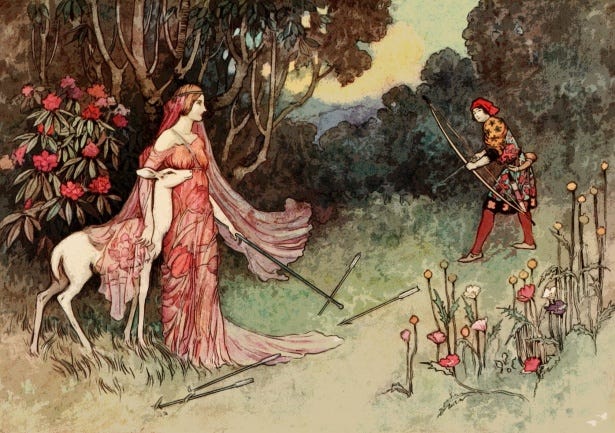
But first, a bit about the book. Fairy Tale is King’s latest effort (Eyes of the Dragon being a much earlier effort in this genre) to summon up some of the magic of fairy tales. It follows the story of a high school boy who ends up befriending a cantankerous older gentleman whose house just happens to have a portal to another world (called Empis) in the backyard shed (how or why it is there is something we just wave away…this is high concept writing). The fairy tale in question comes as our young protagonist explores the fantasy world on the other side of that portal and is, of course, tasked with saving it from the evil that lurks there.
The novel takes place in 2013 but is narrated in 2020 (King wrote it between 2020 and 2022). This is one source of many of the clumsy anachronisms wherein the narrating character appears to think things that nobody in 2013 would have thought outside of the most radical of ethnic studies programs. King himself references this anomalous narrative style toward the end of the book, but overall it feels like clumsy writing. So why do it?
The best books (and movies and video games) give us the opportunity to be free of the real world, to immerse ourselves in fantasy worlds where we can forget, for a bit, the messy scrum of politics and culture war in the real world. It’s become fashionable in left circles to argue that everything is political and failing to speak to politics (left politics specifically) is itself a bad political act. Unfortunately, the inevitable outcome of this is bad art, and Fairy Tale suffers from this in a few points.
Thus, Mr. King takes time from his novel to signal he is on the right side of history not all the time throughout the novel, but just enough that we can get the hint. Early on, our high school student narrator is woken from daydreaming by his teacher asking him to opine on “blue on black shootings”…very much a 2020 talking point, but one barely on the radar in pre-BLM 2013 America still optimistic about its post-racial Obama moment. Never mind that the data suggests that class, not race, is predictive of police misconduct, asides such as this seem to fulfill little function other than to signal King’s rightthink. After all, our student could have been in any class with the teacher discussing any topic, but our student narrator happens to be in an America Today class (I was left wondering how many high schools in 2013 even had such a class) discussing police shootings. The odds, right?
That same page, our protagonist is ogling a pretty blonde girl and declares “white America ain’t all bad.” Generously, maybe this was some kind of satirical joke about the overreaches of progressive narratives, but given King’s other virtue-signals in the book, it was hard to interpret it as such. The comment felt ironic in that King is using the objectification of a teen girl to make a wry but supposedly politically correct statement about race. It wasn’t that long ago that King, with his son Owen (and let us not comment upon the privilege of nepotism), released the utterly forgettable Sleeping Beauties which seemed to capitalize on the #MeToo movement. So much for that, I guess? We’re back to objectifying women (or girls in this case) so long as we do it for the right cause.
The problem with these unnecessary asides is that, in signaling progressive rightthink, King rips the reader out of the narrative. Immersion is killed. These asides just don’t fit and read as silly. A few pages on King assures us he’s not one of the imbeciles who flash the OK hand sign to indicate whites rule. King appears unaware of the hoax origin of this, and giving this issue more oxygen probably both encourages real racists to capitalize on it, but also fuels false accusations such as cost at least one Latino-American man his job. Really, it’s just a goofy and unnecessary aside. We get it, Stephen, you’re not a racist.
It’s important not to make a mountain from a molehill…there are perhaps half a dozen or so similar unnecessary asides. The book ends with an eyerollable reference to how bad (white American) humans are referencing the tentpoles of treatment of Indigenous people and climate change. The line is so obviously shoehorned in as a warning how Americans discovering the portal might ruin the fantasy land beyond. Never mind that Empis, the land beyond, was nearly twice destroyed by its own denizens requiring a literal white savior to rescue them. Nor that the issues of European/Indigenous history and climate change are more complex than progressive narratives allow. Nonetheless, to be fair, the book is a hefty 598 pages long, and if these moral asides are about as subtle and accurate as Reefer Madness it’s possible to forget them in the distance between them.
Part of the issue is that they feel more desperate than sincere. Let’s remember this is the author who included a preteen gangbang scene in IT (no it didn’t make it into the movie for obvious reasons). The comments fit with King’s overall progressive posturing on social media (to which he is welcome of course and I probably share more of his views than I do not), though his tossing JK Rowling under the bus with the “trans women are women” slogan in 2020 felt like an individual rather desperate not to end up on the wrong side of progressive waves. To be fair, twitter rots all our brains, and I can’t claim immunity. What is twitter for, after all, other than to signal how clever and politically virtuous we are? I am hardly one to throw a stone here, and King is only doing what humans do. But the slippage of tweet mentality into novel writing is an unfortunate trend.
Fairy Tale also is limited by several other issues. As has been common with many of King’s more recent books, it’s a slow burn. King is a master when it comes to developing the personalities of core protagonists (by contrast his villains can feel 2-dimensional and they are barely afterthoughts in this book). However, most of the first half of the book spends far too much time on the minutiae of the developing relationship between the teen boy and the old gentleman who owns the house. The second main issue is, once the story gets going, it really just doesn’t feel like a fairy tale, setting aside. Perhaps King makes too many references to people crapping and farting, and much of the second half of the book is essentially a prison break, but this fairy tale lacked real magic. The climax feels rushed and obligatory, and we just never know enough about the bad guys to feel any real loathing for them. The timeline of events that happen before our protagonist arrives in Empis also felt muddled, though perhaps I just misread.
That’s not to say Fairy Tale is an awful book, it’s just not one of King’s best and, being honest, probably wouldn’t have been published without the King name. Optimistically, I think the era of one-dimensional political takes is slowly (too slowly) drawing to an end. Even the “trans women are women” quasi-religious slogan that shattered the relationship between Rowling and King I suspect will be looked upon as an error, if well-intentioned; an error that slowed society’s acceptance of trans individuals, not hastened it (even Rowling, I suspect, is winning her particular battle, likely to King’s ultimate embarrassment). But it is time we ask, no beseech people in positions of actual power and privilege such as King: stop condescending to lecture us on those things which you don’t know well. We have enough of silly politics, whether on right or left. Tell us stories that take us away from all this instead.