

Writing Advice
Stephen King’s Advice On Writing the First Draft
Put away your dictionary.
I found a lovely new writer’s website the other day and it was by accident, as is always the case, because it featured an old article by Stephen King titled: “Everything You Need to Know About Writing Successfully — in Ten Minutes”.
The article is a bit dated with some of the advice maybe not wholly applicable anymore, but the rules are solid and good to follow and given that I just finished a draft that was meant to be seven thousand words but ballooned to twenty-four thousand words, I found his writing rules both encouraging and true. But then the advice is coming from Stephen King. Of course it will be applicable.
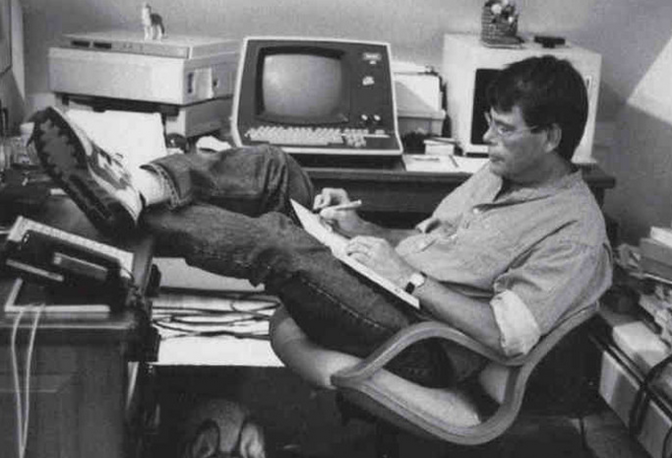
The section that stood out for me, that mirrored my own recent experience, is the following one:
“You want to write a story? Fine. Put away your dictionary, your encyclopedias, your World Almanac, and your thesaurus. Better yet, throw your thesaurus into the wastebasket. The only things creepier than a thesaurus are those little paperbacks college students too lazy to read the assigned novels buy around exam time. Any word you have to hunt for in a thesaurus is the wrong word. There are no exceptions to this rule. You think you might have misspelled a word? O.K., so here is your choice: either look it up in the dictionary, thereby making sure you have it right — and breaking your train of thought and the writer’s trance in the bargain — or just spell it phonetically and correct it later. Why not? Did you think it was going to go somewhere? And if you need to know the largest city in Brazil and you find you don’t have it in your head, why not write in Miami, or Cleveland? You can check it … but later. When you sit down to write, write. Don’t do anything else except go to the bathroom, and only do that if it absolutely cannot be put off.”
Normally I write by the seat of my pants, but in this case I wrote my story from a detailed outline. I did my research until I thought I was ready and then I began. But words… they don’t always come to you when you need them and I made the mistake of chasing them down. That affected my rhythm and, in King’s own words, broke my writer’s trance.
I was also writing to deadline, churning out words at speed much faster than I usually do, and I found searching for words only wasted more time. But here is the thing, though, my normal way of writing is slow and cumbersome. I search for words because I usually get a feeling of what I’m looking for and because I can’t think of the word right there and then, I go look for it. This is contrary to King’s advice, I know. And yet it works for me. So the question is, how well does it work for me?

That, I can’t tell you yet because I don’t know yet. I can tell you this: with writing my latest story I eventually followed King’s advice. I ignored dictionaries. I ignored my thesaurus, and my homemade dictionary (which is still sparse). I even ignored my research and just left markers at places I had to come back to. I repeated a lot of words and I know my sentences are weak and a lot of them are passive and there are errors, but my story unfolded in real-time while I wrote it, and that felt fantastic.
Oh, and I finished the story, which is a biggie.
Once I’ve revised this story and have other people look at it, I will take a moment and reflect on the experience and compare it to how I usually write. Maybe then will I know which way works best.
Cheers!
Woelf
Update: It seems my story did not turn out too terrible. It has now been critiqued by a number of people and I’m currently editing it before sending it to a professional editor. I enjoyed the process so well I am currently writing another story based on an outline. No, I am still a pantser.
Originally published at woelfdietrich.com on March 3, 2015.


