
NEOWISE Comet
Stay Up All Night. Let’s Watch the Universe Move.
Poets and physicists can’t see us up here.
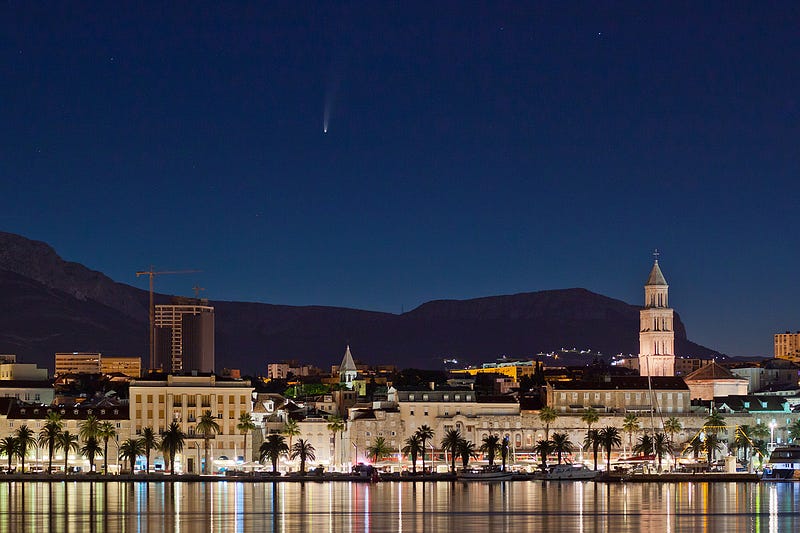
Come with me to the roof.
We can wait for the stars to shine.
What could be more lovely than the garden at the end of a hot day? Even the mosquitoes seem drowsy as they brush your limbs with fat furred antenna. You can’t begrudge them your blood, their nightly wine, on an evening like this. Everything deserves its rest.
The mountains recede into the thick blue haze of the night. Above their snow-scarred crowns, the first stars are showing yellow faces. The mountains cup the valley like fingers curling into the sky, and the broad lazy river is the lifeline running down the center of your palm.
Nonsense. The creases in our skin know no more than we do, no more than the thoughtless stars that only know how to shine. But in the evening when the world breathes, you can believe in nonsense. The day is young, each bright morning bold and new and boiling with the endless potential of new life. Time to be hard-edged, to be productive, to scoff at the flighty nonsense the heart tends toward.
But the night is old, much older than we are. It makes us feel young.
To see and not be seen.
That’s the dream of the mosquitoes and the moths and the mountain lions that prowl the frowning forest. Up here, we have that. Cars go cruising past, pushing white light ahead of them, dragging red light after, like the Doppler shift that tells us the stars are moving.
No one looks up. No one sees us but the stars. And you know, like I do, that the stars can’t see anything. They shine too brightly to look at anything else. These same stars forged the iron in your hot blood that makes the mosquitoes drunk with happiness, fat with life.
The same stars that keep us madly circling, spinning, waltzing through the endless void we pretend isn’t there so we can keep adding to our stock portfolios or working the closing shift.
We are still waiting, you and I, up on the perfect isolation of the roof, for the rough tiles to slowly give back the heat of the day back to the frozen stars above.
That’s okay. It’s nearly seven thousand years since this comet last visited earth. We can wait another hour or two.
Don’t go to sleep tonight, said Rumi.
The longer we stay up here, the brighter the stars become. Maybe now.
Maybe now.
And in this tranquil waiting, the song of a fountain keeps us anchored to the earth while an ocean of stars gives us vertigo. Our scars swell on the surface of our skin, bright as the mist-born rainbow that forms at the blowhole of a whale. The universe wants it back. It wants it all back. It wants to unweave the threads of us both and rework them into the grand and beautiful pattern.
But not yet. Tonight, we’ll leave scraps of skin and sebum behind on the rough roof as the only trace we were here. Tonight, we will stay up and intact.
How could a comet not be a portent?
Surely some momentous event must follow. Comets that can be seen with the unadorned human eye are rare, but for tens of thousands of years, our eyes were all the universe had to look at itself.
It’s easy to forget that the sky at night used to be brighter. That the stars used to be bolder before we learned to push sullen photons around. Every night when our ancestors stayed up, they were adrift in an ocean of hurtling stars.
Of course, comets aren’t stars. We know that now. We’ve always known. These wandering visitors reach us from a dark corner of the galaxy, and when they catch light from our sun, they shine brighter and longer than the stars they came from.
The Great Comet of 1680 was visible in broad daylight, a sickle raised above the earth. The September Comet of 1882 may have been the brightest ever seen, a pitted dagger glowing in Mediterranean sun.
Comets are great travelers, but they are predictable. They migrate like butterflies, and we can track their long journeys around the sun and leap back in time to give names to once-mysterious visitors. It was Halley’s Comet, we now know, that shone in the sky in the eleventh century, immortalized in the Bayeux tapestry as an omen of the Norman conquest of Britain. It was that same comet that Giotto painted in his Adoration of the Magi in 1301.
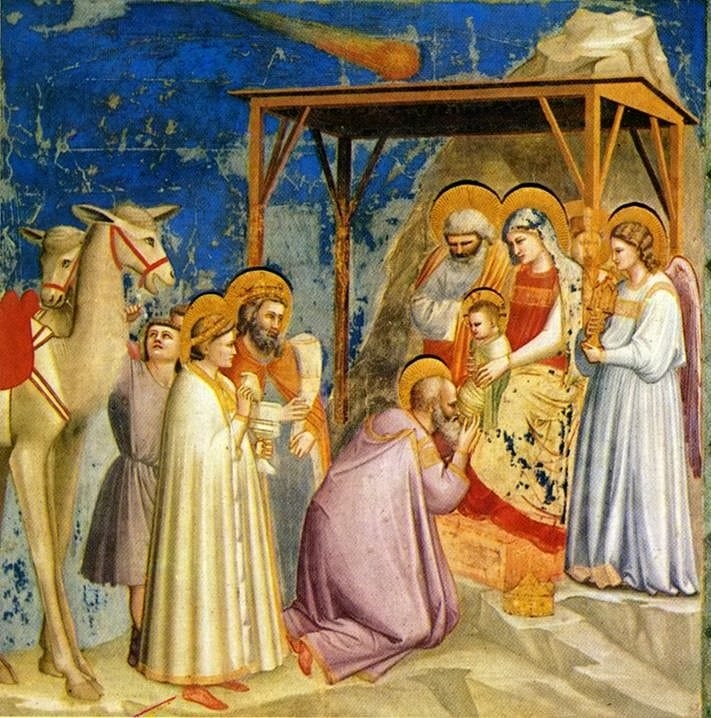
Aristotle wrote about comets in his Meteorology, where he regarded them as a phenomenon of weather. Thomas Aquinas disagreed, but believed them to be evil omens. Silver-nosed genius Tycho Brahe was able to deduce that comets came from the deep reaches of space. Isaac Newton studied the 1680 comet and calculated its long elliptical orbit around the sun.
We know now that comets are chunks of frozen gas and rock left over from the formation of the solar system. But anyone who has lived for any amount of time in this world knows that your brain can know one thing, and your eyes another. Knowing what that glowing ghost in the night sky is made of doesn’t make it any less fascinating.
In fact, the poetry of an occasional visit from these distant and ancient wanderers is greater than any story we ever made up about them.
Halley’s Comet is famous partly because it visits so frequently. Its 75-year cycle makes it the only comet that can appear twice in a human lifetime. Famously, Mark Twain was born during its perihelion in 1835, and died the day after its 1910 apparition, just as he always hoped.
I was three years old the last time Halley’s Comet was seen from Earth.
Maybe we’ll both be alive to see it again in 2062.
I don’t remember Halley’s Comet. I do remember Hale-Bopp. I was fourteen when it started shining in the night sky above my father’s house, and continued shining for a full eighteen months afterward.
I didn’t know back then that I would one day end up on this cooling roof with you, talking in low voices while we wait for another omen to appear. None of us will ever see it again. Its next scheduled appearance is sometime around the year 4385.
We can see the comets, but they can’t see us.
And there’s a distinctly human arrogance in the old idea that comets were omens concerning human fate. Ancient chunks of ice and rock don’t care about your job interview or your daughter’s white cell count or your carefully chosen lottery numbers.
Like so many beautiful things, they don’t care about anything much at all. They merely respond, letting the universe play its long slow music through them without trying to understand the tune.
But you and I are not comets. We are the offspring of stars. Like the stars, we appear once, muted or magnificent, then vanish forever. And the hairy tails we drag behind us affect our orbits as we circle what we love, our wandering paths altered by the massive pull of vast objects.
Maybe it was a comet that first brought life to our planet, or at least created the conditions where life could grow. We might owe our existence to these wanderers. The words I whisper to you now may be the direct result of some haphazard collision billions of years ago.
Midnight comes and goes.
And still, the comet does not appear. It’s out there somewhere, its furry halo lost in the orange glow of the vanished sun. But it’s pulling away from us, hurtling back into the deep reaches of the solar system even as it ignites. One hundred and three million kilometers from this roof and traveling at a speed of 231,000 kilometers an hour.
We are used to the numbers of Earth. A day’s walk. A week’s food. In space, those measurements soon becomes meaningless.
We missed our chance. Tonight’s comet won’t reappear in the sky for another seven thousand years. The last time it was visible from Earth, small villages were just starting to form. A few anonymous geniuses were figuring out how to make tools from metal. No one on earth could read or write.
The last isolated population of woolly mammoths was still making winter ring with their trumpeting. This comet, the one we couldn’t manage to find in the endless ocean of the night, was sailing above it all, as indifferent to that vanished world as it is to this transitional one.
I know you don’t care. We’ve been marking and measuring the universe for centuries, but it hasn’t made us any wiser. A wandering comet is a glorious sight to behold, but outside of our eggshell atmosphere, it’s a cold and lonely place. A void we’re falling through at 1700 kilometers a second, covering the distance from New York to Havana, from Paris to Athens, in the time it takes me to type this period, here, this one.
But up here on the roof, our blood is alive. I seek it the same way the mosquitoes do, feeling for that dusky throb in your neck with blind lips. If comets shone in the sky every night, screaming through the darkness to explode in bursts of brilliance that burned our shadows into the concrete, we wouldn’t care anymore.
These things are only lovely because we know they will be lost.


