avatarR. Rangan PhD

Free AI web copilot to create summaries, insights and extended knowledge, download it at here

2407

Abstract

keeper for whether work is publishable, at least in some fields,” said <a href="https://www.sciencedaily.com/releases/2016/03/160307092305.htm">Jessica Utts</a>, ASA president. “This apparent editorial bias leads to the ‘file-drawer effect,’ in which research with statistically significant outcomes are much more likely to get published, while other work that might well be just as important scientifically is never seen in print. (Source : <a href="https://www.sciencedaily.com/releases/2016/03/160307092305.htm">Science Daily</a>)</p></blockquote><p id="7452">That is to say; we should not conclude that just because the <i>P-value</i> is < 0.05 or some other predetermined threshold, the study hypothesis is true. Whereas a threshold for statistical significance could be useful to base decisions upon, its limitations should be recognized.</p><p id="9704">Hopefully, as we advance, we increasingly take a more nuanced approach to interpretation, communication, and the use of results of scientific methods in research. After all, whether statistically significant or not, clinical information and analysis's systematic documentation is always useful and should be reported accurately.</p><p id="a3c0">Hoping that there is an ongoing search for better methodologies to accurately report scientific data, for the larger good and in words that more of us can understand.</p><p id="d6cc">Thank you for reading!</p><div id="4474" class="link-block"> <a href="https://www.ncbi.nlm.nih.gov/pmc/articles/PMC6532382/#ref1"> <div> <div> <h2>The P Value and Statistical Significance: Misunderstandings, Explanations, Challenges, and…</h2> <div><h3>The calculation of a P value in research and especially the use of a threshold to declare the statistical significance…</h3></div> <div><p>www.ncbi.nlm.nih.gov</p></div> </div> <div> <div style="background-image: url(https://miro.readmedium.com/v2/resize:fit:320/0*5APDrPVeKuV0D_Ch)"></div> </div> </div> </a> </div><div id="cb0e" class="link-block"> <a href="https://www.tandfonline.com/doi/full/10.1080/00031305.2016.1154108"> <div> <div> <h2>The ASA Statement on p-Values: Context, Process, and Purpose</h2> <div><h3>In

Options

February 2014, George Cobb, Professor Emeritus of Mathematics and Statistics at Mount Holyoke College, posed these…</h3></div> <div><p>www.tandfonline.com</p></div> </div> <div> <div style="background-image: url(https://miro.readmedium.com/v2/resize:fit:320/0*AliP51-yibnB9mXV)"></div> </div> </div> </a> </div><p id="b92c">*This is Day 23 of the <a href="https://readmedium.com/science-f4b9855732ba">#sciku challenge</a> — science-inspired haiku-like poetry( so #sciku?) prompts to get you inspired — Our dear readers — why not spend some time each day creating and having a little fun — if you do — publish it anywhere on medium, just tag it with — #30DaysOfScikuChallenge.</p><p id="6fe6">**Tagging <a href="undefined">Lynn E. O’Connor, Ph.D.</a> <a href="undefined">Laura Griffith Machado, PsyD</a> <a href="undefined">Rita Hitching</a>, and anyone else who feels inspired to follow and/or play along with this fun #30DaysOfScikuChallenge and today’s prompt: <i>Statistical Research</i></p><p id="a0e5">What’s next —</p><div id="2a7a" class="link-block"> <a href="https://readmedium.com/the-scikus-collection-446db93d06d7"> <div> <div> <h2>The Scikus collection</h2> <div><h3>S&S — Science-Inspired Haikus</h3></div> <div><p>medium.com</p></div> </div> <div> <div style="background-image: url(https://miro.readmedium.com/v2/resize:fit:320/0*t6Za1raJhRvkymJu)"></div> </div> </div> </a> </div><p id="6007">or perhaps this one —</p><div id="b978" class="link-block"> <a href="https://towardsdatascience.com/p-value-explained-simply-for-data-scientists-4c0cd7044f14"> <div> <div> <h2>P-value Explained Simply for Data Scientists</h2> <div><h3>Without the pretentiousness of Statisticians and with the coolness of data scientists</h3></div> <div><p>towardsdatascience.com</p></div> </div> <div> <div style="background-image: url(https://miro.readmedium.com/v2/resize:fit:320/1*GPwaP0XFjcEvunqxpYsIFQ.png)"></div> </div> </div> </a> </div></article></body>

#30DAYSOFSCIKUCHALLENGE

Statistically Speaking

Day 23 Prompt: Statistical research inspired Sciku
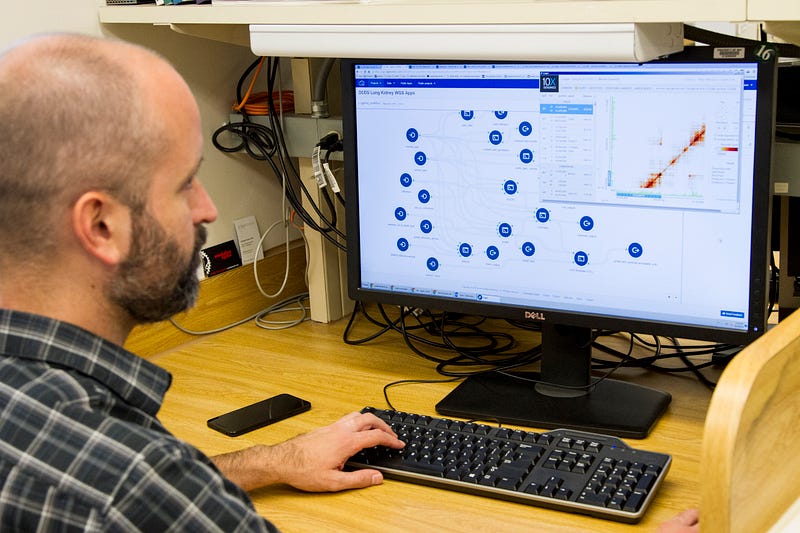
Photo by National Cancer Institute on Unsplash

Compare A and B Statistical and/or Clinical p-value is key?

In empirical research, scientists often apply various statistical procedures to make sense and draw inferences from their observations and collected data. In trying to follow the experimenter’s presentation, the audience is often presented with a statistical test and the associated P-value.

Most people are likely familiar with the expression, “P<0.05” as a cut-off that indicates “statistical significance,” meaning roughly that “the probability that chance is responsible for the finding is less than 5%” and that “the probability that the finding is a true finding is more than 95%.”

So why 5%?

A simple mathematical explanation for this would be something along the lines that —it was set as a general convention —let's say — when estimating the probability that a tossed coin will display the same face (heads or tails) five times in a row is 0.5 × 0.5 × 0.5 × 0.5; that is, 0.0625 and this calculated P-value, 0.0625, is rather close to the value 0.05 therefore by a general convention, we can set the cut-off for “statistical significance.”

Perhaps a slightly more scientific explanation is by looking at the normal distribution of all data — that approximately 5% of the normal distribution comprises outlying datapoints — that is — values that are more than two standard deviations distant from the mean, so 5% cut-off is deemed statistically significant.

Scientists have long debated the best way to use the statistical tools in interpretations — current recommendations are to consider that the P-value should be interpreted as a continuous variable and not in a dichotomous way.

“Over time it appears the p-value has become a gatekeeper for whether work is publishable, at least in some fields,” said Jessica Utts, ASA president. “This apparent editorial bias leads to the ‘file-drawer effect,’ in which research with statistically significant outcomes are much more likely to get published, while other work that might well be just as important scientifically is never seen in print. (Source : Science Daily)

That is to say; we should not conclude that just because the P-value is < 0.05 or some other predetermined threshold, the study hypothesis is true. Whereas a threshold for statistical significance could be useful to base decisions upon, its limitations should be recognized.

Hopefully, as we advance, we increasingly take a more nuanced approach to interpretation, communication, and the use of results of scientific methods in research. After all, whether statistically significant or not, clinical information and analysis's systematic documentation is always useful and should be reported accurately.

Hoping that there is an ongoing search for better methodologies to accurately report scientific data, for the larger good and in words that more of us can understand.

Thank you for reading!

*This is Day 23 of the #sciku challenge — science-inspired haiku-like poetry( so #sciku?) prompts to get you inspired — Our dear readers — why not spend some time each day creating and having a little fun — if you do — publish it anywhere on medium, just tag it with — #30DaysOfScikuChallenge.

**Tagging Lynn E. O’Connor, Ph.D. Laura Griffith Machado, PsyD Rita Hitching, and anyone else who feels inspired to follow and/or play along with this fun #30DaysOfScikuChallenge and today’s prompt: Statistical Research

What’s next —

or perhaps this one —

30daysofscikuchallenge
P Value
Haiku
Science
Poetry
Recommended from ReadMedium