
Statistically Significant Haikus
Day 23 prompt: Quantitatively modeling our way through the world’s variations…
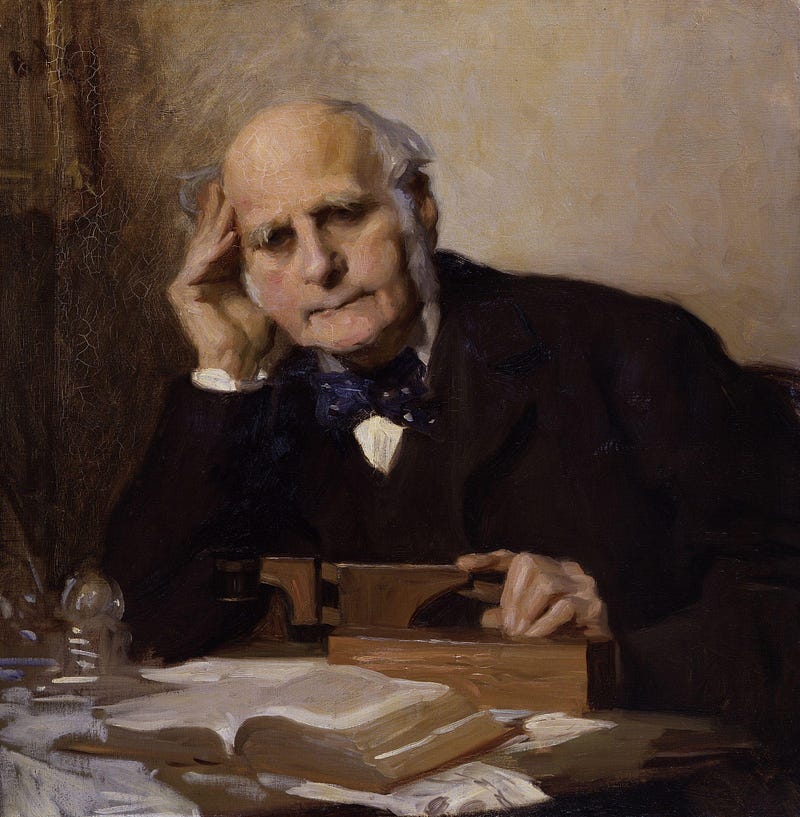
Nature versus Nurture
Sir Francis Galton. Polymath, eugenicist. Birthed the Holocaust.
Darwin’s half-cousin. Where did his genius derive? Statistics answers.
Quantitatively Modeling our way through the World’s variations.
Correlations and Regressions toward the mean Are his gifts to us.
The wisdom of crowds…
Today we often see a jar of jellybeans and enter a drawing to win a prize if we guess the number in the jar. We often speak of the wisdom of the crowds, the supposed magical ability of a crowd to somehow zero in shockingly close to the correct answer. The wisdom of the crowd is actually a calculation of the average of everyone’s guesses. If enough people submitted honest guesses, the average of all the answers is often very close to the real deal.
The person who first came up with this idea is Sir Francis Galton. These contests are older than we thought, and Galton came upon one in a 1906 livestock fair where people were asked to guess the weight of an ox. Galton found out afterwards that the median (the middle guess in a ranked list) was less than 1% from the real number, whereas the average was exactly the correct number, 1,197 pounds. The median is a term Galton introduced, as is the idea of the wisdom of the crowds, or vox populi.
Sir Francis Galton was Charles Darwin’s half-cousin and a brilliant Victorian polymath. He was an extraordinary statistician, psychologist, meteorologist, psychometrician, and much more. Galton’s biggest contributions include the development and use of statistics to answer fundamental questions about humans, such as measurements of intelligence and other psychological traits.
Today, measuring human intelligence is embroiled in an endless and apparently intractable fracas over politics, society, and ethics. Galton started those measurements and the use of statistics to quantify intelligence within a population. He was the first to establish a psychometric center to test human intelligence.
In 1869, 10 years after his cousin Darwin published On the Origin of Species, Galton published Hereditary Genius, where he showed that the rate of “eminence” was highest with the closest relatives of eminent individuals. It was in this work that Galton introduced multivariate analysis and the beginnings of Bayesian statistics.
This led directly to his question of whether we can influence the intelligence of a whole population. Galton invented the field and the name of eugenics as a way to influence and shape intelligence throughout a population.
Eugenics, in turn, led directly to the horrors of the Holocaust in Germany and the abuse of minority or marginalized groups in the U.S. and around the world.
I brought up Galton in my article about testing intelligence in animals here:
I also brought up Galton in another article, this one about how we understand instincts in animals and humans.
We use many of Galton’s statistical tools and concepts, including correlations (the same one where we caution that “correlation is not causation”) and regressions (the same linear regression we use to draw a best-fit line to a scatter plot of data), and the idea of regression toward the mean in genetic inheritance.
Galton’s eugenics and that field’s direct influence on Nazi Germany’s Holocaust in which tens of millions of Jews and other minorities were systematically murdered. Eugenics also strongly influenced racist elements here in the U.S., where many black Americans were sterilized without their consent. These dangerous ideas and actions were born from what can easily be thought of as a noble goal — to improve the intelligence of a community, a nation.
This shows the power of statistics and how easily that power can destroy vulnerable people. That statistical power (meaning a political or practical power, not a mathematical power) is necessary, as we can see in today’s pandemic.
Like any powerful tool, we must use it carefully and fully think through the consequence of what we study and how.
This is not a cautionary tale against math and science. This is a cautionary tale against making judgements about normal human variability, against placing a moral value on deviations from a mean, as if one were good and the other bad.
For More on the #30DaysOfScikuChallenge:


