
Statistically, “Quality Over Quantity” Simply Doesn’t Work
Despite what you may have heard about content creation

It’s a common debate amongst content creators. “Should I go for quality over quantity or the reverse?” And the usual reply — the one we all inherently want to hear — is that quality always wins out above all else.
The tortoise over the hare. The shy guy over the pickup guru. The artist who remains true to themselves always wins.
Except they don’t.
Because quality over quantity is a sham.
The Internet is full of crap for a reason
Just look around you, why is the internet so full of fluff?
When was the last time you read something you truly enjoyed? What random story on the internet provoked your thinking, made you cry, or had you rush to the fridge to make a peanut butter tuna sandwich?
Ever wonder why?
Well, here’s a hint: it’s quantity.
Just look at Wordpress, the biggest hosting platform on the internet. They state that there were over 87,000,000 blog posts on their site. In May 2021.
That’s 2.8 million posts per day.
117,000 per hour.
Almost 2,000 new articles by the time you’ve read this line. (Well, 2001 if you read it right away.)
But that number shouldn’t be too surprising, GrowthBlogger claims those are coming from at least 600,000,000 separate blogs.
The internet is full of crap.
And it doesn’t stop there.
Overabundance in academia
Close to 2 million scientific articles are published every year in journals. That’s a massive increase from the days of old.
A Stanford statistician named John Ioannidis found at least 265 “hyper prolific authors” that released up to 72 scientific papers per year. As in, more than one per week.
An in-depth paper worthy of being published in a scientific journal that takes less than 5 days to create? Man, I didn’t know there were so many uber-Einsteins in the world.
Why does this happen? Several reasons.
Graduation requirements have changed. Some governments like China give financial rewards for each published paper. Grant money can be dependent on the number of scholarly articles published.
But there’s one thing for sure — the Information Age sure is full of a lot of crap.
What does it take to stand out?
As paradoxical as this sounds to my thesis — quality.
High-quality articles are the only way to stand out in a sea rolling in excrement. But you need a lot of them. And you need them consistently.
Orbit Media conducts an incredibly interesting survey of nearly 1,300 established bloggers every year. Their results are fascinating.
The actions that stick out the most?
Bloggers who report the strongest results consistently post more than twice a week. 3% of those say they receive amazing results — and post at least once per day!
The other big factor is in the length of their top-performing posts. This might not come as a surprise but a lot of research points to in-depth, long-form posts beating out other content at a huge rate.
In that survey, posts with 1,500 to 3,000 words received strong results around 40% of the time. Push those posts past 3,000 and that goes up to an incredible 54%!
They had two other actions that were reported as helping to greatly increase results — using keywords in their content and writing over 10 draft headlines for each article.
Those who were able to produce highly clickable, lengthy but high-quality content on a very consistent basis were the 1% who succeeded the most.
It’s not just quality over quantity, it’s both.
And then some.
The reason you need to write every day
If you’re in the content creation world and you’re told that you don’t have to produce at least some output every day — I bet you’re about to be sold something.
Creators need to create.
That’s how you get good at the art of creating. You don’t need to read the War of Art to understand its meaning.
(Although I did read it. Warning: It doesn’t involve warfaring paintings at all. Talk about clickbait.)
By creating every single day, or at least as often as your schedule permits, you’ll achieve several tasks at once:
- You’ll inherently get better at it. Think of the 10,000-hour rule.
- If you post all of those creations every day, you’ll slowly start dominating Google as long as you…
- Work in proper SEO research. Here’s a big How-To guide from Neil Patel.
- Get in the practice of writing as many draft titles as possible. Write 10. Send a screenshot to a friend or two. Ask them to pick out which one stands out the most.
- Bingo.
How to get into the top 1% of content creators
I don’t expect you to be able to set aside 3–6 hours every single day of your life to work on content creation. That would be ludicrous for 99% of us.
But if you really want to get into that top 1% of content earners, that may be one of the only methods to follow.
After all, studies are showing a lot of the revenue for content online is far from being a normal bell curve.
You know, this familiar-looking graphic:
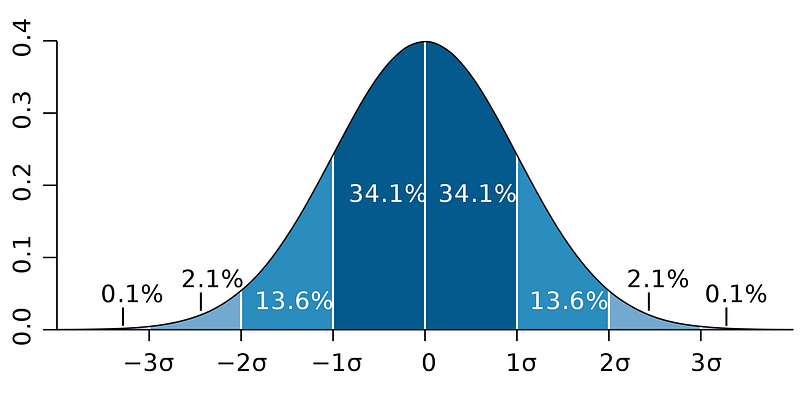
Instead, most platforms you create on disperse their revenue in something that looks way more like this — following the power law distribution.
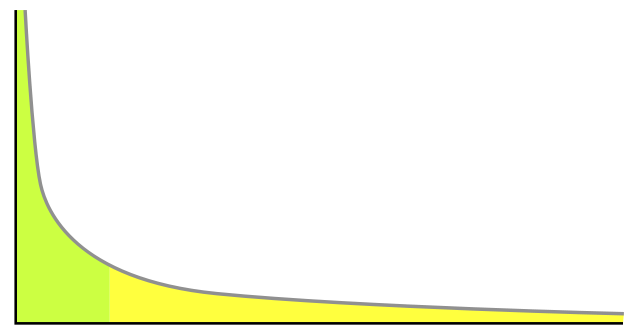
Research by Ernest O’Boyle Jr. and Herman Aguinis fully supports this as well. They performed 5 different studies on over 600,000 entertainers, politicians, researchers, and athletes to measure their performance vs output.
While their work didn’t apply to online content creators specifically — they tried to cover as many industries as possible.
The top 5% of successful creators produced 400% more output than average.
5 times the amount of work published than their competitors. No wonder many of them make millions per year.
Now look at that chart again. Think of any platform that produces content.
YouTube? The top creators pop up in the feed, time after time again, with thousands of ‘You may also like this” pop-ups guiding you to their other work in a perpetual self-sustained content-hole.
Twitter? Same thing. Tumbler? Yup. MySpace? Hah. Used to be.
Even think of Amazon, with their 353 million products listed. Search for any of those products, and chances are an Amazon link will show up.
Amazon is the ultimate SEO guru — they proved quantity over quality wins.
Trust me, don’t buy those Nike knock-offs. You won’t be satisfied. Even if their slogan of “Just Do Eat” does sound delicious.
But if you don’t have billions of dollars in off-shore tax havens nor thousands of wage-repressed workers at your disposal, there’s only one tried-and-true formula to become successful as a creator in the modern world.
Create.
As much as possible, as long as possible, and as high-quality as possible.
Do this over a long time and you will find success.
It’s not quality over quantity. It’s both. And a lot of it.
If you liked this, come join my free weekly-ish newsletter, WTFact.