
Startups Fighting Climate Change, Part 1: Consumer Needs 🌿
No doubt sustainability is one of the hottest spaces in Silicon Valley, and unfortunately it will get hotter if we don’t do anything about it. When Kunal Modi and I quit our jobs to build a company, we wanted to work on something that was personally meaningful to both of us and fighting climate change immediately went to the top of our list. We have spent the past few weeks exploring startup opportunities in the sustainability space and wanted to share some of our learnings and hopefully invite more folks to join in.
Specifically, I will cover some of the learnings on the consumer side of things (B2C) in this post and later, follow up with more business (B2B) opportunities. More broadly, there are lots of other personas in the space, from scientist working on carbon capture, to farmers using more sustainable fertilizers, etc. but given our backgrounds in building consumer social products, we decided to limit our search to serving customers or businesses.
We are sure there are lots of opportunities in “atoms not bits”, but at least for now, we wanted to avoid going into hard sciences and keep using our strengths in software.
The TL;DR; about Consumer Trends
If you search for trends in about Gen Z, the lists and books written about this topic will be more than one can humanly comprehend. I find that simplifying a bit helps here — the big TL;DR: is that the younger generation cares about sustainability and companies need to adapt the new norm, as they should.
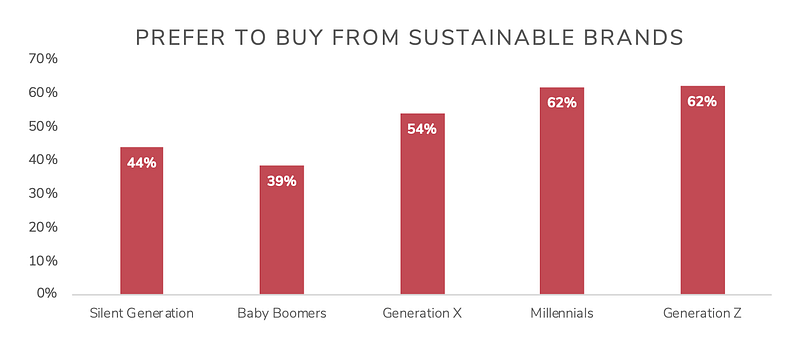
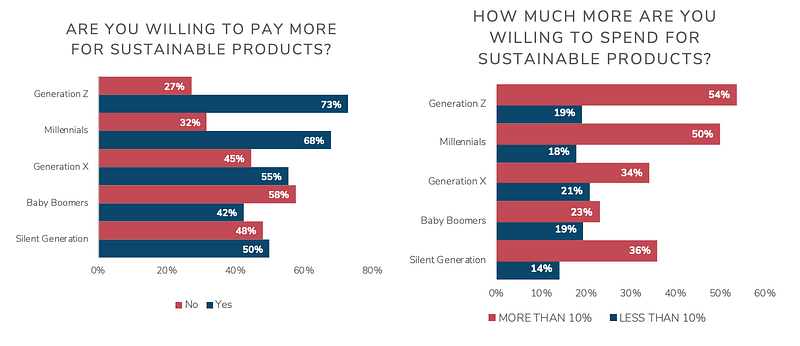
The interesting take away here other than the obvious fact that the younger generation is willing to pay more for sustainable product is that Millennials and Gen Z have this affinity more or less equally.
If you start a company that’s sustainability oriented, it would be wise to target the “younger generation who cares about sustainability” as opposed to purely going after Gen Z. This is especially important as Gen Z had an average of only $115 in spending money each month in 2020, but combined with Millennials, you have nearly $3 trillion in purchasing power for 2020! 🤯
So what?
This newfound demand creates newfound wealth, a win-win for entrepreneurs and the planet. Sustainability practices will infiltrate every crevice of our day to day lives—just think about what it’s going to be like living in 2050, from the clothes that you were, to the car that drives you, to the food that you eat, everything will be close to nearly carbon neutral.
In the context of companies, we suspect that you will see a wave of specialized sustainability products leading the way with the incumbents slowly adopting to the new norm, either wiping out the new ones, buying them out, or co-existing albeit with sustainability becoming less of a differentiator and a moat over period of time.
That last part is important — companies can get new distribution in the next 2 to 5 years based on sustainability, but as these practices become more of a norm, the defensibility purely based on sustainable practices becomes weaker.
If Amazon sees through its Climate Pledge, how valuable is your sustainability marketplace going to be in the long run? 🤷♂️
Digging into Jobs to Be Done
Regardless of the worries above, the future is built on optimism — let’s try to explore some of these consumer needs and see what businesses could we potentially build.
We can use a product development tool called Jobs to Be Done (JTBDs) and a few user interviews to extract out consumer needs. The framework famously quotes, “people hire products, just like they hire employees, to get a specific job done” — so what jobs do consumers who care about sustainability have open in their product org chart? Let’s see…
Help me Change Myself
- Help me understand how I can improve my habits and behaviors
- Help me be consistent with my positive habits
- Help me find more sustainable restaurants nearby [food]
- Help me find more sustainable shopping options [clothing, toiletries, less packaging, less toxic ingredients]
- Help me find affordable ways to living a sustainable life
- Help me live more sustainably [housing]
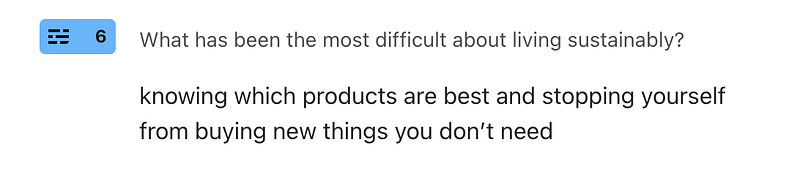
“The most difficult thing about living sustainably is that it is expensive, you are paying more for the better ones.”
“I do want to try to eat less meat, that has been the hard part and I can never last more than 2 days.”
“Slight inconvenience and higher price of more sustainable products.”
“I constantly search for ways and educate myself on how to become even more sustainable and my current lifestyle reflects that.”
Help me Change Other People
- Help me change my family to be more sustainable
- As an influencer, help me find vetted sustainable business I can support
- As an influencer, help me make money selling sustainable products
- Help me showcase my sustainable lifestyle to my friends
“I do not live on my own so there are some changes I’d like to make that I can’t because of my family”
“I watch videos about what products do YouTubers who live this lifestyle recommend. Usually they mention more information.”
“What’s been difficult is knowing that some people don’t care and continue to be contributing to the problem.

Help me Change Businesses
- Help me punish/cancel bad businesses who don’t support the same values
- Help me invest in sustainable companies
- Help me invest in local sustainability causes
- Help me invest in environmentally friendly investments
There is also a cluster of jobs related to “help me change the government”, but we don’t know much about how these systems work, so we avoided going deeper. If you need the more in-depth data, feel free to ping us!
The Birdseye View on Needs
Most people care; they struggle to understand, prioritize, commit and stay consistent with their behaviors, especially with the higher prices of living a zero waste or sustainable lifestyle.
The younger generation looks up to influencers and in return, influences their family to change their behavior as well. It was quite funny to hear all the, “omg, my family is terrible, I have been pushing them to recycle so hard.”
Shopping is a major opportunity for any commerce enthusiasts. Consistently people complained about the expensive prices of sustainable options.
Minor behavioral changes like using a metal straw, reusable mug, turning off lights, faucet, etc. seems prevalent and will probably keep growing with the younger generation.
Next up… we’ll try to see if any of these needs translate well t startup ideas and how they could work!


