
DESIGN
Start your UX Design career by leveling up
Suppose you don’t know where to start or what’s next. This article is for you.
I structured the Knowledge and Expertise of a User Experience Designer base on levels of creativity. To catch up on this story better, please read my previous article: 5 levels of creativity.
Regards to NN Group:
User Experience is all the aspects of a user when using, interacting with a company, service, or product.
A User Experience Designer (UX Designer) is the person who will go through the design process to create products that provide meaningful and relevant experiences for users.
If you are a newcomer, you might be confused with Brand Experience, Customer Experience, User Experience. You could google for more information.
Creating a satisfying experience for a product would require lots of different combined aspects, including Business and User Technology. Therefore, UX Designer does not have control over the product’s entire experience.
Elements that create UX
There are various ways of an aggregate ‘Elements of User Experience’:
- 5 Elements: Strategy, Scope, Structure, Skeleton, Surface.
- 7 Factors: Valuable, Useful, Usable, Findable, Credible, Desirable, Accessible.
After many years of working, I realized the aggregates below seem more understandable and clear to me.
It does not mean the other knowledge is wrong or that I am about to share more accurately. Simply providing one’s perspective, I hope that my fellows within the industry would exchange so we could have various viewpoints.
There are four main elements to create User Experience and the degree of their importance:
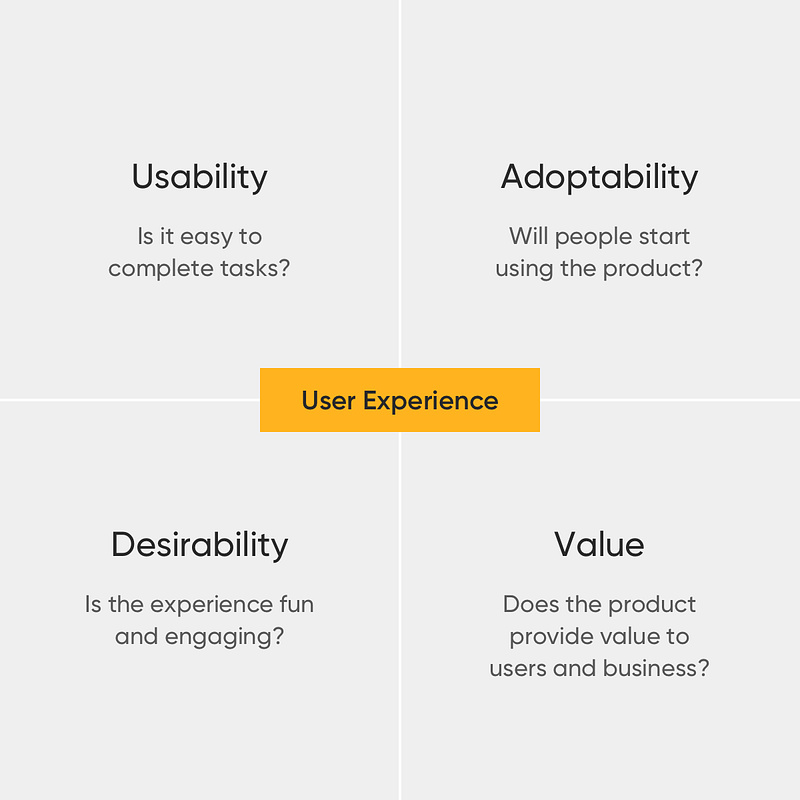
- Value — 50%: create value for business and users’ usage or buy products. An application must have a steady source of users with a profitable model to grow a business. At the same time, the user benefits must receive more than they spent (time, money, effort).
- Usability — 35%: Is it easy to use and complete the tasks when the users use the products? Usability is often assessed by quantitative factors such as the number of screens, the number of clicks that increase or decrease. However, usability also needs other qualitative factors such as satisfaction, feeling, etc.
- Adoptability — 15%: Is the product easy to approach or use? Adoptability is slightly different from Usability. Adoptability is reflected in how long it takes the user to understand the system or how much it costs initially.
- Desirability — 10%: Is the product experience enjoyable and engaging? I hesitated a lot to rank the importance percentage of this element at 10%. However, I have seen countless products unable to launch because people have been too focused on this last factor in the early stage.
It can be said, only focused on the first three elements when the product has not yet formed. After receiving feedback from the final user and measuring the product’s effectiveness, we can start on the last 10% elements.
Today, creating a working product is easy, but establishing an impactful product is indispensable for any of the above elements. At the end of the day, to compete with competitors, Desirability will make a difference.
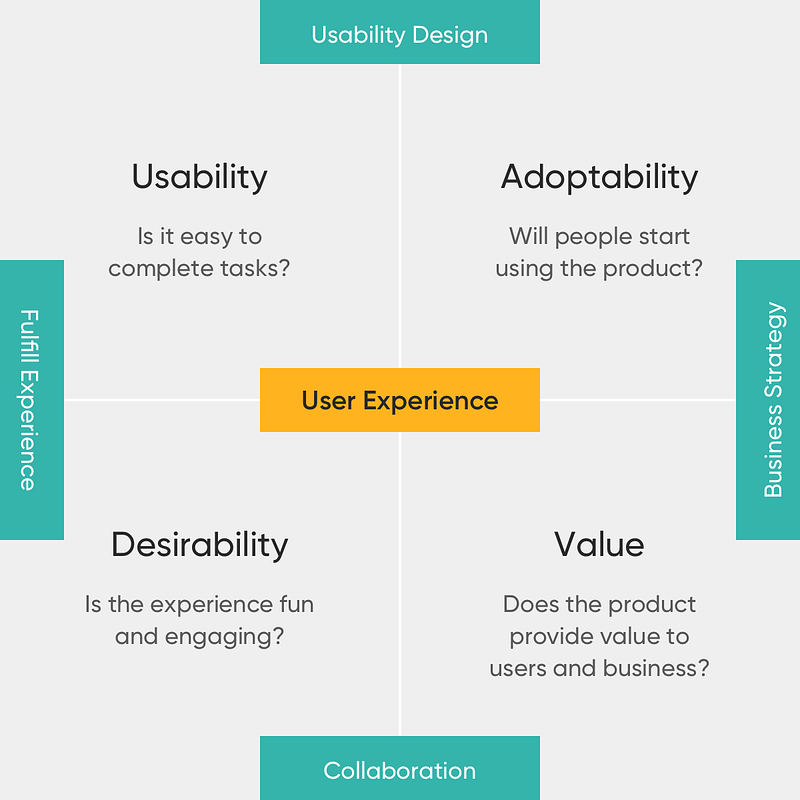
To achieve Usability and Adoptability, UX Designer needs to equip themselves with Human Psychology, Design Principles, and Design Pattern knowledge to understand user behavior and find suitable design solutions. We can call this process Usability Design.
To achieve Value and Desirability, UX Designers must coordinate with specialties such as Business, Front End, Back End, Marketing, Operations, etc. It would help the designer to understand product goals and actualization.
Usability and Desirability require direct experience from the product and the completion of additional services and touchpoints from offline to online. This experience is building customer experience.
Adoptability and Value start from a business strategy. A reasonable approach will allow the products to reach the users and thereby create value for both parties.
As can be seen, creating a User Experience requires lots of expertise work. UX Designer only plays one role in this process, but equally important as it takes two main aspects of Usability and Adoptability. Here are the levels:
Level 0: The Beginner
To start learning anything, we should start from 101 — all the basic principles and concepts of Usability Design, such as:
Study about procedures:
Learn how to use specialized tools for Usability Design:
At this level, it is crucial to know the ‘What’ of the amount of knowledge above. You don’t have to understand them all, but you have to know what’s in there and what you realize about it.
Level 1: The Novice — Copy
Theory needs to be combined with practice to be effective. It’s not required to know all the knowledge listed at level 0 to start getting your hands dirty with them.
At first, when making User flow and Wireframe for functions, start looking for applications with similar operations and see how it designs the interaction models there.
Study and copy from the big companies, popular with a large number of users (this action also make the products easier to get starting with)
Companies with well-made products with fine-tuning systems:
Work at this level would also be tedious, and if you cannot come up with a proper practice method, you will feel as if you cannot learn anything at this stage.
Back then, I had a UX notebook to copy and note like this:
- Notification with number and Notification without number: Psychologically, numbers will always carry the feeling of conquest, and records will always be attractive to people.
- Typing the password two times is inconvenient. It is better to add the show/ hide icon.
From time to time, these little notes will work to their full potential effectively. Do not be discouraged!
Level 2: The Apprentice — Copy + Modify
Finding a Mentor is to find a person with a richer experience than us to give appropriate advice, especially for the majors that have not yet had any formal training in Vietnam.
To ‘Modify,’ you have to understand ‘Why’ and ‘When’ by working with each Feature that has been designed by which Flow.
In general, each product will have two features:
- Main flows: main feature, essential in creating competitive value and elements for the business.
- Sub flows: sub-feature, usually requirements to complete the main feature.
- Ex: Hotel booking App, main features are Booking, Payment, sub-features may be taking notes for the manager, adding a payment method, etc.
When you think with flows, you will start to apply the Design Pattern effectively.
References for Design Pattern Libraries:
Not stopping there, to get better at adjusting, you have to research psychology, understand more about things that affect customers’ behavior. It is a kind of vast knowledge and complicated.
- Behavioral psychological emotions
- 7 principal Psychological Phenomena in UX Design
- The psychology in UX Design
- UX and Psychology
And if you have a Mentor, see them more often with two or more design plans for one matter. Also, do not forget to mention their Pros and Cons. The advice, the experiences that your Mentor provides can become yours later on.
Another way for you to have hands-on experiences from Case studies is that you can find them at:
Tips: prioritize looking for a suitable environment to develop a career with these elements:
- Having challenging projects
- Having experienced Mentor for instructions
- Having existing hands-on experiences and knowledge
And start to care about Non-Expertise Skills.
The next level is Level 3: The Associate — Copy + Modify + Improvement
For UX, Non-Expertise Skills are critical. Especially three skills: Critical Thinking, Communication, and Teamwork. For that, I will discuss this level in another article to focus more on it.
Read more UI Design Career level:


