
Start Investing Today: The Power of Compounding

The earlier you invest, the greater your returns over time. It’s the power of compounding. And of course, it works for everything, not just the stock market and money market investments.
Let me tell you a little more about it.
What is the Power of Compounding?
The power of compounding is a concept in investing that refers to the ability of an investment to generate earnings, which are then reinvested to generate even more earnings over time. In simple terms, it’s the process of earning returns on both the original investment and the accumulated returns from previous periods.
When you invest money and earn a return, whether it’s through interest, dividends, or capital appreciation, those earnings can be reinvested instead of being withdrawn. By reinvesting the earnings, the total investment grows, and the subsequent returns are calculated based on the increased investment amount. This cycle continues and accelerates over time, resulting in exponential growth.
The key factor in harnessing the power of compounding is time. The longer the investment is allowed to compound, the greater the impact. This is because compounding is based on the principle of earning returns on both the principal amount and the accumulated returns, creating a snowball effect.
For example, let’s consider an investment of $10,000 with an annual return of 8%. After the first year, you would earn $800 in returns, bringing the total investment to $10,800. In the second year, the 8% return would be calculated on the new total, resulting in $864 in returns. Over several years, the compounding effect becomes more pronounced, and the investment grows significantly.
Compounding can have a substantial impact on long-term investments, allowing them to grow exponentially. It’s particularly advantageous for retirement savings, where the power of compounding can be harnessed over several decades.
To make the most of the power of compounding, it’s important to start investing early, be consistent in contributing to your investments, and reinvest any earnings to maximize growth over time. It’s also crucial to choose investments that have the potential for compounding.
A Large-Scale Example
Let’s say you have $1 million. You don’t know what to do with it, so you want to invest it (I recommend you be at least a little wealthy before investing your money, otherwise it’s better to try to increase your income). Without doing too much research, you find that since 1950, the value of the S&P500 has risen by 11.20% a year. You assume that it will continue to do so, invest your million in it, and come back in 30 years’ time to see how it has evolved.
To your surprise, you now have $28 million in the S&P500. That’s a capital gain of $27 million — not bad, eh?
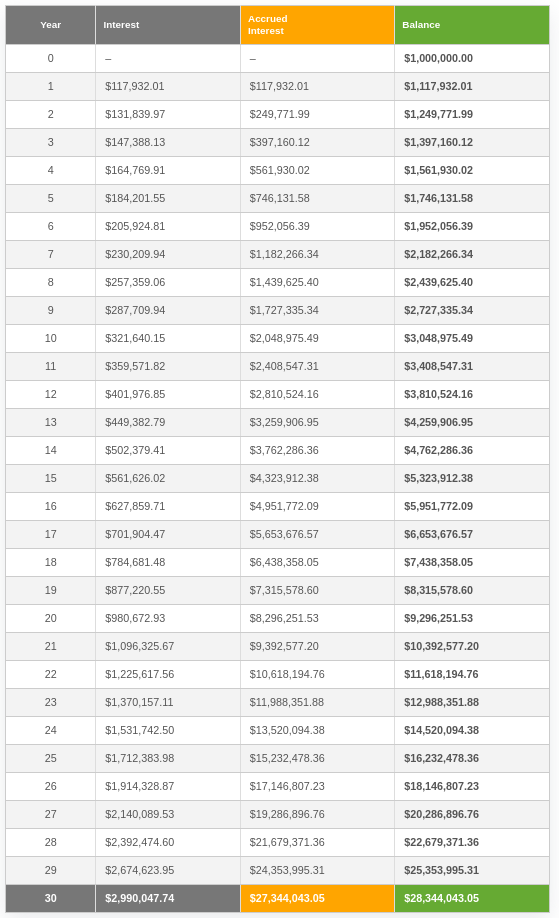
But don’t forget inflation. Every year, prices rise, and the purchasing power of money declines.
If we take inflation into account, the value of the S&P500 actually increases by 7.42% a year. Which is already a lot, but in the end we won’t be at 28 million. Let’s do the math again.
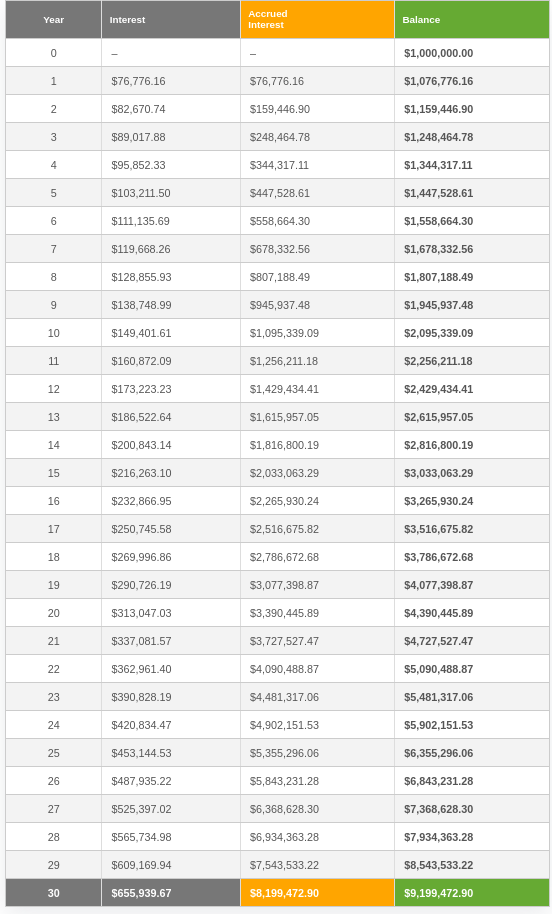
We obtain a final value of 9 million, which is not the real value, but the value taking inflation into account, i.e. the real capital gain is only 8 million or 800%, even if your investment has gained 2800% in value.
The Power of Compounding in Other Fields
I said in my introduction that the power of compounding is not limited to stock market or monetary investments. And indeed, many things have a snowball effect.
For example, a YouTuber who has just started out may only gain 3 subscribers a day. 5 months later, he’s gaining 100 a day. And 1 year later, he’s gaining 1000 a day.
I see this, for example, with what I write on Medium. My views have increased exponentially since I started.
In short, what I’m saying is that you can benefit from the power of compounding in many areas. It’s up to you to find them and get started as soon as possible to get the most out of it.
On the other hand, there are limits. Power functions tend towards infinity, but money, a number of subscribers, or a number of views, cannot reach infinity, given that the resources available in the world are finite. There is therefore a certain ceiling beyond which growth diminishes or stagnates.
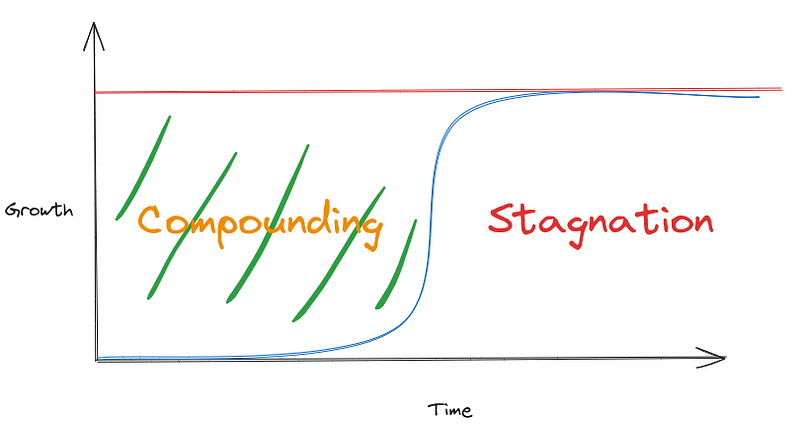
Of course, you have time before you reach these limits, and even when you start to stagnate, your growth is still very important, albeit linear rather than exponential.
Final Note
As I mentioned in the article, only invest your money if you’re already at least a little rich. If we take our example over 30 years and invest only $10,000, we end up with a capital gain of $80,000, which is nothing at all over 30 years.
For more info on this subject, check out another article I’ve done: Saving Won’t Make You Rich, Do This Instead
To explore more of my stories, click here!
If you want to be notified every time I publish a new story, subscribe to me via email by clicking here!
If you’re not subscribed to medium yet and wish to support me or get access to all my stories, you can use my link:
A Message from InsiderFinance

Thanks for being a part of our community! Before you go:
- 👏 Clap for the story and follow the author 👉
- 📰 View more content in the InsiderFinance Wire
- 📚 Take our FREE Masterclass
- 📈 Discover Powerful Trading Tools


