
Starry Night Over Your Dreams
Microfiction: night trains, silence, and possibility…
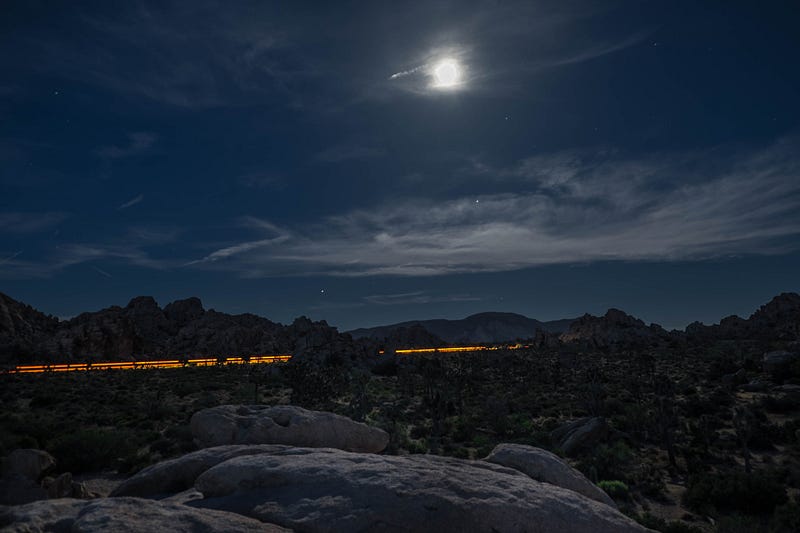
Sitting to write in the deep velvet of a chair, was like sinking into a stary night — once upon a time. When I shut the door to my writer’s nook at the top of the stairs it was like stepping into a vault. I could black out the morning air with a flick of the shutters, along with the birdsongs and the rooftops. Let the darkness become the new color of things. Let the stars emerge on the ceiling above where my poems and words gathered in galaxies.
These days, everyone works from home and the light is eternal. My own children are buzzing lilting fireflies. My husband perpetually dreams aloud wondering where things are.
Do we have a strainer? A funnel? Where do we keep the batteries? The oversized map of Europe? The remnants of our past lives?
When my household is quiet, the children from the family upstairs gallop over the wood floors — our ceilings. Somewhere a couple argues out an open window, their words and cigarette smoke rising and wafting through my shutters, filling the void between my ears, depriving it of empty, blank possibility.
First, there was nothing. Then there was too much. The sound and vibration of it all is a child’s painting slashed with color and fingerprints.
My head is so pounding full of all the words coming in that aren’t mine and all of my own words screaming to leave.
One evening after the pumpkin soup is rinsed from the turquoise sea of our bowls and the children are turning on the colorful explosion of their pillows, I slip out into the black and white of night.
I tell myself the gendarme will not come out to check my papers, to see if I’ve walked past my allotted 1km. Or to see if I’ve overspent my hour for ‘getting some air.’ And if he does, to hell with him. I will tell him I forgot, that I can’t remember my name or the strange land I was born in. That I must have misplaced my papers, my pen, my mind. Here is the proof — I have wandered out in my slippers.
So I leave, empty pockets, no phone, no paperwork, no ID. I’ve got a small notebook and my favorite pen, just in case. Always.
What leads me to take the pedestrian path between the tilting old houses? Perhaps familiarity. I know my way in the dark — I’ll pass a doorstep where cats gather, under a balcony of flowers, and finally emerge along the train tracks.
It has always seemed incredible to me, the way the rails here are flooded by light at this tiny platform in the middle of nowhere before they plunge into the darkness of the countryside.
I imagine the way it would feel to pull away from this stop, away from this village, and to watch the light disappear, to lurch and rock on the train’s rhythm into the fields of stars, into the soft, enveloping blackness that feels so close. But that is wishful thinking.
Trains pass through without stopping. They can’t be bothered with this place in the middle of nowhere.
So I sit on a bench under the pouring light of a lamp. The concrete around the platform begins to waver like water. Light ripples off the fields beyond tossing on waves of darkness. I am remembering Starry Night Over the Rhone, painting it over my surroundings. The artist is layering ripples in heavy strokes — the light and absence of light. Everything seems to be currents and waves spreading outward in constant motion.
Something is coming into the station. A ripple in the puddle of my being. A train so dark as to be the absence of light glides to the platform in near silence. In fact, the silence of its presence has even sucked in the sounds of crickets and other insects.
Starry Night over this waving field. I can see only a shimmering outline to the blackness of this train as it glides to a stop in front of me. My feet feel cold in my slippers as I step closer.
The doors whisper open and inside, I sink into the velvet sea of a bench by a window, and the stars twinkle in the darkness in the ceiling. I touch my breast pocket and feel the tiny notebook beating there under the surface.
The train glides away from the platform over the rippling fields. I pull out my notebook to capture the silence.
I wrote this story in a workshop alongside other writers. We were playing with referencing a work of art in a story…in this case I am referencing Starry Night Over the Rhone by Van Gogh. It’s just a painting that haunts me — the way it is so dark and so beautiful. I was also chanelling the feeling of the frustrated artists and creatives through time after reading the book, The Equivalents. (A dense read, but fascinating too…)
© 2020 Trisha Traughber. Thanks for reading.


