
Mature Flâneur Down Under
Stargazing Inside a Cave
New Zealand’s most bizarre tourist attraction
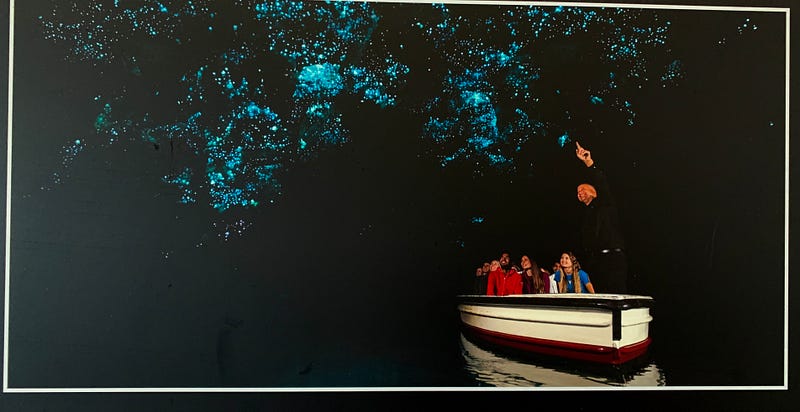
We sat in utter darkness in a little boat in the depths of a cave. Our guide had warned the twelve of us: no talking, don’t make a sound, no photographs. It gave me an odd feeling of sensory deprivation. All I knew was that I was cold. I had lost track of my beloved wife Teresa’s whereabouts on the boat — it was not much more than an aluminum shell with seats. Perhaps she was sitting next to me? I wasn’t sure, and I was not about to grope around for her hand, lest I make a mistake and cause some poor Chinese tourist in our group to cry out in alarm. That would ruin the experience for everybody.
Our guide, sitting in the bow, slowly pulled the boat forward, deeper into the cave. He told us he would be drawing us through the darkness by pulling a cable secured to the cave wall. I could feel us surge forward a little. I stared up, into infinite nothingness, though I knew we were 200 meters deep inside a mountain, on a tiny lake within a large limestone cave.
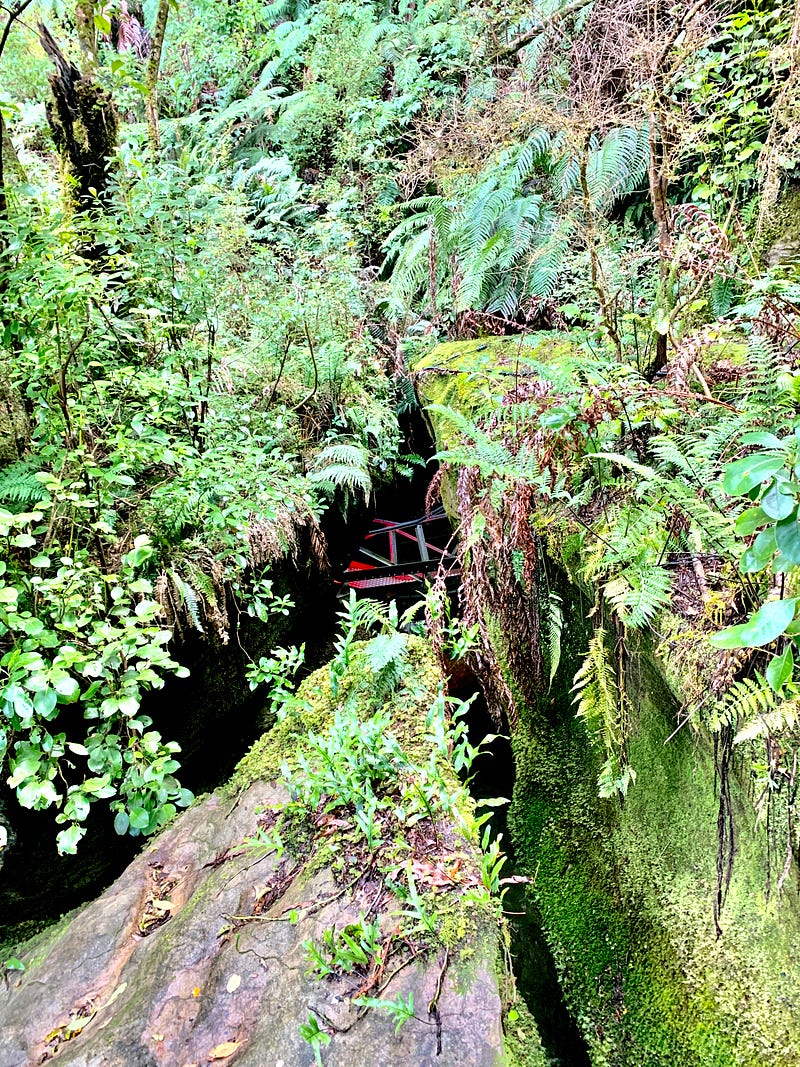
To get this deep in the cave we first had to walk, slowly groping our way along a constructed metal walkway that followed the course of an underground river. Sometimes we had to hunch low where the cave roof shrank. Other times the walkway skirted the edge of gushing subterranean waterfalls, and once we passed through a wide cavern that had been lit to reveal high, yellow walls made of limestone, carved by water to resemble the interior of a miniature cathedral, with black water coursing down the main aisle.
“Are there any fish in the water?” I asked our guide (cleverly pronouncing “fish” with a New Zealand accent).
“No. Only eels. They grow pretty large, as long as my leg.”
Soon after that, the lights along the gangway ended, and we were compelled to climb a steel ladder and then feel our way onto the boat in darkness and absolute silence.
Now, that we were aboard and underway, our little boat seemed to turn a corner. Suddenly, I could see the stars above, though I knew it was the middle of the afternoon. Bright pin-pricks of bluish light seemed to move slowly overhead, though I knew full well it was us gliding past them on the roof of the cave, and not the other way around.
I was awed, and it was odd: experiencing this strange night sky, its unfamiliar constellations appearing so astronomically far away, even though I knew they were close — so close, in fact, that our guide recommended that however enraptured we became by these glowing stars, to keep our mouths shut, in case one of them should come unmoored from the roof, and fall, as it easily might, into one of our gaping maws.
That would be gross. For these stars in the ersatz night sky were the famous New Zealand glow worms. Worse, they are not even real worms — they are the larvae of a species of fungus gnat that breeds in caves and then lays their eggs on the roofs. Technically speaking, fly larvae are maggots, so, these are actually glow maggots.
When the larvae hatch, their bellies glow with intense bioluminescent light that attracts other insects that might have wandered into the cave — moths, mosquitoes, pretty much anything. To trap their prey, the glow-worms secrete “fishing lines” — strands of sticky mucus that hang down several inches from the cave roof like miniature stalactites. With the touch of a wing, an insect gets stuck to the mucus. The glow worm sucks the fishing line back into itself, and then voraciously devours its prey. We were shown a video in the info center at the end of our little cave cruise that explained all this in graphic detail. Frankly, I was very glad to have seen these magnified images of the gnat maggots only after the mystical experience of the night sky boat ride.
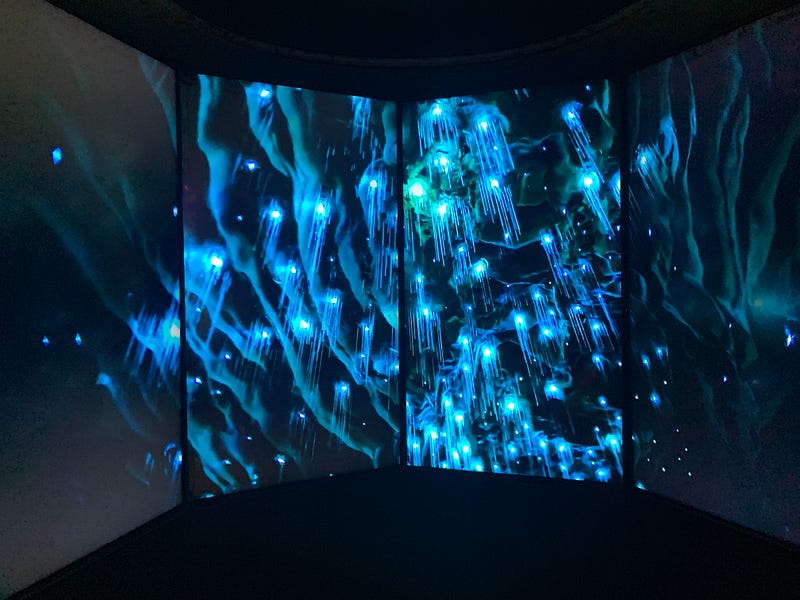
It was, however quite fascinating. We learned these larvae live for about ninety days before metamorphozing into adult fungus gnats. The adult's single purpose is to have sex and reproduce. They have no mouth with which to eat. In fact, no digestive tract at all. If you are an adult gnat, you screw, lay eggs and die. Afterward, a new generation of glow-worm larvae each stake out their square inch of territory on the roof, set out their fishing lines, and bedazzle the cave with their glowing bellies.
Ah nature: weird, gross and breathtakingly beautiful all at once.
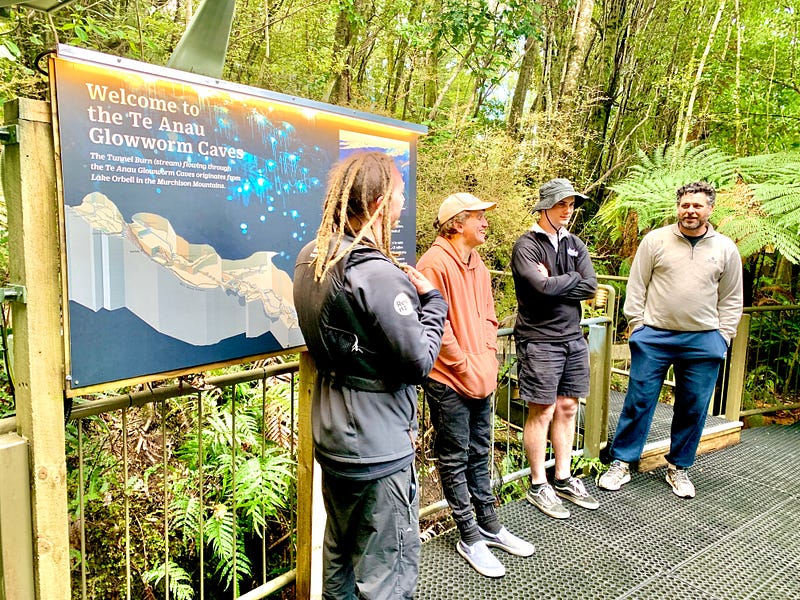
The really amazing story, however, is how New Zealanders managed to turn staring at maggots in dank caves into a nationwide tourism craze. Teresa and I each paid about $50US for the glow worm experience, which lasted three hours, including the boat ride across lake Te Anau to get to the cave.
Across New Zealand, there are dozens and dozens of commercial glow-worm tours, plus a great many more remote glow-worm caves one can visit on one’s own. The biggest and most popular site, Waitomo, in the North Island, is a complex of some 400 glow-worm caves, that gets approximately 500,000 visitors a year. Glow worms have in fact metamorphozed into a multi-million-dollar tourism industry!
Of course, wherever there is industrial-scale tourism, there is also the risk of killing the gnat that lays the golden egg — or glowing maggot, to horrifically scramble the egg metaphor.
In the presence of light and noise, the startled glow worms shut down their bioluminescence, ending the display, and preventing them from catching their prey. So the tour guides have to enforce strict protocols to ensure the glow worms don’t starve. There’s no photography allowed at all (because too many idiot tourists don’t know how to turn off the flash on their smart phones). Also, too much carbon dioxide, the wrong amount of humidity, or any introduced pollution can upset the delicate balance of the cave ecosystems the gnat larva requires to thrive. Tour operators have to monitor their operations and do whatever it takes to maintain the ecosystem’s health.
In Waitomo, this has meant regulating the surrounding farmland, so that agricultural waste water does not contaminate the streams that feed the underground cave-lakes where the glow worms live. As a result, certain areas are no longer used for crops or pasture and are conserved as wild spaces that keep the aquifer pure and the glow-worms glowing. Given the number of jobs created by the caves in this once-remote area, the farmers have complied. Good for the economy, good for the ecology. Good for the worms, good for the tourists. This is regenerative economics at work, all due to a little gross larva in some little dark caves.
I wrote about regenerative economics in my previous post on whale watching, and have since stumbled upon several great articles on Medium.com on this subject, including, to my amazement some from researchers working in New Zealand at The Edmund Hillary Fellowship.
Backed by the Hillary Institute for International Leadership, the Fellowship funds pioneers and researchers dedicated to finding innovative scientific, cultural, social and political solutions to today’s problems. New Zealand is in many ways a perfect testing ground, in that is it a progressive democracy that knows it is facing big problems, and has the capacity to anticipate and respond, rather than react to events after the fact — or simply turn a blind eye.
And so, to better deal with these urgent issues, the Fellowship recruits the best minds in the nation, and the world — the intellectual equivalent of glow worms, might we say? By generating new ideas that shine a light on the nation's problems, not only can new answers be discovered, but new innovative ecosystems — constellations of ideas — can be created. Solutions that show promise will be shared with other nations, which can adapt and adopt them to their own context.
Imagine, for a minute, visiting policymakers and heads of state in the metaphorical equivalent of aluminum boats, coming to New Zealand in order to gaze up at the Hillary Fellowship glow-worms, and their constellations of ideas for a future New Zealand, and a future world.
You may gape in wonder as you contemplate the possibilities, with nary a fear that a glowing maggot might drop into your open maw.
***
Please check out my new book about the art of slow travel in Portugal, France, Italy and Norway:


