
Stanley James McKoy: A brother and son remembered
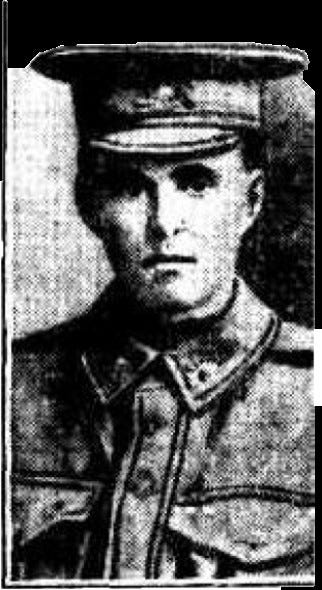
Stanley James McKoy, and his younger brother Augustus Dedrick McKoy, grew up in a large family that was well-known and well regarded in Wodonga, Victoria.[1] In a letter to the Officer in Charge of Base Records their mother, Helena Merea McKoy, described the brothers as good lads who worked together and had never been separated.[2] So it was probably not unexpected that, when they decided to enlist in the Australian Imperial Force (AIF) in September 1914 after seeing placards at the Albury Show encouraging men to join the war effort, they did so together.[3]
The service records for Stanley contain only basic information about Stanley himself and very little of his experiences in the war. Much of what is known of Stanley from publicly available records are from the reminiscences of loved ones and the few writings from Stanley that his family shared with local newspapers after his death at Gallipoli in May 1915.[4] In memory, Stanley is larger than life and as a ‘fallen Anzac’ his mark upon the world appears to be more significant in the tragedy of his death than it was in life. This is particularly salient, given that his death also represents the futility of war and wasted lives of young men who might otherwise have had bright futures.
Having enlisted in the AIF in September 1914, Stanley, and his brother, were early volunteers to the war effort.[5] Motivations to join the AIF varied across the course of the war but Stanley’s decision to enlist was influenced by the need to protect Belgium women and children, to be ‘part of the action’ and ‘have a go at the Turks’.[6] This aim was realised in December 1914 when the brothers, now members of the 13th Battalion, embarked on the troopship Ulysses and left Australia.[7] An excerpt from Stanley’s diary was reported in local newspapers began with the Battalion stationed Mudros, Greece in mid-April, where they were preparing for their assignment on the Gallipoli Peninsula.[8] Over the next 12 days Stanley describes banality, chaos and moments of peace and it is this blending of experiences both big and small, that is the most poignant element of this diary .
On April 23, prior to leaving Mudros, Stanley described what may have been the last afternoon of equanimity that he experienced. He wrote “it seems hard to believe, as I lay here on the sunny deck, that in a few hours we will be under fire, and some of us very likely killed.”[9] Later, on April 24 still waiting to move out, Stanley noted that “ships have been leaving at intervals all day. We are still here, but we must be going soon …” but more enjoyably “we have been living high the last two days on the food we buy off the Greeks.”[10] However, life was not alternately banal or peaceful, it was infested “We are all lousy. It is a common thing to see men with their shirts off, looking for lice.”[11]
On April 25 Stanley is yet to disembark so he is a spectator to the events on the peninsula. He sees the shelling of the peninsula, knows that troops from other ships are landing under fire but had no clarity regarding the loss of troops.[12] Still he can marvel that “it is a great sight watching those big guns — well worth coming from Australia to see.”[13] For better or worse, this was a whole new world beyond Wodonga.
At 3am on April 26, having disembarked, Stanley was on the beach and for the first time confronted with wounded and dead soldiers along with the noise of shelling and gunfire.[14] He reported being close to “the enemy” but not able see or assess the impact of fire upon them because they were hidden in scrub.[15] He spent two sleepless nights in the trenches reporting “we got cut up quite badly today” due to an enemy manoeuvre that led to the loss of a lot of men.[16] Between April 28 and 30 Stanley moved between the firing line and dug outs where he found the opportunity for sleep but also noted difficult fighting, heavy losses and damage done by Turkish snipers.[17] In one of his last writings, after what he described as fierce fighting, he descended 200 yards from the firing line where he finally had the opportunity to make tea “it was good — the first tea I have had for a week” a small solace in amid the chaos.[18]
Despite this suffering, reports from home about Australians soldiers were not always sympathetic and Stanley was prompted to write a whole-hearted defence in a letter to his parents. Specifically, he took issue with how
“‘Truth’ has been running us down a bit, and I would like to see Johnnie Norton skirmishing about in the desert here. He would change his opinion about us being ‘six bob a day tourists.’ It is a pity he should write as he has done …”[19]
The last entry from Stanley’s diary on the morning of May 1, 1915 shows some respite “Things are quieter in our part of the trench. The fighting is mainly on the flanks this morning.”[20] Stanley was killed in action on May 2 or possibly May 1 which is the date reported in family notices including the first notice reported after his death.[21] However, given that Stanley’s body was never recovered and that his brother Augustus, also in the 13th Battalion, sought information on Stanley’s death, the exact time and manner of his death will most likely not ever be known.[22] Stanley’s writings reveal an earnest, thoughtful and articulate man and his reports of life at Gallipoli were consistent with other writings about the chaos and privations of life on the Gallipoli Peninsula for the 13th Battalion.[23]
After the war Stanley was awarded the Star Medal, the Victory Medal and the British War Medal.[24] He was memorialised at the Lone Pine Memorial and in the Roll of Honour at the Australian War Memorial.[25] His family were sent several tokens of respect from defence including a pamphlet Where the Australians Rest a memorial scroll, and a memorial plaque.[26] On 26 December 1915 a plaque in honour for Stanley was unveiled at St Luke’s Church of England in Wodonga.[27] His family co-opted poetry, hymns, and biblical text for family notices posted in local newspapers that expressed their sorrow and indescribable loss. It is not clear who posted these notices, but they appear to cease shortly after the death of Stanley’s father, John Henry McKoy in 1933, suggesting that they were largely written by him.
Official gestures and the family notices say a lot about sacrifice and grief, but it is the words of his mother, Helena Merea McKoy, who expressed the tragedy of Stanley and his generation. In her letter to the Officer in Charge of Base Records in Melbourne she says
“You would think there would be some better way now when people are educated in settling their disputes instead of calling all our beautiful young manhood to sacrifice their lives when they scarcely know they are in the world yet.”[28]
That letter articulated a mother’s pain at the loss of her son and the impact of the war on her family, but equally, it challenges our understanding of war and the perceived necessity for it. Her words ask us to take a higher road and not to expect young men to settle the differences of their politicians. Stanley himself responded to government propaganda, sought to protect women and children in Europe and defeat the enemy that threatened them. In this, he did what he was called to do, finding a brutal world vastly different from the world he knew at home and his own untimely death. Even though there ought to have been a better way.
Bibiliography
Australian War Memorial, ‘Private Stanley James McKoy’, https://www.awm.gov.au/collection/P10253154, accessed 7 September 2020. Jobson, K H ‘First AIF Enlistment Patterns and Reasons for their Variation’, Australian Defence Force Journal, no. 132, September/October, 1998, p. 61–66. National Archives of Australia, B2455. The Albury Banner and Wodonga Express The Argus Upper Murray and Mitta Herald White, Thomas A, The Fighting Thirteenth: The History of the Thirteenth Battalion A.I.F., The Naval & Military Press Ltd, Great Britain, 2009. Wodonga and Towong Sentinel.Jobson, K H ‘First AIF Enlistment Patterns and Reasons for their Variation’, Australian Defence Force Journal, no. 132, September/October, 1998, p. 61–66. National Archives of Australia, B2455. The Albury Banner and Wodonga Express The Argus Upper Murray and Mitta Herald White, Thomas A, The Fighting Thirteenth: The History of the Thirteenth Battalion A.I.F., The Naval & Military Press Ltd, Great Britain, 2009. Wodonga and Towong Sentinel.
Footnotes
1] ‘Personal’, Wodonga and Towong Sentinel, 25 June 1915, p. 2, https://trove.nla.gov.au/newspaper/article/71344898. [2] Service record of Augustus Dedrick McKoy, Second Australian Imperial Force Personnel Dossiers, 1914–1920, National Archives of Australia, B2455, McKoy Augustus Dedrick, p. 32. [3] Service record of Augustus Dedrick McKoy, p. 31. [4] Service record of Stanley James McKoy, Second Australian Imperial Force Personnel Dossiers, 1914–1920, National Archives of Australia, B2455, McKoy Stanley James, p. 7. [5] Service record of Stanley James McKoy, p. 1; Service record of Augustus Dedrick McKoy, p. 1. [6] K H Jobson, ‘First AIF Enlistment Patterns and Reasons for their Variation’, Australian Defence Force Journal, no. 132, September/October, 1998, p. 61; Service record of Augustus Dedrick McKoy, p. 31; ‘Personal’. [7] Service record of Augustus Dedrick McKoy, p. 25. [8] ‘A Soldiers Diary’, Upper Murray and Mitta Herald, 17 August 1916, p. 3, https://trove.nla.gov.au/newspaper/article/120980162; ‘The Passing of a Gallant Lad’, The Albury Banner and Wodonga Express, 8 December 1916, p. 18, https://trove.nla.gov.au/newspaper/article/101146758. [9–18] ‘A Soldiers Diary’. [19] ‘Australians in Egypt’, Wodonga and Towong Sentinel, 30 April 1915, p. 2, https://trove.nla.gov.au/newspaper/article/71344237. [20] ‘A Soldiers Diary’. [21] Service record of Stanley James McKoy, p. 7; ‘In Memoriam’, The Argus, 1 May 1916, p. 1, https://trove.nla.gov.au/newspaper/article/2110446. [22] Service record of Stanley James McKoy, p. 41. [23] Thomas A White, The Fighting Thirteenth: The History of the Thirteenth Battalion A.I.F., The Naval & Military Press Ltd, Great Britain, 2009. [24] Service record of Stanley James McKoy, pp. 37; 39; 41. [25] Service record of Stanley James McKoy, p. 41; Australian War Memorial, ‘Private Stanley James McKoy’, https://www.awm.gov.au/collection/P10253154, accessed 7 September 2020. [26] Service record of Stanley James McKoy, p. 42.