
Standing Out in a Sea of Sameness
How to use Blue Ocean Strategy to win your category over

Major US airlines aired their dirty laundry last week.
American, Delta, and United lost over $1B. Southwest’s flight report came with a pleasant surprise. $116M in profit — a first black quarter among reds for any airline stock since the pandemic began. The two main reasons cited were government relief funds and favorable winds boosting the company’s domestic, leisure travel focus.
But a closer look reveals a third, more important point of difference. Southwest built the right metaphorical plane to chart a strategically sound path to achieving profitability. How?
Stop competing and start substituting
It’s a bird, it’s a plane, it’s…Southwest!
Eerily published back in 2005, Blue Ocean Strategy by Renée Mauborgne and W. Chan Kim outlines ways for companies to stand out from the competition and create uncontested market space through value innovation.
The book explains that the universe is composed of two types of oceans.
- Red oceans are industries turned bloody due to existing competition. The markets are crowded and demand is scarce. There is only so much revenue to go around, so profit pools shrink over time.
- Blue oceans represent vast, untapped markets with no competitors. Brands and companies swimming in blue waters are able to create new demand and enjoy uncontested market space as a result.
In other words, a blue ocean sounds like a far-fetched fallacy for most.
But it doesn’t have to be.
Those who wade their way into blue oceans don’t do it by accident. They broaden their perspective by taking cues from the indirect competition and understanding what matters to customers.
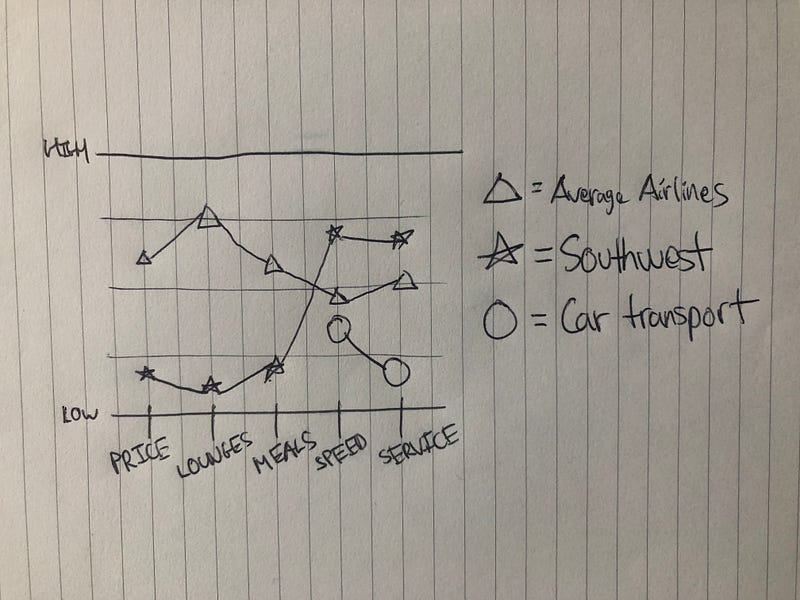
Southwest created a market by breaking the trade-offs between the speed of airplanes and the economy and flexibility of car transport. They intentionally forewent factors that every other airline was competing on.
The same wind blows on us all; the winds of disaster, opportunity, and change. Therefore, it is not the blowing of the wind, but the setting of the sails that will determine our direction in life. — Jim Rohn
Focus on key factors and eliminate the rest
Be different to stand out. Stand out to be different.
The average airline was obsessed with pricing, seating choices, lounges, and meals. But customers didn’t buy plane tickets for the seat choices, they just wanted to get somewhere. The other essential competition to consider was the substitute or alternative — car transport.
The job to be done here was quite simple: get from point A to point B. Armed with this insight, Southwest narrowed its focus on friendly service, speed, and frequent “point-to-point” departures.
The graph below shows how they literally zigged while others zagged.
It takes discipline to eliminate and reduce so many other factors. The shiny objects add up, and it becomes tough to say “no” to employees or customers.
But the juice is definitely worth the squeeze. Southwest has been able to price against airlines by avoiding costly investments in fancy meals and lounges. At the same time, it beats out car transport through friendly service and speed.
Every great strategy needs focus, and the canvas offers a visual way to show it. Now how do we get there?
Take action on divergent thinking
Focus, divergence, and a compelling tagline.
According to the authors, the three characteristics above serve as a litmus test for a good strategy. Southwest showed us focus. What about divergence?
Look no further than Apple’s launch of iTunes.
By 2003, over 2B illegal music files were exchanged each month and physical CDs were soon to be a distant memory. Digital music was here to stay, but no one wanted to pay.
More specifically, no one wanted to buy an entire CD — they wanted to pick and choose individual songs. Apple capitalized on this nuance, spinning up an agreement with major music companies to offer “legal, easy-to-use, and flexible à la carte song downloads”.
iTunes was born, creating value for everyone including the customers and recording artists. The rest is history.
“The creative process is fueled by divergent thinking — a breaking away from familiar or established ways of seeing and doing.” — The Innovator’s Toolkit, Harvard Business Essentials
Tell the story of how you create value
Three to six words.
That’s all the pros usually need to craft a compelling tagline or slogan. More importantly, that’s all you should need.
Southwest was able to offer the speed of a plane…at the price of a car…with convenience to match. They boiled it all into one word: “transfarency”.
Imagine the plight of marketing agencies working for the competitors. They would have to package meals, seat choices, lounges, and hub links into a single message and try to promote value. Without having the benefit of lower prices, faster speeds, and highly-rated customer service.
The ability to spin up a strong tagline is a good indicator of a great strategy. Here are a few other brands that “got lucky”:
- Nike: “Just Do it”
- Disneyland: “Where Dreams Come True”
- Toyota: “Lets Go Places”
- Dunkin’ Donuts: “America Runs on Dunkin’”
- Dollar Shave Club: “Shave Time. Shave Money.”
Don’t be the next Southwest
Go North and East as fast as possible.
What can these principles teach us as marketers? As Apple would say, “think different”. Applying Blue Ocean Strategy enables us to:
- Eliminate and reduce conventional product attributes to improve focus
- Double down on divergence to create value
- Tell your story and dare to stand out