
St. Petersburg’s Alcoholic, Cannibal Drinking Buddy
A man’s last shot of vodka and a killer’s first victim
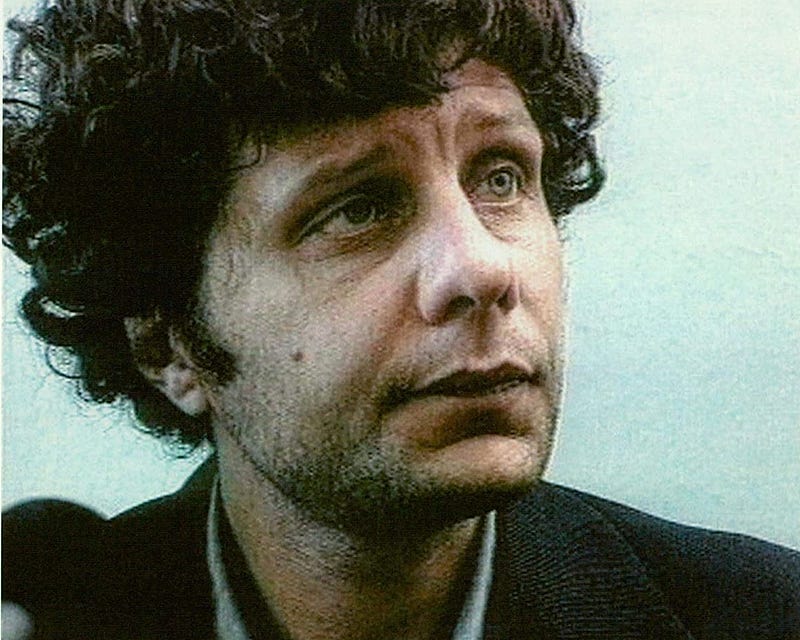
Ilshat Kuzikov, was a lonely drunk at the age of 35. Kind to his neighbors and highly devoted to his pet cat “Dasha”, his appearance was inoffensive yet captivating to most people at the time, he was taller than the average Russian with black curly hair and a warm smile. His favorite topics of conversation whenever people would have a chat with him: cuisine and animals, he was able to fool just about anyone without even trying.
He had worked as a street sweeper at the local market, usually seen in his uniform with a large canvas bag he always seemed to have with him. The St. Petersburg suburb families living at Block 22 on Ordzhonikidze Street had no reason to suspect anything sinister about him, although he had fame for being a heavy drinker and a once upon a time outpatient of the local psychiatric hospital, he was an apparently inoffensive neighbor.
Kuzikov had at one time been married to another former patient at the mental hospital for a couple of years. She later chose to walk out on their two-year marriage after he attacked her with a knife.
“He was good with his hands, If you ever needed help with changing a lock or a shelf, he would always muck in. He was very quiet and didn’t often seem to have visitors.” Said 69-year-old neighbour, Luyba Vasilevna.
It wasn’t until November in 1992 when the neighborhood took a turn for the worse. A human torso was found dumped in the basement of a local house by a resident of the area, nobody associated Kusikov with the murder, yet this would turn out to be his first victim.
“It was an open basement — anyone could have come and dumped stuff there” said 72-year-old Olga Petrovna, Kusikov’s downstairs neighbor.
After Kuzikov’s arrest in 1997 , he confessed to killing his first victim Sasha Pichonkinin in 1992, after he received his disability pension from the hospital. Kuzikov invited him to his flat for a drink to end the night. He then shared his preferences in regards to his “homosexual appetite”, but once Pichonkinin showed signs of rejection, Kuzikov attacked and dismembered him, later disposing of the rest of the limbs and the severed head in the communal garbage dump.
The murderous cannibal described the horrid scene during an interview. As Sasha Pichonkinin slumped over the table, Kusikov struck him on the back of the head with a knife handle before slitting his throat. He then stripped himself and his victim, selected one of a dozen cleavers above the bath and began dismembering the body.
“Since 1979, we’ve had nearly 100 people in our center who fit the criteria of serial killer. In the early 1980s, we had between three and five per year. Now it’s a steady 10 a year and the rate is growing.”
— Andrei Tkachenko, director of the Serbsky Psychiatric Center in Moscow.
The police started to close on Kusikov three years later, when the severed head of a homeless man, 37-year-old Misha Bochkov, was found dumped in the block’s communal rubbish, and the arms from the same victim were discovered in a nearby burnt-out car.
A month passed and during late August, his downstairs neighbor Olga Petrovna happened to find another severed head while she was walking her dogs, later identified as one of the mental patients from the local facility, 43-year-old Edik Vassilevski.
“It was about 07:00 am and already quite hot, the dogs must have smelt it. It was horrible. There were also jars with other stuff that I thought were just old bits of meat. You couldn’t imagine it was human.” Said Petrovna to the police.
Remember the large canvas bag he always seemed to have with him? It was found in his flat full of human bones.
The authorities were struggling with the cases until they spotted Kusikov’s name and his three other victims in the archives of the same psychiatric facility, giving the St Petersburg police a lead to finally jump on.
They had to come up with a plan, so then the agents would cut off Kusikov’s water service and play as plumbers, knocking on his door to figure out what was the issue. Kusikov wasn’t exactly buying it, the police had to take the door down in the end, but he wasn’t as evasive during the interrogation.
“He did not try to deny it, he was quite open when we asked about what we saw.” stated St Petersburg police inspector Mikhail Baluhka.
Inside Kusikov’s apartment, the walls were decorated with posters of cute kittens and martial arts film star Jean-Claude van Damme. The police could’ve imagined they had been mistaken by intruding into this man’s flat, but looking around they found Fanta bottles, not filled with soda, but the blood of his victims.
An old Gherkin pickles jar was also found with stored pieces of dried skin and ears. There was an aluminium pot containing shashliki, Russian kebabs, skewered with onions and human remains of Edik Vassilevski, ready to cook in the balcony.
After two days of interrogation, Psychiatrist Dr Valery Ivanov has made a breakthrough, earning Kusikov’s trust, convincing him of how he understands him, that he can empathize with the crimes he has committed.
Kusikov chatters away at Ivanov. He mistakes him for a fellow cannibal.
“Come on, we understand each other. You could get me out of here. We will go off together and do things that we like to do.”
As he draws on a cigarette, ignoring questions from anyone except Dr. Ivanov’s. The psychiatrist tries to fake a smile, carefully trying not to destroy Kusikov’s confidence so they can proceed with the interview.
Further into the interrogation, it seems that Kusikov has adapted a logical mindset. He knows it’s wrong to kill, but a serial killer’s perverted mind can always find the ways to justify his murders. Then he adds
“You know, I am a nurse of society. I am cleaning up all the rubbish. At work, I swept streets. Now I’m just cleaning up a different kind of rubbish.”
Dr. Valery Ivanov believed that Kusikov was simply a sadist.
“For a sadist, the most important thing is to have complete control of their victims and they have ultimate control over them when they eat them. That is cannibalism.” said the psychiatrist.
During an extensive conversation with Kusikov, at some point he expressed
“You know, I always wanted to be a surgeon, but it’s better to be a cannibal. If you are a surgeon, you have to put the body back together and you stop having any control over it. But a cannibal kills and then he can do what he wants with the body. After he kills, he owns it for ever.”
Kusikov’s family background and poor school grades made it impossible for him to realize his medical career. When his family moved to St Petersburg in the early 70s, he was barely able to graduate from his low-grade technical college. He also worked as a welder before claiming his pension.
Deeply buried records showed that he was turned down for work at a nearby morgue more than once, whenever he would apply to wash the corpses.
Dr. Valery Ivanov admitted to not being able to understand what caused this young man to go from wanting to become a surgeon, veterinarian or a chef, to a man who finds sexual satisfaction out of the thought and scent of rotting human flesh.
As it is commonly suspected, these type of disorders can be triggered by a cataclysmic childhood event. Though there was barely anything known about Kusikov’s childhood, further investigation brought the psychiatrist to old records from Tadzhikistan, where the cannibal murderer grew up, revealing information about how his father strangled his young wife, Kusikov’s mother, when he was only 11 years old.
The investigators still didn’t know what kind of effect this incident had in Kusikov’s psychosis, but he later admitted that around those years he and his brother had an incestuous homosexual relationship. He felt obsessed with the human body and was able to have orgasms while watching surgical procedures on the T.V. at the hospital.
Ilshat Kuzikov end wasn’t to be sentenced to death or a life-time confinement. He was found insane and sent to a maximum-security psychiatric hospital, for killing three identified drinking partners and eating their internal organs, sentenced to closed psychiatric confinement in 1997.
Alexander Bukhanovsky, the psychiatrist whose physiological profile helped to catch serial killer Chikatilo, believes the recent surge in serial murder and cannibalism in Russia during that time, was attributable to a wide range of factors. “You have the collapse of the family, severe economic difficulties, a wide distribution of pornography, coupled with a lack of sex education.” And let’s not forget the cruelty of Russia’s history, Stalin’s brutal labor camps and the widespread famine caused by collectivization, created conditions where cannibalism certainly took place as the only form of survival.