
If a Crypto-Token Goes Up 45,000% Within a Few Days You Can Be Damn Sure It’s a Scam
Squid Game Token isn’t the first cryptocurrency scam and it won’t be the last.
If you’ve been following cryptocurrency, you may have heard of a cryptocurrency token that was reported to have gone up an insane 45,000%.
This was also covered by mainstream media. Just last week, the BBC reported that “Squid Game cryptocurrency rockets in first few days of trading ,” only for them to make a 180-degree and announce instead: “Squid Game crypto token collapses in apparent scam.”
I wasn’t surprised.
In another Medium story I published a few days ago — even before mainstream media confirmed that it was indeed a scam— I had written that if you cannot sell any token, it’s 100% loss and obviously a scam.
Unfortunately, as it turns out, my skepticism was well-placed.
Squid Game — Crypto-style
Unless you’ve been living under a rock, you would have heard of Squid Game, a Netflix show that transcended cultural and language barriers to become the streaming service’s top show globally. The story is about the destitute members of Korean society being forced to play a series of survival games. Only one person will walk out with the prize money.
That’s exactly how the Squid Game Token turned out.
A thorough and complete scam, a “Crypto-Squid Game” with only one person walking away with the prize money. Everyone else lost their money.
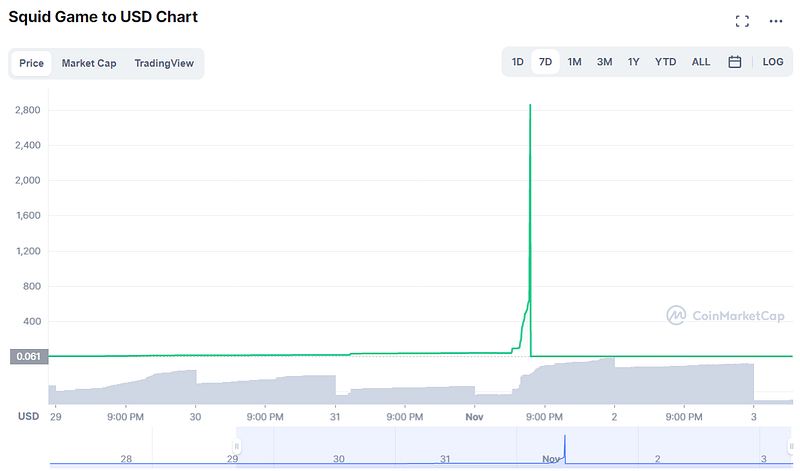
The Squid Game scam was finally confirmed, when the price of Squid Game — which had “rocketed” an insane amount in a mere ten minutes — finally collapsed from over 2800 USD to 0.06USD in the time it takes you to visit the bathroom.
In total, the scammers made off with 3.3 Million dollars worth of Binance Coin (BNB).
The writing was on the wall
In truth, there were huge red flags that indicated to me that this was a scam.
2000% up over two days and no one thinks to take profit?
People were reporting that they couldn’t sell the token. That was very suspicious to me. That’s a very big red flag.
If you cannot redeem any token for anything else (zero liquidity), its effective market value is zero.
Turns out, there was a logical reason for why the price appeared to rocket. Investors couldn’t sell the Squid Game token, so there was only buying pressure. That’s why the price just kept going up, explaining the monstrous “gains” over the course of a couple of days. Because no one could sell, there was no liquidity, making it look like there was insane demand for it.
Now, I read from our good friends at the BBC that according to the developers of the Squid Game Token, they had implemented an “anti-dump technology,” to prevent traders from dumping the token.
I didn’t know this at the time, but apparently, to sell you actually needed Marbles, another token, which could only be received when you play some game that was going to be launched.
Tokens upon tokens. Red flags upon red flags:
“As you can see, $SQUID implements an innovative anti-dump mechanism. Buying in the market will release selling credits with a rate of 2:1. $Marbles is the token built on BSC chain as the key for Squid Game. Obtaining Marbles without using violence is the key to Squid Game. Marbles holders will have the right to trade SQUID freely,” the creators say in a Whitepaper PDF document .
This sounds awfully like a scam. If you hear that your money cannot be redeemed at any time, run far, far away.
The details have been covered much better than I can, in this article here: “New Squid Game Cryptocurrency Launches as Obvious Scam (gizmodo.com).” Other even more blatant and obvious red flags:
- Spelling mistakes on the website
- Fake profile pictures of the development team
- Blatant lies about collaborating with big name companies on the website
- Unresponsive social media accounts
Rug pull, or, the ending of a crypto scam
This sort of scam, called a “rug pull” in the crypto world, are fairly common in the DeFi world. Usually, this is achieved when the founding developers suck out all liquidity and leave the initial investors holding useless tokens. Mainstream news outlets are still figuring out how the scammers made off with the money:
“The reasons behind Squid’s collapse, reported earlier by Gizmodo, weren’t clear. Neither were the identities of its creators. Its website appeared to have been taken offline. An email sent to its developers bounced back. Its social media channels appeared to have been shut down. Its Twitter account was not accepting direct messages or replies.”
Source: Squid Cryptocurrency Crashes, and Investors Lose Money — The New York Times (nytimes.com)
Well-known tech-turned-crypto Youtuber Tech Lead (Patrick Shyu) has posted an analysis of how the scammers apparently made off with the money.
I’m not a developer, but based on my understanding, developers actually created a “backdoor” in the contract source code, which allowed them to subsequently alter the source code and prevent anyone holding the token from selling it, while they were free to remove the underlying Binance Coin (BNB) liquidity from the liquidity pool.
Worse, they managed to do it in such a way such that the source code shown is not even the actual source code the smart contract is running, because it has already been replaced by something else. Like a crypto changeling.
The developers also threw in a few other decoys, so that even if you were smart enough to check the source code, you might still overlook the security lapses.
It’s not the first crypto-scam and certainly won’t be the last
Having succeeded in walking away with 3.3 Million USD, these sacmmers are most likely going to try to repeat their success with a similar modus operandi.
If you hear in the news again that out of nowhere, a new token has rocketed thousands of percentage points, you should be very skeptical.
Skepticism is a healthy attitude to have in the world of cryptocurrency and DeFi.
Just earlier this year, there was another crypto-scam involving a famous 17-year old Tik Toker who sucked in many of his fans into losing their monies together.
DeFi is like the Wild West. Opportunities and scams co-exist and FOMO drives the decision making process of many people who pile in.
Use extreme caution and a strong dose of common sense before investing any money into cryptocurrencies, and especially DeFi. If you’re new to the world of cryptocurrency, you can check out another article of mine below, and learn to avoid mistakes that new cryptocurrency investors (especially if you want to buy meme tokens), can make.
Update 1:
I don’t believe it, but apparently traders are still buying this scam: Traders Are Still Buying This Crypto Scam | by Alvin Tan | Nov, 2021 | Medium
Update 2:
Why I think the media ended up becoming an unwitting accomplice to this crypto-heist. Squid Game Token Revisited — Was the Media an Unwitting Accomplice to This Crypto Heist? | by Alvin Tan | Nov, 2021 | Medium
Note: This is not financial advice to buy or sell any asset, digital or otherwise. Please do your own due diligence before trading or investing in any digital assets. I am not affiliated with or paid by any of the news agencies mentioned above.
In the spirit of full disclosure, I own a variety of cryptocurrencies.
The author writes on a wide variety of topics. His key topics are Japan, society, culture, modern work, and cryptocurrency. Discover his most-read stories here.
If these topics interest you, consider subscribing to receive new stories from the author via e-mail.


