SQL Mastery for Data Scientists: A Comprehensive Guide from Novice to Advanced
SQL Roadmap for Data Scientists from Zero to Hero
In today’s data-driven world, the ability to analyze and manipulate large amounts of data has become a critical skill for data scientists. SQL (Structured Query Language) is a powerful tool that allows data professionals to extract valuable insights from vast amounts of data.
However, mastering SQL can be a challenging task, especially for those new to the field. This comprehensive guide aims to bridge the gap between novice and advanced SQL skills for data scientists.
From the basics of SQL syntax to advanced techniques such as optimizing queries and data modeling, this guide provides a step-by-step approach to mastering SQL for data science. Whether you are a beginner or an experienced data professional, this guide will equip you with the knowledge and skills needed to become a SQL master and excel in your data science career.
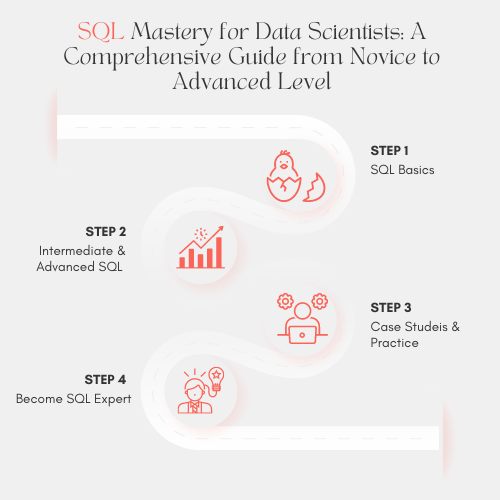
Table of Content:
- SQL Basics
- Intermediate & Advanced SQL
- Database for Data Science
- SQL Case Studies
- SQL Practice
- Become SQL Expert
If you want to study Data Science and Machine Learning for free, check out these resources:
- Free interactive roadmaps to learn Data Science and Machine Learning by yourself. Start here: https://aigents.co/learn/roadmaps/intro
- The search engine for Data Science learning resources (FREE). Bookmark your favorite resources, mark articles as complete, and add study notes. https://aigents.co/learn
- Want to learn Data Science from scratch with the support of a mentor and a learning community? Join this Study Circle for free: https://community.aigents.co/spaces/9010170/
If you want to start a career in data science & AI and do not know how. I offer data science mentoring sessions and long-term career mentoring:
- Long-term mentoring: https://lnkd.in/dtdUYBrM
- Mentoring sessions: https://lnkd.in/dXeg3KPW
Join the Medium membership program for only 5$ to continue learning without limits. I’ll receive a small portion of your membership fee if you use the following link, at no extra cost to you.
1. SQL Basics
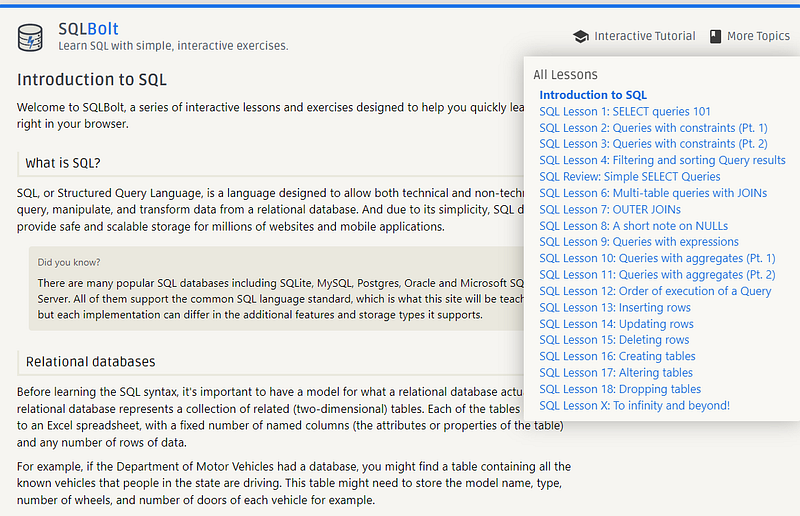
First, you will start by learning the SQL basics commands which include SELECT, WHERE, JOINS, Aggregate Functions (Count, Sum, AVG, etc.), and table commands such as (create, delete, insert, etc.) There are many resources to learn these basics but I recommend SQL Bolt.
The lessons are designed to be interactive and hands-on, allowing users to practice writing and executing SQL queries in a real-world setting. This makes SQL Bolt a great resource for anyone looking to learn SQL, whether you’re a beginner or an experienced developer looking to brush up on your skills.
It has 19 lessons I believe you can finish all of them in one day or two and by that you will have the SQL basic knowledge and it will now be time for learning intermediate topics.
2. Intermediate & Advanced SQL
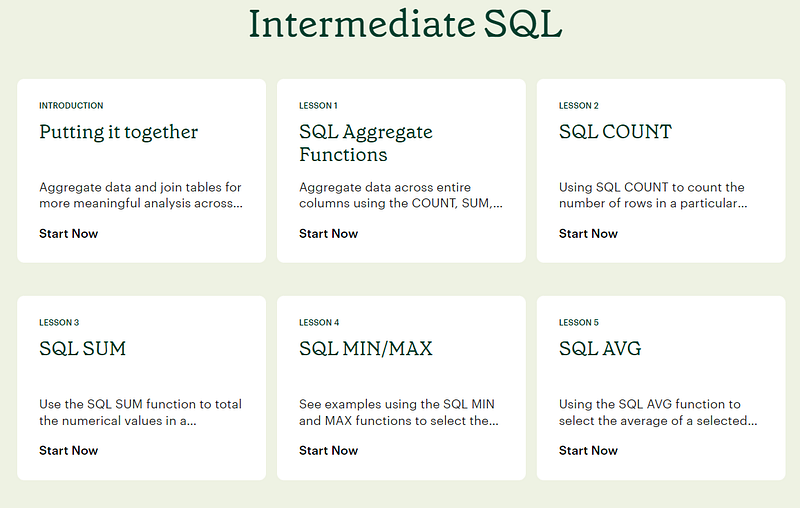
Now it is time to learn more advanced SQL concepts such as Subqueries, Window functions, SQL for data wrangling, and more. A great place to learn these concepts is Mode SQL. They have 4 levels of SQL lessons:
- Basics (14 lessons)
- Intermediate (20 Lesson)
- Advanced (8 Lessons)
- SQL Analytics Training (7 Lessons )
Since the basics were covered before you can skip them or you can take them again if you would like to revise the basics and have a deeper understanding of them. However, you have to take the three remained levels to cover most of the important SQL commands and concepts.
After finishing the basics and the advanced level, it will be good to have a basic understanding of databases. Although as a data scientist, you might not have to deal with it directly it will give you a new perspective and understanding that will help you build better solutions.
3. Database for Data Science
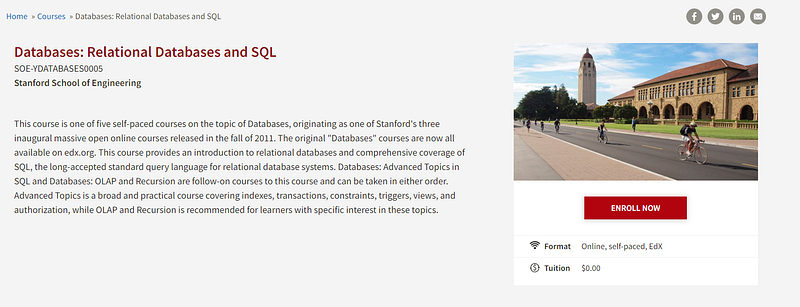
After studying SQL commands and statements it will be important to have a basic understanding of databases and their main characteristics and concepts. My recommendation is the Stanford Databases: Relational Databases and SQL Course.
This course is one of five self-paced courses on the topic of Databases, originating as one of Stanford’s three inaugural massive open online courses released in the fall of 2011.
This course provides an introduction to relational databases and comprehensive coverage of SQL, the long-accepted standard query language for relational database systems. Databases: Advanced Topics in SQL and Databases: OLAP and Recursion are follow-on courses to this course and can be taken in either order. Advanced Topics is a broad and practical course covering indexes, transactions, constraints, triggers, views, and authorization, while OLAP and Recursion are recommended for learners with a specific interest in these topics.
5. SQL Case Studies
Now you are ready for practicing. I would recommend starting with practicing real case studies. A great place to do so is the 8-week SQL challenge by Danny Ma.
6. SQL Practice
Finally, you can start to solve SQL questions that you will expect to meet in a data science interview and also in practice. There are a lot of resources to do so. Here are a few good options:
7. Become SQL Expert
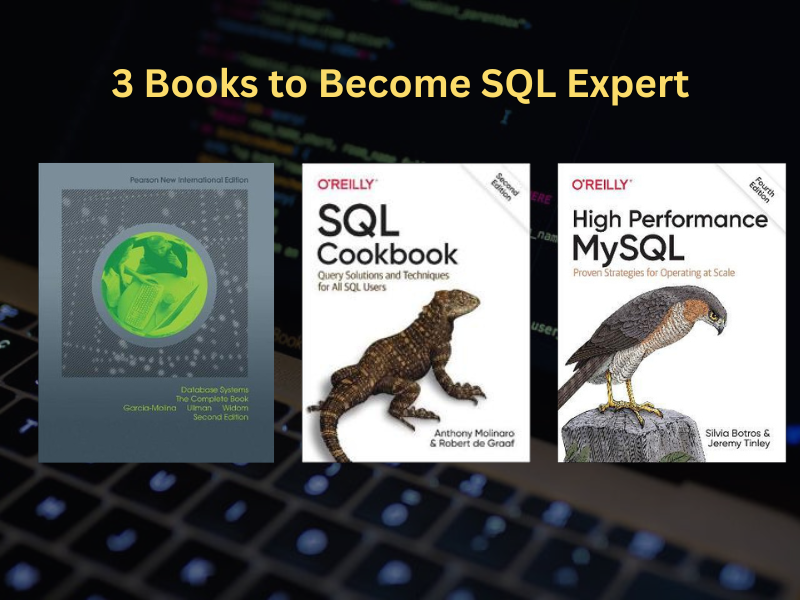
If you would like to build more knowledge you can start studying from more advanced resources. I recommend three books:
- “Database Systems: The Complete Book” by Hector Garcia-Molina, Jeffrey D. Ullman, and Jennifer Widom — This comprehensive textbook covers the fundamentals of database systems, including data models, schema design, query processing and optimization, and transaction management. It also includes advanced topics such as distributed databases, data warehousing, and data mining.
- “SQL Cookbook: Query Solutions and Techniques for Database Developers” by Anthony Molinaro — This book provides practical solutions to common SQL challenges faced by developers, administrators, and analysts. It covers a wide range of SQL topics, including data aggregation, table design, text manipulation, and window functions.
- “High-Performance MySQL: Optimization, Backups, and Replication” by Baron Schwartz, Peter Zaitsev, and Vadim Tkachenko — This book focuses on advanced topics related to optimizing and scaling MySQL databases for high performance. It covers areas such as query optimization, indexing strategies, replication, and backup and recovery techniques. It also includes real-world examples and case studies to illustrate key concepts.
If you like the article and would like to support me make sure to:
- 👏 Clap for the story (50 claps) to help this article be featured
- Follow me on Medium
- 📰 View more content on my medium profile
- 🔔 Follow Me: LinkedIn |Youtube | GitHub | Twitter
Join the Medium membership program for only 5$ to continue learning without limits. I’ll receive a small portion of your membership fee if you use the following link, at no extra cost to you.
Looking to start a career in data science and AI and do not know how. I offer data science mentoring sessions and long-term career mentoring:
- Long-term mentoring: https://lnkd.in/dtdUYBrM
- Mentoring sessions: https://lnkd.in/dXeg3KPW