
SQL Imposter Syndrome
If you still use Microsoft Access, you may know what I’m Talking about.

Let's first understand what exactly imposter syndrome is.
the persistent inability to believe that one’s success is deserved or has been legitimately achieved as a result of one’s own efforts or skills. [1]
It’s that nagging, scary feeling that you don’t have the skills or knowledge to do what you’re doing. Most often, it can come up in our professions or hobbies.
Speaking from experience, it can lead to a major identity crisis. All of the sudden the room starts spinning. You get lightheaded. You think to yourself, what am I doing here?!
What does this have to do with SQL?
At my job, Microsoft Access is our primary Database Management Software (DBMS).
It may be old and clunky, but hey it’s not my decision to make.
If you’ve ever used Access, you are probably familiar with Design View.
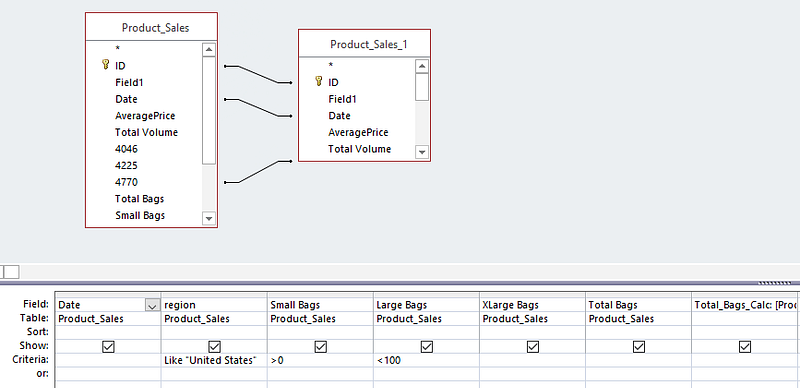
You throw in some tables, make table relations, and maybe input some criteria you’re looking for.
You can see in the picture I want my ‘region’ field to contain entries like “United States”. I want my ‘Large Bags’ field to be less than 100. You get the picture.
Once you’ve satisfied your requirement, Access spits out your SQL code for you. No typing, no syntax.

Convenient? Yes. But I'm not actually writing SQL while claiming I know how to write SQL. In reality this is just performing queries in a database environment. Sometimes that’s good enough.
But what if you want to apply to a new job that requires SQL, and they don’t use Access? Or what if your company switches software? Hopefully you practiced. Right?
The Good News
You’re not alone. Most (if not all) of us have experienced imposter syndrome at some point. It’s a part of the growing process.
There are things you can accept, and there are things you can do.
- Give credit where credit is due.
To do the above task you still need to know skills and knowledge within database management. You need to know how to set up relational databases. you may even know some syntax to put in the criteria field.
My point is you still know something. Something that gives you a working knowledge to complete a task.
Don’t be so hard on yourself just yet.
2. Use it as a learning opportunity
If you’re a beginner learning SQL, this tool can actually be incredibly helpful for learning. You may not know the exact SQL syntax to type, but if you can set up tables and table relations, you’re 90% there.
Take some time to experiment with the tool. Then you can study the syntax. Voilà, you’re improving!
As I mentioned earlier this feeling is part of the growth cycle. Embrace it and use it as fuel to keep learning.
3. Assume it won’t last
First, assume the imposter syndrome won’t last because the hope is you will continue to learn and grow if you’re serious about your profession.
Second, assume that this environment (MS Access) won’t last either. A scary thought, I know. What happens when your company decides on a new software. Are you prepared? Hope for the best, prepare for the worst.
How do you prepare?
4. Study and practice your skills
If you don’t use it, you lose it. Utilize the internet to practice SQL and coding skills.
- Hacker Rank is a website with pre-made coding challenges for many different languages
- Research and study other projects done by people on Kaggle. I recommend looking at past contest winners to analyze their process and code
- YouTube videos on SQL. here are a few recommendations: https://www.youtube.com/@programmingwithmosh https://www.youtube.com/watch?v=h0nxCDiD-zg&t=2s https://www.youtube.com/watch?v=HXV3zeQKqGY https://www.youtube.com/watch?v=AA7i2GcTGwU
- Read a book. I wrote an article about one here:
Conclusion
Comparison is the thief of Joy. In order to avoid imposter syndrome don’t compare yourself to others. You are where you deserve to be in your journey. It takes time and work that many aren’t willing to put in. Then they complain and expect themselves to be further along than they deserve.
Use the tools I have laid out here. Play the long-term game to defeat imposter syndrome. Best of luck!
Originally posted on sheetfreek.com
Other Stories:
https://readmedium.com/what-is-the-salary-of-a-database-administrator-3f19adfb4a2d
Sources


