
WWTBD? What Would the Boss Do?
Springsteen Changes His All-time Favorite Song to Make It Less Personal
Make your story more universal
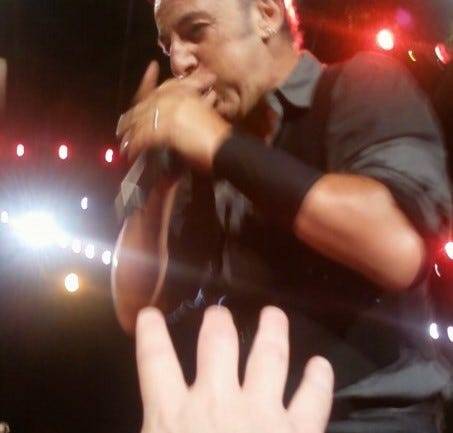
Explaining his early songwriting, Bruce Springsteen said his only goal was to write something he could still stand to sing thirty-some years later. Goal achieved. He’s in his 70s now, and most of his songs have held up fine.
However, for the past 30ish years, he could no longer sing the original version of a song, which I had always thought was his favorite.
The song is from Darkness on the Edge of Town. The album was his first release after a grueling lawsuit that prevented him from recording for several years. The strain in his life is evident on the album. It touches on some bleak issues, including anger, desperation, and loneliness.
In some ways, I think of the album as an ode to depression. To wit:
From Streets of Fire: When the night’s quiet and you don’t care anymore, And your eyes are tired and there’s Someone at your door And you realize you wanna let go … I live now, only with strangers I talk to only strangers I walk with angels that have no place
The song in question has the same name as the album Darkness on the Edge of Town.
In its final verse:
Tonight, I’ll be on the hill cause I can’t stop I’ll be on the hill with everything I got
The song portrays a character fueled by passion and perseverance who faces challenges and darkness head-on. The character and the album understand the stakes of searching in darkness to find worthy meaning and experience. There are consequences.
In the final lines: I’ll be there on time, and I’ll pay the cost For wanting things that can only be found in the darkness on the edge of town
Darkness and shadow (Was he reading Jung then?) flirts with self-destruction. But hope tempers the darkness. Ultimately, the darkness and “the cost” act as a rite of passage that forges a man strong enough to thrive. (From the album’s The Promised Land: “Mister, I ain’t a boy, no I’m a man, and I believe in the Promised Land.”)
Bruce discovered a line in the song that worked for the 30-year-old him but not the approaching 50-year-old version. To make it something he could “stand to sing,” he had to change two words.
The original line from the song Darkness on the Edge of Town that represents the character’s rock-bottom:
I lost my money, and I lost my wife (Those things don’t seem to matter much to me now)
Bruce has become almost a billionaire from the only job he has ever had. No one is worrying whether he will ever lose his money or be broke.
He is not unaware of the irony.
It’s a sad funny endin’ when you find yourself pretendin’, a rich man in a poor man’s shirt. — Better Days from the album Better Days.
When Bruce was in his 20s talking about another 20-something character, it would be completely understandable that money was urgently vital to him and was scary to lose.
Years later, he looks back on that time and realizes that a loss/lack of money may have contributed to an insurmountable frustration or desperation. Still, there may be a more powerful situation, one that appeals to more of his audience.
Original I lost my money, and I lost my wife
Rewrite I lost my faith when I lost my wife
Aha, it wasn’t about losing money … it was about losing hope … and faith.
I’ve been broke, and I’ve been hopeless. And I will tell you that hopelessness is scarier and serves as fodder for bigger and better stories than a simple lack of cash.
Do you see how the change helps the song?
It makes the story more relatable. It’s not any less personal, but it becomes more universal.
Sometimes, the slightest tweak to your story can help it appeal to a broader audience. It can make the protagonist’s journey relatable and understandable.
When we write autobiographically or characters loosely based on ourselves, we sometimes lose perspective on the story’s core. We might not have the insight or distance from the inspiration in our life to effectively turn it into a coherent and meaningful story that will resonate with strangers. This applies to movies, short stories, poems, and songs.
Here’s an example I used a decade ago to illustrate the point. I will avoid the temptation to rewrite it now.
Let’s say I am a hopelessly neurotic teenager (For those who know me: what a stretch, right?), and I write a story about a kid who breaks up with his loving girlfriend because she doesn’t like Bruce Springsteen as much as he does. From my perspective, I have written a story about love and loss. It’s big, and everyone should get it, understand it, and feel it. Right?
Well, maybe.
When I am 17 and write the climax, it becomes “Woe is me, ’tis better to have loved and lost, than never to have loved at all.” I am too close to the ideas and the main character to see what’s happening. More likely, I have written a story about stupidity or immaturity.
Let’s say I revisit this story as an adult with some perspective on the character and the original inspiration for the story. The climax now feels more like, “Why did I throw away love and affection for no reason?” or “I was so wrong and scared. Please forgive me and take me back. Here are Taylor Swift tickets.”
This isn’t the tragic love story full of loss that the teen me first tried to write. It’s smaller. But it’s a better and more honest story. An immature and insecure teen makes a mistake that leads to him growing and learning. But the imaginary teenager me didn’t see that and couldn’t (or wasn’t ready to) write it.
You can write a story with characters based on you, but it might take some time and self-knowledge to nail it. Your path to getting there might be script analysis (with someone like me). More likely, it will be psychoanalysis. Kidding, mostly.
You can also write characters who are decidedly not you and revel in that fact. The distance and perspective often allow you to understand them better than the autobiographically tainted ones.
In Darkness on the Edge of Town, it was a simple rewrite. Changing the word money to faith allows a 70-year-old singer to sing the song with the same passion and connection to it as his 30-year-old self.
When considering the rewrite of your personal stories, strive for a perspective that will allow your story to be something you (and your audience) will appreciate now and 30-plus years from now. Look to frame the character and dilemma as something universal and powerful to a broad audience. This helps you create a more honest and understandable theme.
I have an entire chapter in my book about a character’s dilemma and how it’s the key to the character and most of the key scenes in your script.
Imagine the Muse of Screenwriting fluttered down from spec script heaven and offered me the choice between an elaborate 10,000-word bio of my character or a perfect single sentence that nails the essence of the character’s. Although I would find the choice a true dilemma, I would choose the latter because it would serve me better in writing better drama.
— Me
The teacher who first introduced me to the concept of dilemma recently released an entire book on the subject.
If you are a storyteller, sign up for my free story talks.
For more writing lessons from me and Bruce, check these out. The bottom story got boosted.


