
Is this gift Fermi?
Spread Your Brain Legs for this Huge Nuclear Knowledge Bomb
Nuclear war doesn’t have to be a nuclear bore

New York City released a public service announcement in July 2022, detailing what to do in case of a nuclear strike. The randomness of the message, and the casual tone of the presenter, left people confused. Plus, it didn’t look that helpful.
- Get inside.
- Stay inside.
- Follow media for more information.
I thought to myself, “Well, what would happen if a nuclear bomb exploded in New York City? How helpful would this video message be?”
I took a bunch of pills — prescribed, don’t worry — and got to work on finding the answer. I’m coming in with twice the ill-fitting tone of the PSA, but half a New Yorker's knowledge of the area. I’ve never been there. Who better to talk about the ruin of a city than someone with no emotional connection to it, whatsoever?
I’m no monster. I won’t drop you in a hypothetical nuclear strike situation without context. Nope. You’re still getting dropped into one, but we’re gonna get a little ambience going.
Ahem.
It’s a bright, clear Tuesday afternoon in New York City. You’re on your way to a lunch date with the attractive person you met on Hinge. You settled on a lunch date because you’ve always wanted to try that one restaurant’s lunch special. You arrive and gosh darn it, your date is even more attractive in person.
Since it’s so nice outside, you take a table on the patio. The waiter comes with your food.
A cool and pleasant wind ruffles the napkins, and one blows away. You try to grab it and fall out of your chair. It’s funny. It’s a cute and endearing sort of thing that both of you will recall years later.
Or you would, if there hadn’t been a nuclear detonation at that precise moment.
How’s that for ambience?
I hope you liked it. It’s all numbers from here on out. My four main sources for this information are at the bottom of this piece.
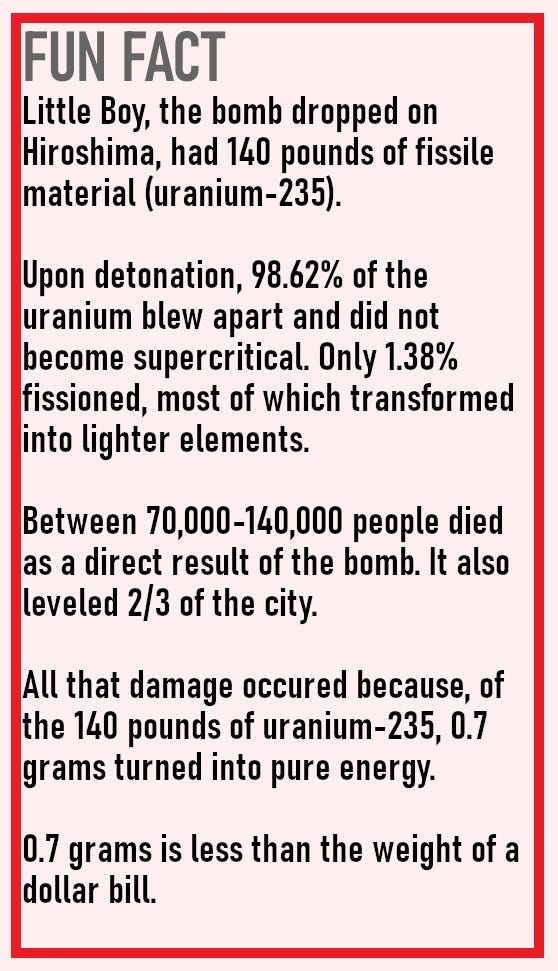
So, what happens when a nuclear weapon strikes a city? A single one might go off but there would probably be more. There’s no way to use a single nuclear weapon and not have the crisis escalate. However, let’s move forward on the assumption that only one nuke went off. Makes things easier to discuss.
But, you know, if one went off more would follow.
I don’t know precisely where to jam this information in, so I’ll do it right here. Nuclear explosions are measured in kilotons and megatons. A megaton is equal to one million tons of TNT. The strongest nuclear weapon ever detonated was the Soviet Union’s Tsar Bomba. That 50 Megaton monster had the explosive power of 50 million tons of TNT (on the off chance you didn’t already know, the Soviet Union is now Russia).
A kiloton = 1,000 tons of TNT. Little Boy, had a yield of 15kt (15,000 tons of TNT).
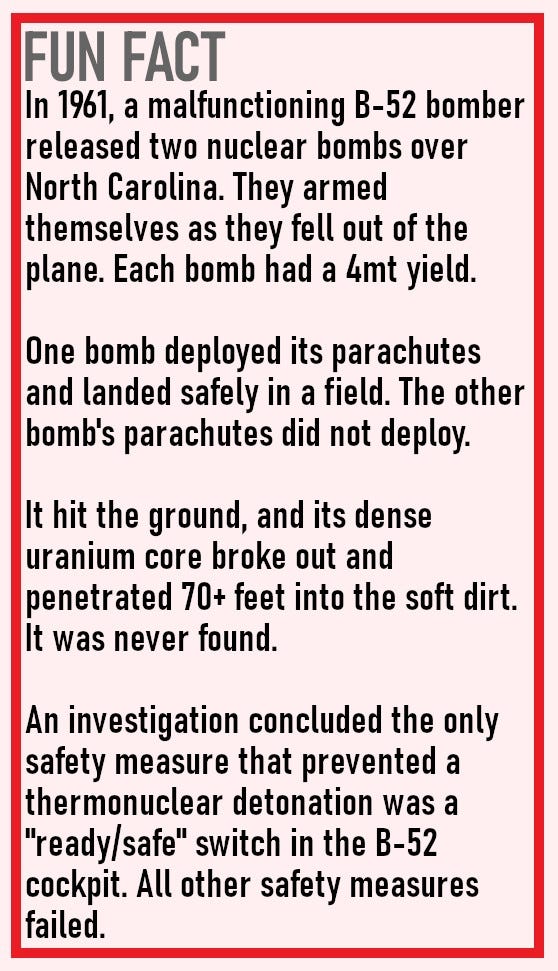
Nuclear weapons are set to detonate at certain altitudes to maximize certain effects given variables in the target structure. Higher altitudes for civilian targets (Strategic). Lower altitudes for military targets (Tactical). Strategic and tactical are more about how the weapons are used, than their design. Tactical weapons do tend to have lower yields than strategic, and a shorter range.
The altitude determines whether you have an air burst or surface burst. The two seem self-explanatory on the surface (heh), but there are major differences in the damage each one causes. For the most part, both types technically explode in the air. The determining factor is whether the fireball makes significant contact with the ground.
An air burst is a nuclear explosion whose fireball doesn’t make significant contact with the ground. There’s little localized radiation (fallout). The infamous mushroom cloud is a result of condensation of water droplets, rather than debris.
Air bursts produce high levels of overpressure over larger areas, and increased yields of thermal radiation. An overpressure is the amount of air pressure greater than that found at sea-level, measured in pounds per square inch (psi). It’s what gives a bomb its kick.
- An overpressure of 0.5 psi shatters windows
- An overpressure of 2 psi destroys wooden homes
- An overpressure of 8 psi knocks down brick walls.
As a general rule, city areas are destroyed with an overpressure of 5 psi.
Surface bursts also benefit from overpressure, but their key difference is nuclear fallout. After the explosion, radioactive particles such as fission material, radiated soil, and debris are sent into the atmosphere. Wind speed and direction play a role in the spread of radioactive fallout. It can spread over long distances —even hundreds of miles.
Finally. We got all the boring nerd stuff out of the way. You’re on your date. A nuclear bomb exploded.
Now what?
I’ll tell you what — more nerd stuff. More numbers. However, if you’ve come this far, perhaps you’re willing to go a bit further.
Our hypothetical NYC nuclear explosion
- Our nuclear weapon will detonate above Times Square.
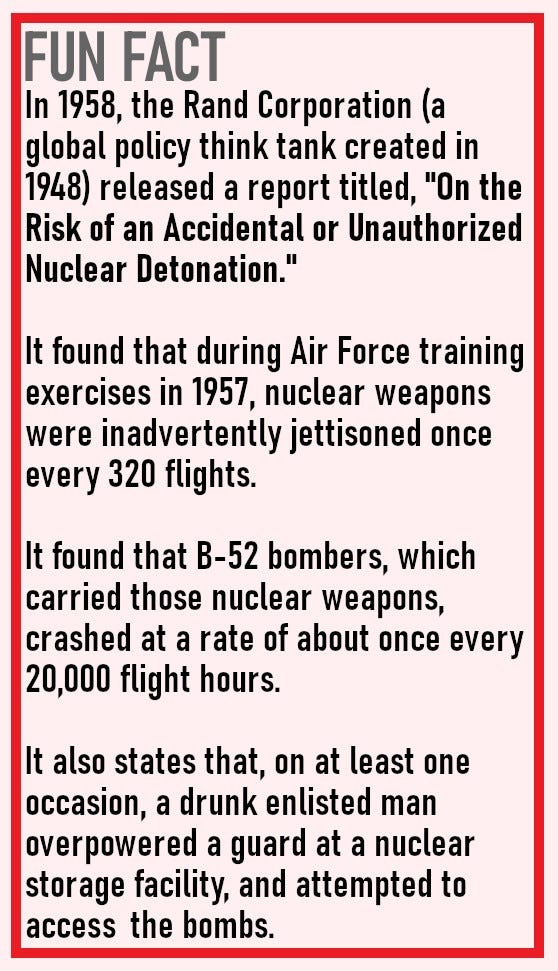
- We’ll use a yield of 4 Megatons, or 4mt. I chose this because NYC would be a “strategic target” and so an intercontinental ballistic missile (ICBM) deployed there would likely have a high yield. ICBMs can carry such warheads, and do. China’s current ICBMs, for example, carry a 5mt warhead. I also chose 4mt because of the “fun fact” mentioned earlier regarding the bombs dropped over North Carolina. Which isn’t the most scientific reason, but whatever.
- From what I understand, we want to maximize heavy blast damage (overpressure of 20 psi). The optimal distance from the ground we’ll want our nuke detonating is 1.8 miles.
- We’ll also want as many people out and about as possible to maximize another effect I’ll get to later, which is why our hypothetical nuclear strike situation occurs during lunch time.
Okie dokie. Here we go. Remember, you’re on your date. You’re eating at a place in… I don’t know. Brooklyn? We’ll go with Brooklyn.
You fell out of your chair. Before you get back up, a nuclear bomb explodes above Times Square.
Boom.
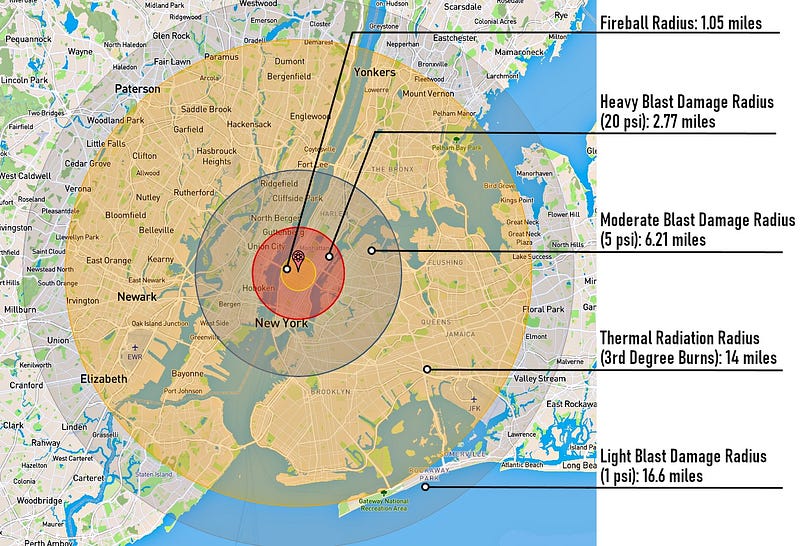
In less than a second — 1/1,000 of a second — a fireball hotter than the surface of the sun grows to at least 450 feet in diameter. In 8-10 seconds it will reach its maximum diameter of 2 miles. Anything caught in it would be effectively vaporized. Evaporated. Poof — just gone. The fireball from this explosion does not reach the ground. The diameter is 2 miles, but the radius is 1 mile.
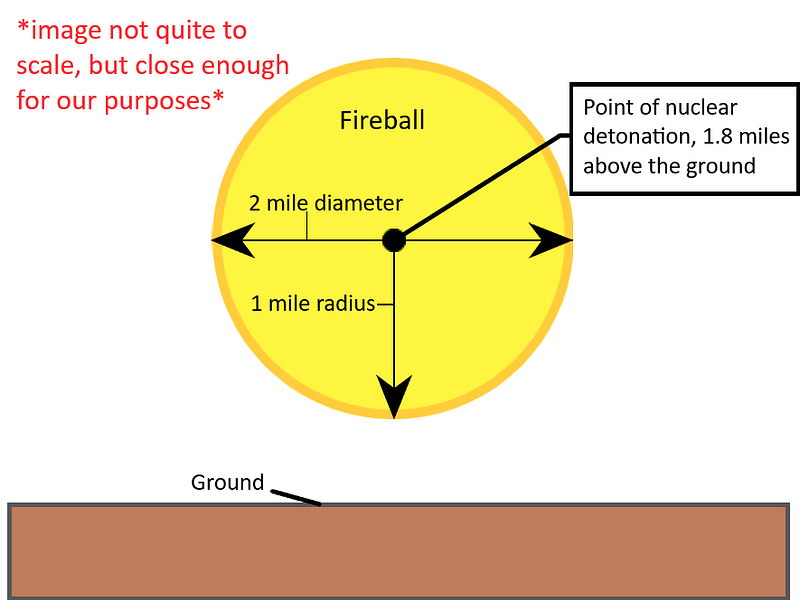
At the instant of detonation, an intense light would wash over everything. If you’re facing that direction when it occurs — congratulations. You’ve gone blind. It might not be permanent. Depending on where you are when this happens, you might not be around long enough for it to matter.
The heat of the light produces a thermal pulse. Everything burnable within 14 miles of the detonation site almost instantly catches fire. This is the “100% chance of 3rd degree burns” area. This pulse lasts for several seconds.
Here’s a famous scene from Terminator 2 that shows a nuclear blast. It’s a bit dramatic, obviously, but nuclear bombs are inherently dramatic. Anyway, the scene serves up a solid demonstration of a thermal pulse. It’s the part right after the bright light, where everyone catches fire — before the shock wave hits and turns Sarah Connor into a skeleton.
Speaking of shock waves…
The heat and radiation of the fireball creates a shock wave that travels faster than the speed of sound. At the start, its overpressure is at least 20 psi. At this strength, it spreads out 2.75 miles from the blast site, after which it begins to weaken. Within that 2.75 miles however, every structure is knocked down and fatalities approach 100%. Only heavily reinforced buildings partially withstand the force.
There’s a crater at the blast sight. It’s about 500 feet deep and 2,000 feet in diameter. Times Square no longer exists. Anyone within probably 2.5 miles of the detonation died before even knowing anything happened. One minute, you’re taking pictures of some ducks. Then the next minute — there is no next minute.
But what about you, all the way over there in Brooklyn?
The light in the sky catches your attention, and you’re on fire. People inside the surrounding buildings might avoid getting set on fire, depending on some variables. You, however, burn for about 30 or so seconds before the shock wave hits. The shock wave will extinguish the fires set by the thermal pulse, though anything smoldering might reignite later.
You’re out of the heavy blast area. You’re barely out of the moderate blast area, which would see all but the sturdiest structures leveled to a radius of 6.21 miles. A blizzard of shattered glass and other debris bombard you, but at least you’re not on fire anymore.
You might even survive that. People survive crazy things all the time. After that shock wave passes you, it will have a minimum overpressure of 1 psi for up to 16 miles from the blast site. That’s enough to shatter all windows.
As this happens, a mushroom cloud rises 15 miles into the sky. The mushroom cloud head (that thing that gives the mushroom look) is about 30 miles in diameter. It rapidly pulls in fresh air to the base, which could reignite anything left smouldering after the shock wave. The result of the in-rush of fresh air might create a firestorm. A hurricane of fire, basically, with temperatures that could reach 1,400 degrees Fahrenheit.
A nuclear detonation is like every natural disaster happening at once. Roads are destroyed. Hospitals are reduced to rubble. Emergency workers are among those dead or injured. Let’s say there’s fallout — radiation raining from the sky would sicken and kill more people than I care to think about. It’d also prevent helicopters from getting too close.
There is no help coming. No plan exists to deal with this sort of thing. Even if the injured were all evacuated, where would we put them? Can we put them anywhere?
Based on this simulation’s parameters, an estimated 3.5 million people would die as a direct result of the blast. Either right away or in the days/weeks to follow. An estimated 3.3 million people would be injured. Many with 3rd degree burns. Such a high amount of injuries would overwhelm medical centers in nearby cities.
To put it lightly, if you’re in Brooklyn and a 4 Megaton nuclear weapon detonates above Times Square at an altitude of 1.8 miles — you’re fucked.
Returning to the New York City PSA, if you have the chance to get inside and decontaminate, you should do that. It’s not bad advice. If the weapon had detonated on the ground, or if it exploded low enough so its fireball touched the ground, you’d have fallout. Radioactive dust would fall like snow, or rain. You won’t want to be outside when it comes down.
As far as “following media” goes, that may or may not be possible. Nuclear detonations release EMPs which could damage or destroy electronics. Things like smartphones — so long as they’re not charging — would probably be fine. But things like cellphone towers and all the other equipment that goes into a communications grid could/probably would suffer damage. That would limit, if not remove, an agency’s ability to disseminate information.
Remember, that all of this was for one nuclear weapon. One. I did not account for radiation death/injuries.
Fatalities and injuries could be higher, or they could be lower.
But they are all unacceptable.
Main Sources
Wellerstein, Alex. “NUKEMAP.” Restricted Data: The Nuclear Secrecy Blog, 2012. https://nuclearsecrecy.com/nukemap/. [This link is to the results used for our simulation. For some reason it doesn’t keep the burst height at 1.8 miles. So adjust that in the “advanced settings” above the detonate button, then click the detonate button.]
Schlosser, Eric. Command and Control: Nuclear Weapons, the Damascus Accident, and the Illusion of Safety. New York, NY: Penguin Books, 2014.
Kurzgesagt. “What If We Nuke a City?” YouTube. YouTube, October 13, 2019. https://www.youtube.com/watch?v=5iPH-br_eJQ.
Ellsberg, Daniel. The Doomsday Machine: Confessions of a Nuclear War Planner. London, England: Bloomsbury Publishing, 2019.
Open up your inbox to a writer in need. I’m not radioactive. I promise. If you aren’t a Medium member and want more of my supple words, sign up here!
You following me on Twitter? No? What are you, dumb? Get over here, you goofball!


