
Spotting Opportunities in a Changing World
Mapping your Terrain of Opportunity to Own The Future

Change is the only permanent constant in the marketplace. The marketplace terrain environment is saturated with relevant as well as irrelevant and immaterial variables which have to be grasped, sorted, combined, and meaningfully configured for analysis in accordance with systematic risk evaluation protocols.
Blue Leadership is best suited for this era of uncertainty and permanent turbulent change.
The multivariate marketplace is complicated by capricious changes from both known and unknown sources. Where business competition is already daunting during relatively stable periods, the uncertain impact from known unknown variables regularly upsets existing competitive relationships to produce the stormy turbulence often described as volatility, uncertainty, complexity, and ambiguity (VUCA).
Blue Leaders readily embrace VUCA challenges in the search for alternative sustainable solutions. The first step in Blue Leadership decision-making is to be agile by continuously scanning and capturing sufficient but adequate relevant material variables in his Terrain of Opportunity for processing, configuring, and developing feasible viable scenarios.
The Blue Leader conceives a unique Terrain of Opportunity schema as the Framework for strategic and operational analysis. The Terrain of Opportunity provides the battlefield context for Blue Leadership. Blue Leaders continually perfect the Art of Blue Leadership as they sense, navigate and execute strategic moves in anticipation and response to uncertainty and permanent turbulent changes in the Terrain Vectors.
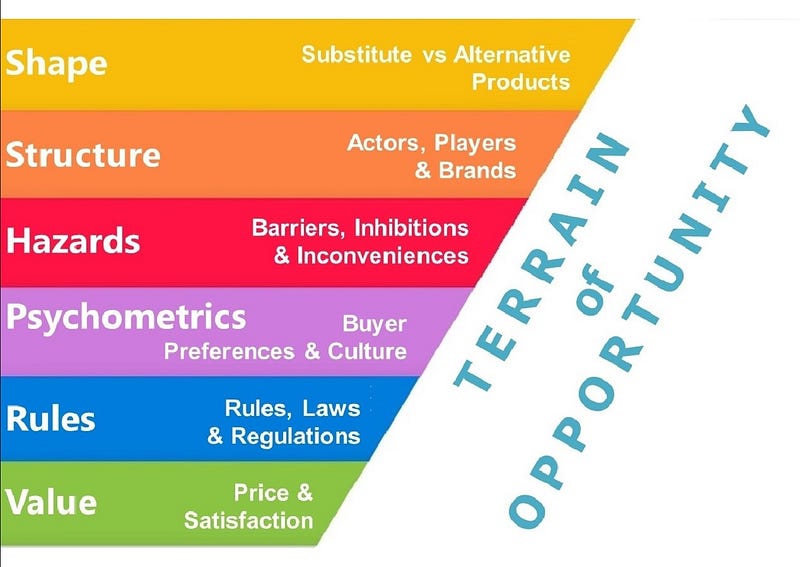
The Terrain Vectors are configured as Shape, Structure, Hazards, Psychometrics, Rules and Value. Together, the confluence of their permutations and combinations embodies and defines the dynamic situational and contingent character of the Terrain of Opportunity itself.
Understand The Terrain of Opportunity
The Terrain of Opportunity is the natural battleground arena of the Blue Leader. It also provides the framework for his strategic scanning, analysis and decision-making. In his pursuit of business and organizational excellence, the Blue Leader visualizes and envisages his Terrain of Opportunity according to the following diagram:
[1] Shape
Refers to the numerous products and services in the Marketplaces. Blue Leaders understand the distinctions between substitute and alternative products. Bloody market competition happens between substitutes, not alternatives. There are just too many marketing communications battles designed against both substitutes and alternatives alike. Such marketing efforts increase wasteful costs and distract as well as diffuse buyers’ attention. The key is to “know your true competitors”. Competitors would know each other personally and intimately. The basic competitors' test is simple: “if your presumed competitor does not know you exist, you are not his competitor, even if you had benchmarked him to be yours”.
[2] Structure
Refers to the influencers, actors, players — people — and landmarks in your Terrain of Opportunity. Landmarks are strong brands that act often as surrogates for their owners and players. It includes important stakeholders such as the community, suppliers, employees, and human climate. People include inventors, designers, entrepreneurs, managers, executives, workers, service providers, shareholders, funders, buyers (+family and friends), non-buyers, and the internet.
[3] Hazards
Refers to the physical and psychological obstacles, barriers, and inconveniences to a more fulfilling and satisfying buying experience. Also, include environmental concerns. The cost of market entry is a huge factor in determining choice options for buyers but high entry costs would also spur the introduction of alternative products and services. Technology is both a facilitator and obstacle to the total consumption experience to the extent of its requirements of computer knowledge, access devices, compliance rules, registration, anonymity, and privacy considerations.
[4] Psychometrics
Refers to the customer’s experience; buyers’ preference and psycho-emotional desires derived from their use of your products, including cultural factors. Includes influencers, opinion leaders, media, researchers, and lifestyle shapers. They indicate, measure, and influence buyer decisions. The impact of marketing communications in their battles for positional advantages is a key consideration here.
[5] Rules
Refers to applicable laws, regulations, and norms relating to the products and services. Include power brokers, politicians, regulators, enforcers, lawyers, judges, religious minders, and advocates. Include corrupt practices. They tend to be common to most if not all buyers and are relevant and material to the extent that they affect buyers differently and between them.
[6] Value
Often conflated with price, which is merely a surrogate for perceived value. A price level is acceptable and tolerated as long as the price lags behind the corresponding perceived value. True value is often distorted by the market forces of demand and supply. The Psychometric Vector is often biased and allocates too much undeserved weightage to tangible, luxurious, and superficial features of products and services. Blue Leaders see through the lenses of their 4 Passions to authenticate the truly sustainable value of their products and services.
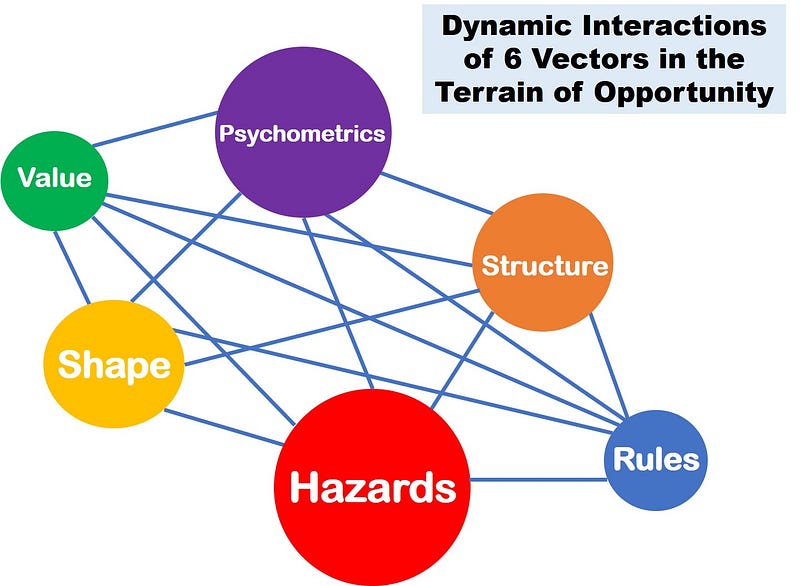
The 6 Terrain Vectors influence one another during interaction in some limited manner as they pulsate in meaningful significance in the minds of buyers and non-buyers.
The 6 Terrain Vectors are correlated. They also influence each other by a matter of degree. Immediately, they would produce 46,656 (=6 to the 6th power) basic patterns or combinations of the initial get-go scenario snapshots. These combinations also increase exponentially when the relevant elements within each Vector are captured, selected, consolidated, and factored into possible scenarios for actionable consideration. The strategic choices generated are tremendously astounding.
The Terrain Vectors affect each other in some limited manner in their interplay and interaction as they influence and blend in the minds of buyers and non-buyers as well as the major actors in the socio-political-economic marketplace and produce possible scenarios for strategic decisions.
Blue Leaders use Mindfulness to overlay the Terrain Map to provide a “sense” of the turbulent change in real-time. Mindfulness is the Capacility [capacity+capability] to capture holistically the authentic pattern(s) of changing social realities. Mindfulness self-mastery in Blue Leaders imbues in them the consciousness of action through sense-making. It emboldens and empowers profoundly insightful reflection to inform fearless engagement and innovative decision-making.
Instead of trying to predict the future using failed conventional models, organizations must strengthen their capacility to engage effectively with VUCA. They need Blue Leadership with its unique approach to terrain scanning and strategy formulation so as to empower companies reframe their long-term survival strategies by developing Blue Solutions from several feasible realistic scenarios.
Mindfulness in Blue Leaders strengthens their prediction confidence on the most likely patterns of future social reality amidst turbulent change to visualize meaningful coherence of the emergent trends in their Terrain(s) of Opportunity. They weigh the longer-term risks of the possible robust solutions needed to transform their business in a successful change response.
Blue Leaders understand that many organisations have failed to navigate victoriously through the permanent turbulence in their terrain(s) of opportunity due to 2 major reasons; namely their inability to escape the past, and/or their inability to invent their future. The Dao (道) [or Way] of Blue Leaders provides the discipline for effective and successful navigation through the uncertainty of permanent turbulence change.
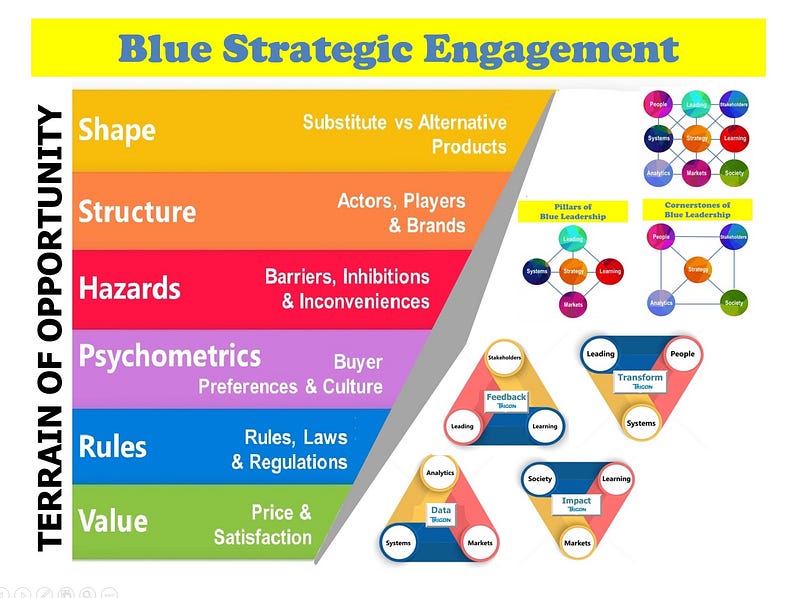
The 6 Terrain Vectors provide the decision-making context for Blue Leaders, whose self-mastery maturity in the Art of Blue Leadership emboldens their action decisions and empowers strategic moves using the 9-Actions Pathway in effective and successful strategy.
Blue Leadership self-mastery in its Tao or Way is cultivated by his mindfulness of the change characteristics in the applicable terrain(s) of opportunity perceived in the Terrain elements of Shape, Structure, Hazards, Psychometrics, Rules, and Value. Perfection is assured through the discipline of The Tao in its elements of Timelessness, Formlessness, and Intelligent.
Blue leaders use their various Terrain Maps to capture the turbulent dynamism of the 6 Terrain Vectors as they build and develop the respective strategic narratives for specific re-combinations of the Vectors to engage the VUCA challenges in the global business environment.
RELATED ARTICLES –
Unpacking the Passions of Blue Leaders
Everyone can be a Leader for This Era of Uncertainty and Change
Be an Action Leader for these Turbulent Times (Part 1 of 2)
Using Action Trigons for More Effective Leadership (Part 2 of 2)
Spotting Opportunities in a Changing World
Water — The Amazing Dynamism of Effective Strategy
Future Articles shall elaborate further on Blue Leadership for this era of uncertainty and permanent turbulent change. Please Follow me.
Please enjoy my recent Articles.
You can also subscribe to my stories and social media posts via your email.
Enjoy more interesting Articles by signing up to Medium here: https://thefuturistoracle.medium.com/membership


