
Spotify: The Public Library Of Music

My experience is not categorical, but drawing an analogy between Spotify and the public library maps well in my mind. You might need to consider some tax you pay as a substitute for your monthly Spotify subscription, but it’s an attractive enough price for what you get access to.
I go to the library with some frequency and typically with purpose. Whether it’s to borrow something I wouldn’t necessarily buy or to do a little browsing, it’s a low-level commitment and well short of significant decisions, like which records I ought to buy.
Though purchase decision criteria are complex and difficult to distill into reliably repeatable patterns, Spotify is a noteworthy research tool. It’s critical in aiding decisions regarding what to buy when shopping for vinyl.
I’ve evolved to a point where I’ll only buy LPs after adequate advance listening, and outside of that utility, or the ability to immediately access some artist from my mental archive, the endless array of options that Spotify affords isn’t always attractive to me — the dichotomy, of course, being that without the vast catalogue Spotify offers, as a product offering, it’d be inadequate.
Put simply, too many options can lead to paralysis.
If you open Spotify and can’t find anything to listen to, you may be experiencing the friction of over choice.
Of the myriad currents of exuberance I experience as a vinyl record collector, one immediate benefit is that a physical assemblage of records reduces the burden of over choice.
A heavy Spotify user, I don’t find the abundance of artists and recordings available to be conducive to making easy or satisfactory selections.
The influence of listening habits.
Irrespective of the platform, my listening habits are more or less the same — linear, and albums from start to finish. It’s the What do I want to listen to? question that causes cognitive disruption.
Being something of a visual person, the spines of record sleeves are perpetually engaged in a battle for attention, and though I will select specific releases to enhance an emotion - the How do I want to feel? decision, most of my selections are no more complex than spotting something on the shelf before me.
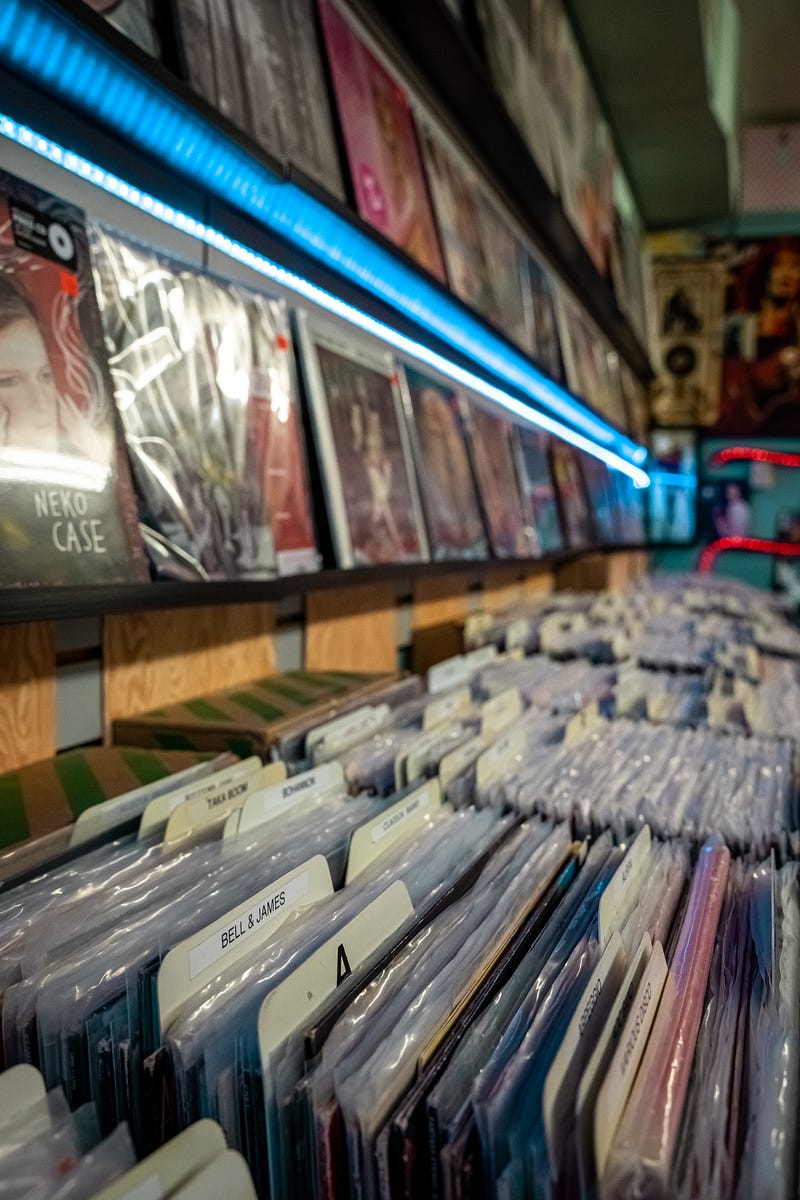
Researchers refer to this friction as overchoice.
Overchoice describes the paralysis some people experience when faced with decision-making where there are infinite options.
Coupled with this paralysis is a sort of decision dysphoria — so in the instance of Spotify, a chosen album will be second-guessed.
Was this what I wanted to listen to?
Am I getting what I hoped for from it?
Should I have chosen something else?
Though a seemingly mundane point of irritation, if you listen to support other activity, this disruption is anathema to achieving a desired flow state. For me, music is paramount to that achievement.
What this looks like in practice.
Exercising an approach to buying records that reduces this possibility of over choice is comforting. My belief is that if you get 20 spins out of a record, that’s a good ROI, and in my experience, you need at least five end-to-end listens to get a reasonable sense of what an album has to offer. You can’t achieve intimacy through surface listening, and I’m done with the flings.
Overchoice, is it actually a problem?
There’s abundant research that supports that position as true, but it’s difficult to draw a simple conclusion.
Generational variables observe teens and adults have similar experiences where children and seniors find themselves in a common grouping — and as is to be expected from any academic lens, the more nuanced the hypothesis, the fuzzier the conclusion.
Though the premise of this piece considers whether ownership of physical media reduces the friction of over choice, record collectors are by default consumers, and American psychologist Barry Schwartz, in his book, The Paradox of Choice — Why More Is Less, not only addresses this phenomenon but may well provide you with a roadmap that effectively addresses your own unique requirement. Of note is the economic theory of satisficing, a means to manage the abundance of choice and an alternative to the notion of maximising, which is more inclined towards regret.
It may be dramatic to suggest that Spotify is conducive to regret, but I do find it a barrier to the depth of intimacy one can achieve with a physical release.
The answer seems elementary.
Buy m̶o̶r̶e̶ records; it’s good for you.