
Spot and Stop Fallacies in Your Brain.
It’s Time to View Your Conversations Through a Logic Lens.

Ever wondered why some conversations leave you scratching your head?
Fallacies might be the culprits.
These culprits hide in everyday conversations like silent ninjas.
Identifying them is simpler than you might think –Just pay attention to identify faulty logic or emotional manipulation.
But I find it challenging.
Throughout our lives, from playground arguments to online discussions, we keep making these common thinking errors in our lives.
Examples like,
- You’re wrong because you’re stupid.
- His argument can’t be valid because he’s just a kid.
- This movie must be good since so many people like it.
Does it seem easy to predict these are fallacies?
Now, picture this conversation.
Friend: Is your girlfriend a romantic?
Me: Yeah, A lot. She is the best.
Friend: How do you know?
Me: Umm.. What?
Friend: I just ask, How do you know that she is best?
Me: What question is this?
Friend: Okay, I ask you another question. Whose cooking do you prefer your girlfriend’s or your neighbour’s?
Me: My girlfriend’s. Our neighbor is terrible at cooking.
Friend: How did you know?
Me: Because I’ve tried their cooking already. That’s why.
Friend: Now tell me again — Is your girlfriend romantic?
Me: Umm…
It could be confusing at first. Maybe reading 2–3 times helps to find what’s wrong in this chat.
Still not getting it?
Alright. Find the fallacy here.
Confusing, right? I got confused at first.
That’s why I said earlier, “These culprits hide in everyday conversations like silent ninjas.”
It not only affects arguments but also plays tricks on our everyday thinking.
For example:
- We might think something is true because we heard it a lot.
- In arguments, we used to think loud voices had the best points.
- We tended to trust information more if it made us emotional.
Can you believe it? More than 300 fallacies are waiting to play tricks on our thinking. Instead of diving into research, let’s focus on the four major ones. Once you do, you’ll catch more.
Bandwagon Fallacy:
popularity ≠ truth
It’s natural to want to fit in with the crowd. But just because something is popular, doesn’t mean it’s right for you.
In high school, I joined a ton of clubs. Not because I was interested, but because it seemed cool. I changed my major in college too, just because my friends did. After struggling in classes, I had to change it back.
I used to think taking shortcuts would make me successful. But they often led nowhere. I learned I had to create my own path, even if others weren’t on it.
It’s easy to nod along when everyone else agrees. But their approval doesn’t make something the best choice. I had to stop and really think — “Is this what I want?”
Here are some tips:
- Don’t be afraid to change course if a choice isn’t working out.
- Do what feels right for you, not what the crowd says you should do.
- Just because everyone agrees doesn’t mean it’s right for you. Trust your gut.
Staying true to my values and goals kept me focused. I stopped chasing what was trendy and popular. Once I created my own path, I realized how rewarding it was to think for myself.
Inner voices encouraged, “Follow the crowd!” But, sometimes, you’ve got to create your own path.
Appeal to Ignorance:
I still remember I accused my sister of deleting shows from our DVR without proof — just because she used it the most.
I’ve heard people say Gods exist since because no one can prove they don’t.
This faulty thinking sneaks into talks, social media, and news too.
I’ve seen myself agreeing with things not because they were proven true. But just because no one proved them wrong yet.
It’s easy to assume something is true just because it hasn’t been disproven. But that’s faulty thinking.
Imagine being stuck in a small tunnel, trying really hard to find the way, but you can only see what’s right in front of you. You can’t see other things that might be important. It’s tempting to keep looking in the same spot, thinking it has all the answers just because that’s all you can see.
But there are so many other views if we admit our view is limited.
I realized this because I’m scared of being wrong or having my ideas questioned.
Truth often hides not in what is unsaid, but in what stays unproven.
Instead of guessing, let’s light up reality by asking questions and exploring.
The possibility of error is not proof of truth.
Anecdotal Fallacy:
Individual Stories ≠ Universal Truths
Ever use personal examples to make sweeping claims?
Like sharing stories?
If yes, That’s fine.
But, using them as hard proof? — That’s where the problem arises.
Because These fallacies have psychological pull too.
I was in a minor car accident as a teenager. After that, I thought the place where it happened was super dangerous. I avoided driving there.
I’m still scared to eat at a restaurant where I got food poisoning a long time ago.
My experiences are vivid and memorable. But a few examples can’t support broad conclusions.
Is it because I’m lazy in my thinking? Maybe it’s because it’s easier to decide things quickly instead of looking into them more. It’s probably a mix of reasons.
The tricky thing is, that even though many people are aware of these errors, they still trust other people’s stories without giving them much thought.
It’s okay to learn from personal experiences, but they shouldn’t be the only basis for what we believe.
Demanding real proof, at least a Google search, helps us see beyond the simplicity of anecdotes.
Believe me. Anecdotes alone don’t cut it; They’re like trying to use one key for every lock.
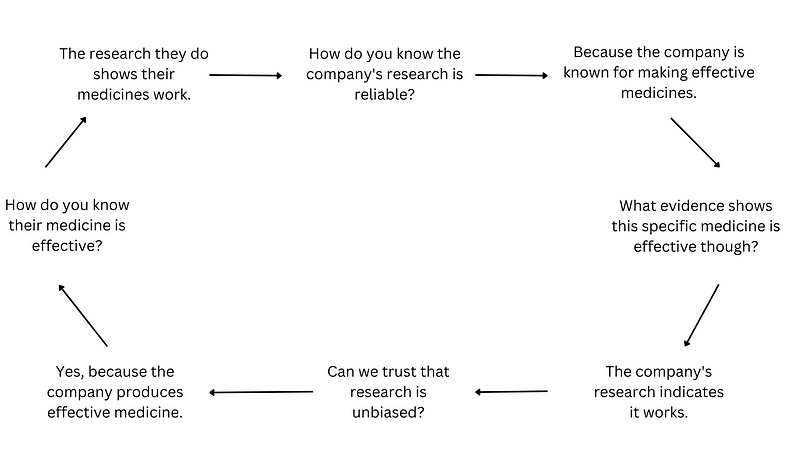
Circular Reasoning:
It’s a maze where the exit is the entrance.
Remember this example that I already said?
Believing because it’s familiar, trusting because it feels right. — these are the traps of circular reasoning.
In our daily choices, circular reasoning acts as a two-sided coin. We stick to beliefs because they’re familiar, yet forget to question their validity.
The assertion repeats without offering any real evidence or progression. It’s a confusing dance of words, presenting a conclusion that merely restates the premise without adding substance.
It creates an illusion of support without actually providing any new information. It’s akin to building a house of cards — the structure seems sturdy until you realize it’s just a repetition of the same card.
Circular reasoning confuses us. We end up going in circles, believing something without real evidence.
Believing without evidence is like running in circles — it gets you nowhere and makes you dizzy.
The only solution is: Don’t trust without proof. Seek real evidence, not just repeated words.
Breaking free from the grasp of fallacies was no easy feat.
In my journey, I discovered the power of questioning. As I asked myself tough questions, I found a path to clarity and a deeper understanding of the world around me.
Even though they may be silent ninjas, we can combat them by being vigilant and critical in our thinking.
Before I conclude, did you find the fallacy in the chat between me and my friend?
keep this in mind and read the chat again:
“My friend is presenting me with a limited set of options and then using my response to manipulate it into answering a different question”
Explanation: The problem in this chat is the “equivocation fallacy” because the friend uses the word “know” in different ways. Initially, he asks for evidence, but later, he means personal preference. This mix-up makes it hard to answer his question.
Breaking free from the grasp of fallacies was no easy feat.
In my journey, I discovered the power of questioning. As I asked myself tough questions, I found a path to clarity and a deeper understanding of the world around me.
Even though they may be silent ninjas, we can combat them by being vigilant and critical in our thinking.